Thiele TT01 Zero Tracking Error Turntable with Thiele DB and DW01

Review Context
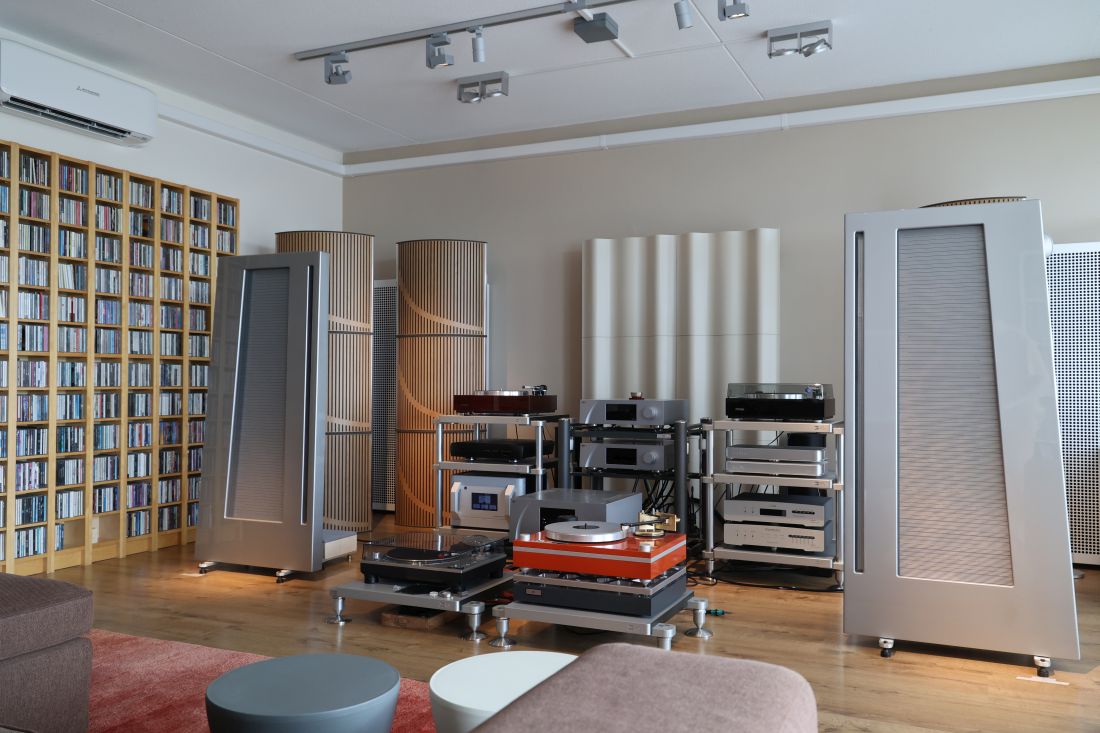
I listened to the Thiele TT01 in the main system, comprising the CH Precision C1.2 DAC, L1 preamplifier, and A1.5 power amplifier. Other turntables available for comparison are the Thorens TD1601 with TP92 arm, the Thorens TD1601 with TP160 arm, and the Technics SL1200G. All turntables were positioned on the same HRS EXR Stands. The phono preamp used was the Grimm Audio PW1. Speakers used are the Apogee Duetta Signature (recently refurbished and fitted with new foils). All interlinks are Driade Flow Link Reference 808, and the speaker cables are Driade Flow Reference 808. All components (including review components) are powered by the PS Audio P20 PowerPlant.
Turntable Setup By Michael van Polen of Rhapsody
Michael personally delivered the turntable and spent ample time setting it up in my system. Michael (or Michel for friends) is not just extremely knowledgeable (he’s referred to as the Dutch Michael Fremer), but also super-friendly and highly talkative.
As we chatted while he was tuning the tonearm, there was an uncanny moment watching him fine-tune the VTA as he played a track from What Was Said by Tord Gustavsen, Simin Tander, and Jarle Vespestad. He described seeking the position where everything begins to flow freely, with decays shifting from shortened and staccato to ever-lingering, and that being in this ideal spot would evoke goosebumps. Precisely when he said that, I felt the hairs on my neck tingle, and he confirmed he had just found the spot. That was a special moment, and it clearly illustrates a level of professionalism one doesn’t often witness, if ever.
Listening
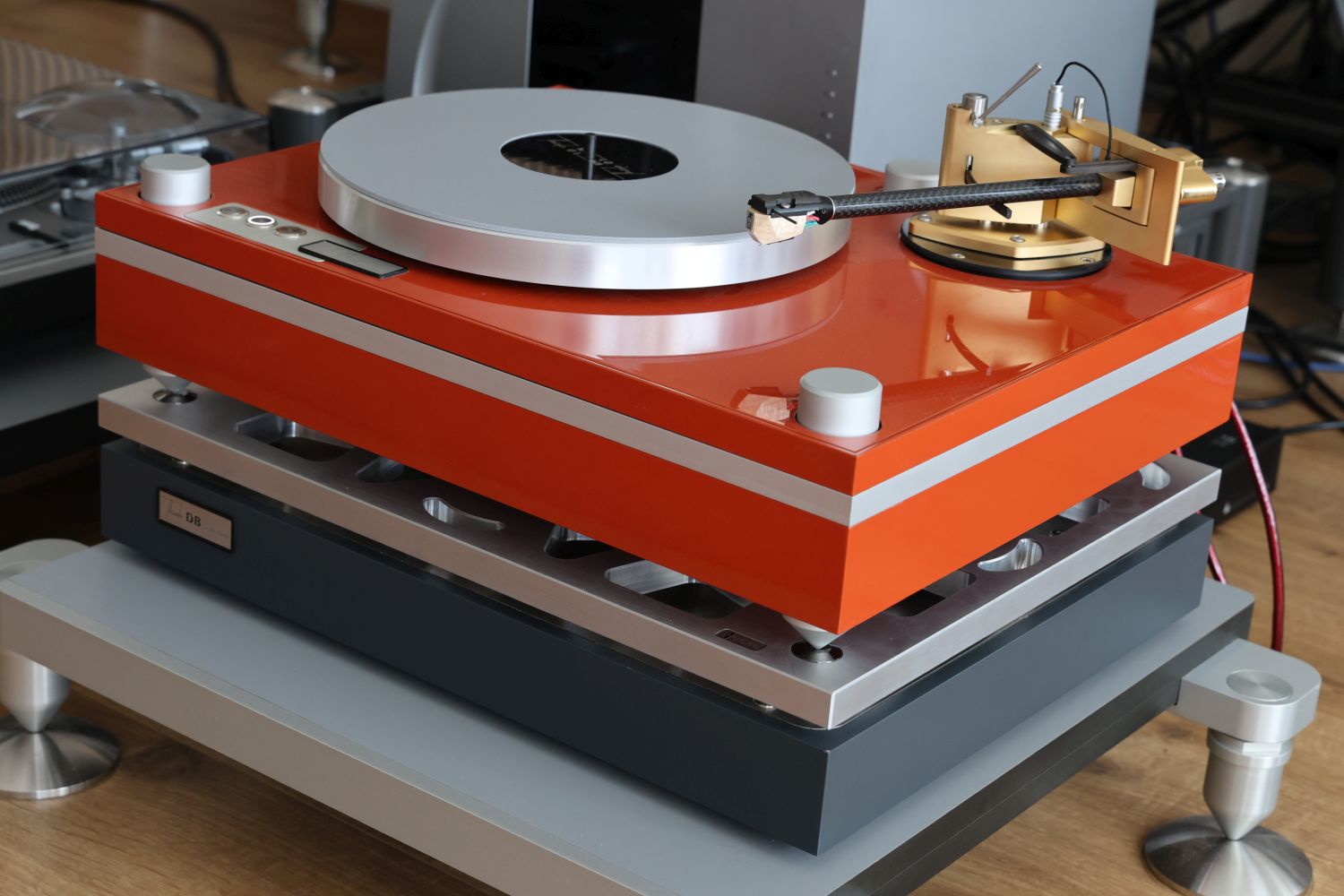
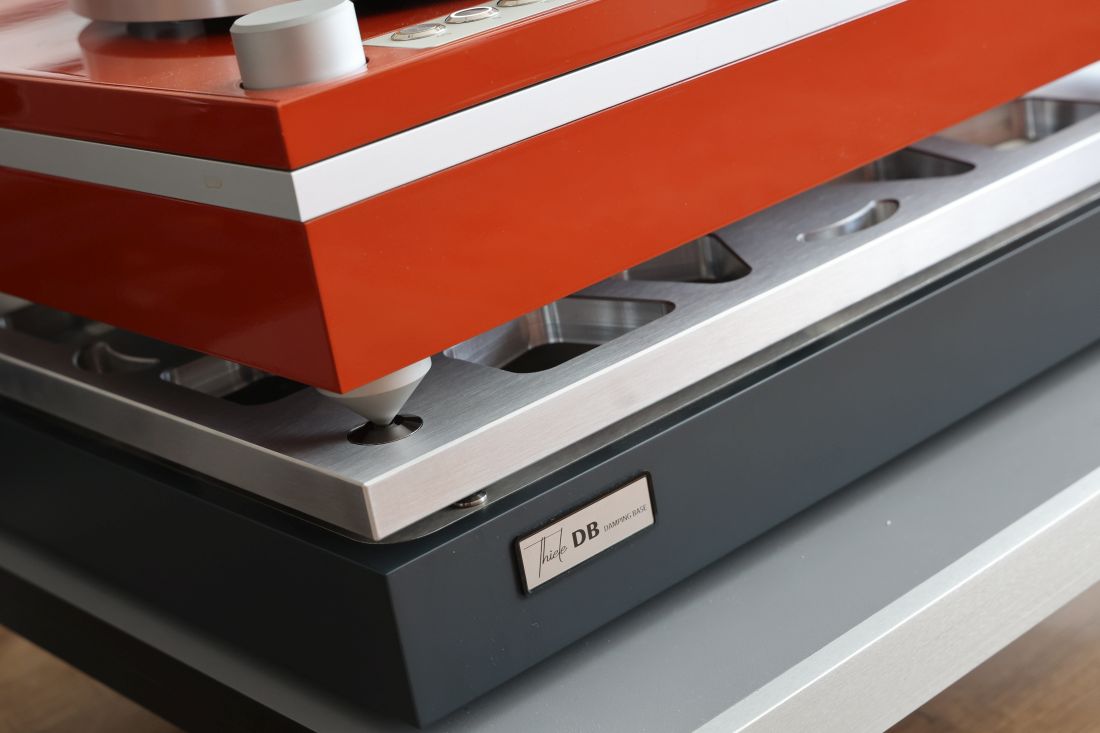
I will start my listening impressions with the turntable in its most complete form: on the optional DB Damping Base and with the RM01 Recordmat on top. Naturally, I will also assess the influence of the RM01 Recordmat, as well as the TT01’s performance on its own footers without the DB Damping Base.
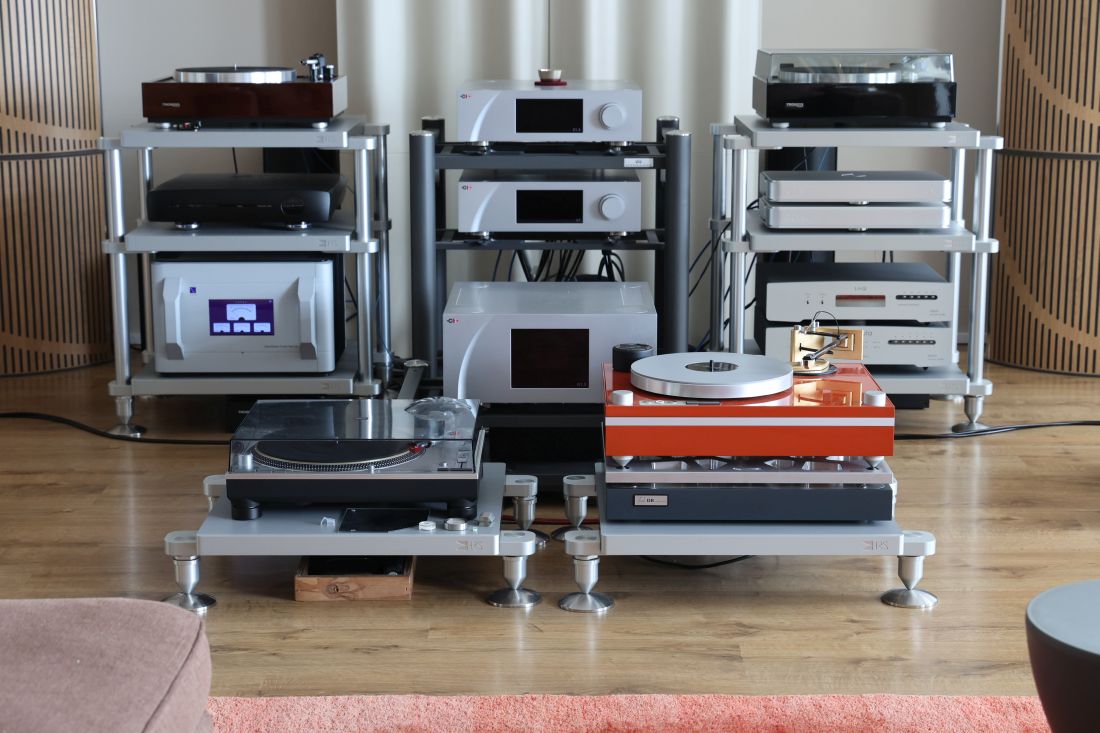
I positioned the TT01 side by side with the Technics SL1200 G that I have been using most lately. I also set up my two Thorens TD1601 turntables. One has the older single-piece TP92 arm and the other has the current TP160 arm with a removable SME-style headshell, and I made sure the circumstances were identical for all turntables. All four sat on individual HRS EXR Audio Stands, on the same Artesania Audio floor discs, and were connected with the same standard power cables. For my three turntables, I used the same humble but neutral and well-balanced Van den Hul MC The ISIS interlinks to the Grimm Audio PW1 phono stage. The Thiele TT01 turntable, however, has XLR outputs, and Rhapsody provided the Van den Hul MC Silver IT MkIII XLR-to-RCA interlink for this, adding that it was a particularly good match for this turntable and cartridge. I will also use the ISIS interlinks with XLR adapters for the TT01 later, but I wanted to start with the recommended configuration for my initial impressions.
The TA01 arm’s unusual weight distribution makes it feel distinct from any other pivot tonearm I’ve used, whether Thorens, Technics, and similar tonearms, or heavier designs such as SME, Rega, or Origin Live. However, it takes only a couple of records to get used to this, and after that, the arm actually feels more secure and precise than other tonearms. From that moment, the arm handles superbly uniformly and predictably. It follows the movements of the hand very smoothly, and, because there’s zero drift, I find that it’s easier to find the exact beginning of particular tracks on a record with this arm than with any of the other turntables’ arms. This is partly because the arm has been calibrated very carefully and doesn’t use traditional anti-skating, but also because of its precise, perfectly damped lift mechanism. I wouldn’t have thought it at first, but rather than the delicate instrument you might expect, the lift mechanism and handle are very sturdy, and the arm movement isn’t affected by how you operate the handle.
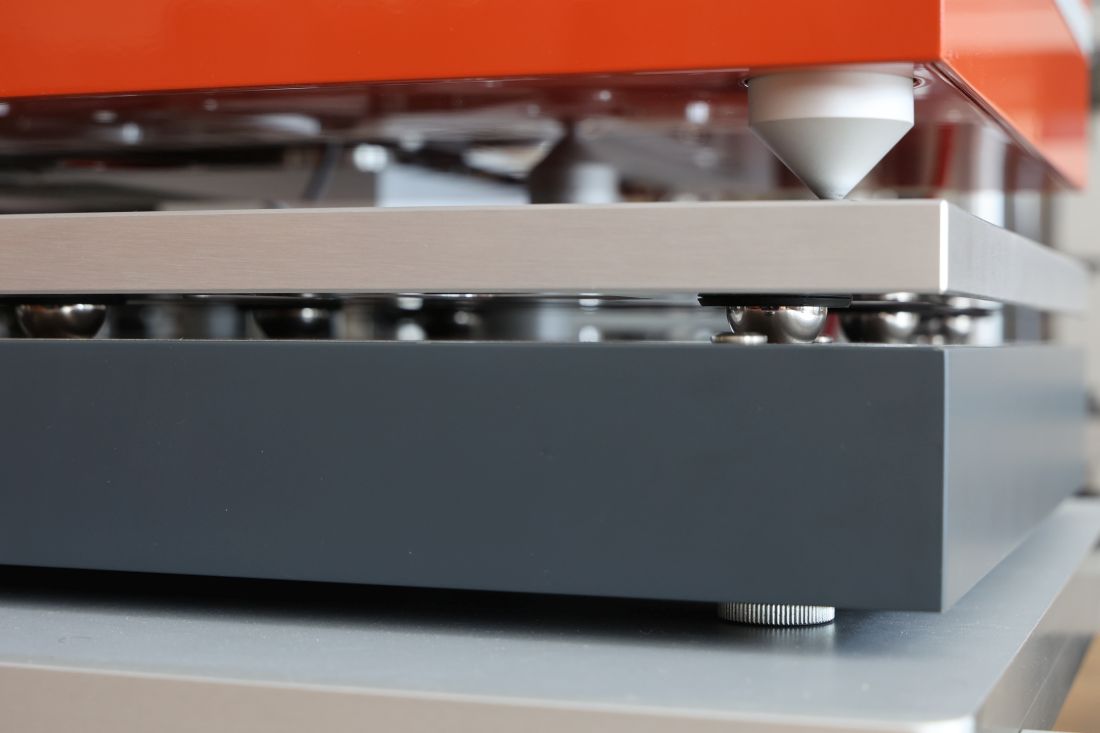
Besides the TT01 turntable’s obvious benefit of Zero Tracking Error thanks to its TA01 tonearm, it also places a strong emphasis on vibration control. The turntable has multiple insulation layers and additionally sits on a dedicated Damping Base.
From my experience, damping can be a double-edged sword. When misapplied or excessive, it can diminish liveliness and expression. However, at times, these qualities are deliberately subdued to create a performance that is non-aggressive, quiet, calm, and relaxed. So whenever I hear that damping is a special point of attention, I can’t help but fear a dulled or less exciting experience.
Well, I needn’t have worried. The TT01 sure sounds beautifully clean, quiet, calm, and composed, but in a good way, superbly natural, and, importantly, the TT01 is neither polite nor restrained! Quite the opposite, actually. The music is living and breathing, and bursting with energy, but with a total absence of stress. Furthermore, this turntable’s bass is also something else! Rock-solid in its stability and full-blooded, yet fluid and organic. In this respect, the TT01 reminds me of the AVID HIFI Sequel SP, but with a more free-breathing and free-flowing nature. Whereas the Sequel could feel a little cerebral, the TT01 is overwhelmingly emotional and organic.
The Thiele TT01’s sure-footed pacing and utter absence of any particular drive-type signature is remarkable, especially given its seemingly simple belt-drive motor. It has certain qualities normally attributed to Direct Drive, such as stability and assured pacing, but without exerting excessive control; it also has the unstressed flow normally associated with belt drive, without sacrificing pacing, drive, or stability. This shows that implementation truly matters more than the technique itself.
The TT01’s timbre is earthy and very natural, neither oversaturated nor lean. The turntable has a generous, lyrical, gushing feel combined with direct-coupled realism, avoiding the overly dreamy, floaty etherealism that can come from some turntables. A super-delicate, airy, and free-floating sound can be highly seductive initially, but without grounding, solidity, and drive, such a presentation soon fails to keep my attention. Don’t get me wrong: the TT01 is definitely delicate and refined, but unlike many turntables, it doesn’t prioritize fluidity, flow, and delicacy over solidity and dynamic impact. Rather, it weaves it all into a super-coherent whole. With the TT01, there’s never the feeling of the sound being shaped in any particular way. Instead, it is “simply” relayed as is, without rounding or hardening, oversaturating or graying, overdamping or shouting.
Of course, such a superb neutral balance is not at all simple to achieve. Usually, the most neutral products allow a degree of leanness or desaturation, or worse, a sense of clinicality, but this is completely alien to the TT01. This turntable is a full-blooded music maker!
Naturally, one expects an absence of tracking error with a Zero Tracking Error tonearm, and this, the TA01 most definitely delivers. I tested this by comparing degradation across a range of well-known records, and paying particular attention to the sound degradation between and around the two null points, and particularly where tracking error rises most significantly in my experience, which is usually in the last track. First, I listened to this on the TT01, and then on my other turntables. And sure enough, the TT01 shows no signs of mistracking, no matter which track is played, while the other turntables consistently show clear signs of compression, reduced refinement, and, most annoying of all, sibilance in hi-hats and loudly pronounced S’s in vocals, as the tracking error increases and the information is at its most dense in the last track.
Of course, music can still be enjoyed with a very good standard pivot tonearm, so must you have perfect tracking? That depends on the person. Some listeners have no problems with a little more sibilance in the last tracks, while others can’t stand it. In recent years, even though I always noticed it, I convinced myself I could live with it. But as I discovered, truly pure and clean playback, as achieved by the TT01, is something you get used to all too quickly, after which it becomes jarring to listen to the same record on one of the other turntables.
Along with its super-accurate tracing, which delivers pure, clean, articulate, and delicate treble, the TA01 arm offers another major benefit: a dead-center, absolutely non-wavering center image, along with rock-solid soundstaging. As mentioned, I have owned several linear tracking turntables, and even though these illustrated, to some extent, the benefits of low tracking error in typically high-error locations on the record, none of them achieved a TT01/TA01 level of accuracy. It was always only just noticeable, and the results were offset by other downsides. Consequently, when playing records on the Technics or one of the Thorens turntables with regular pivot tonearms, I certainly hear tracking error, particularly in the last track, but a pivot arm offers inherent ease of use and non-wavering repeatability. Thus, so far, I still wondered whether tangential arms were worth the extra complexity. As complex as the TA01 appears, as simple it is to use, and in practice, as long as the turntable is on a solid rack and non-bending floor, the arm offers the exact same ease of use and stability as a regular pivot arm, with the significant benefit of Zero Tracking Error!
Nevertheless, I still was not prepared for the additional benefits the TA01 arm brings. Sure, the arm’s price raises expectations, but nothing can prepare you for what you’re missing with ordinary pivot tonearms until you hear what the TA01 can do.
No matter what happens rhythmically or dynamically, and no matter how busy the mix gets, imaging stays 100% locked in place, whether it’s centrally positioned vocals or very subtle sounds buried deep in the mix and far back into the soundstage. Furthermore, while enhanced resolution and precision often result in clearer transient behavior that benefits percussive sounds, and the TA01 sure delivers this, it also extends this benefit to sustained sounds and the quietest reverbs. With this turntable, I frequently hear subtle sounds better fleshed out, more immediate, more distinct, and more realistically portrayed.
While I’m sure the TT01’s triple-layer enclosure contributes to its excellent performance, I’m increasingly convinced that the TA01 arm plays an absolutely crucial role.
Next: Adding DW01 Damping Weight, Removing RM01 Recordmat, Removing DB Damping Base, and Technics SL1200G


