Thiele TT01 Zero Tracking Error Turntable with Thiele DB and DW01

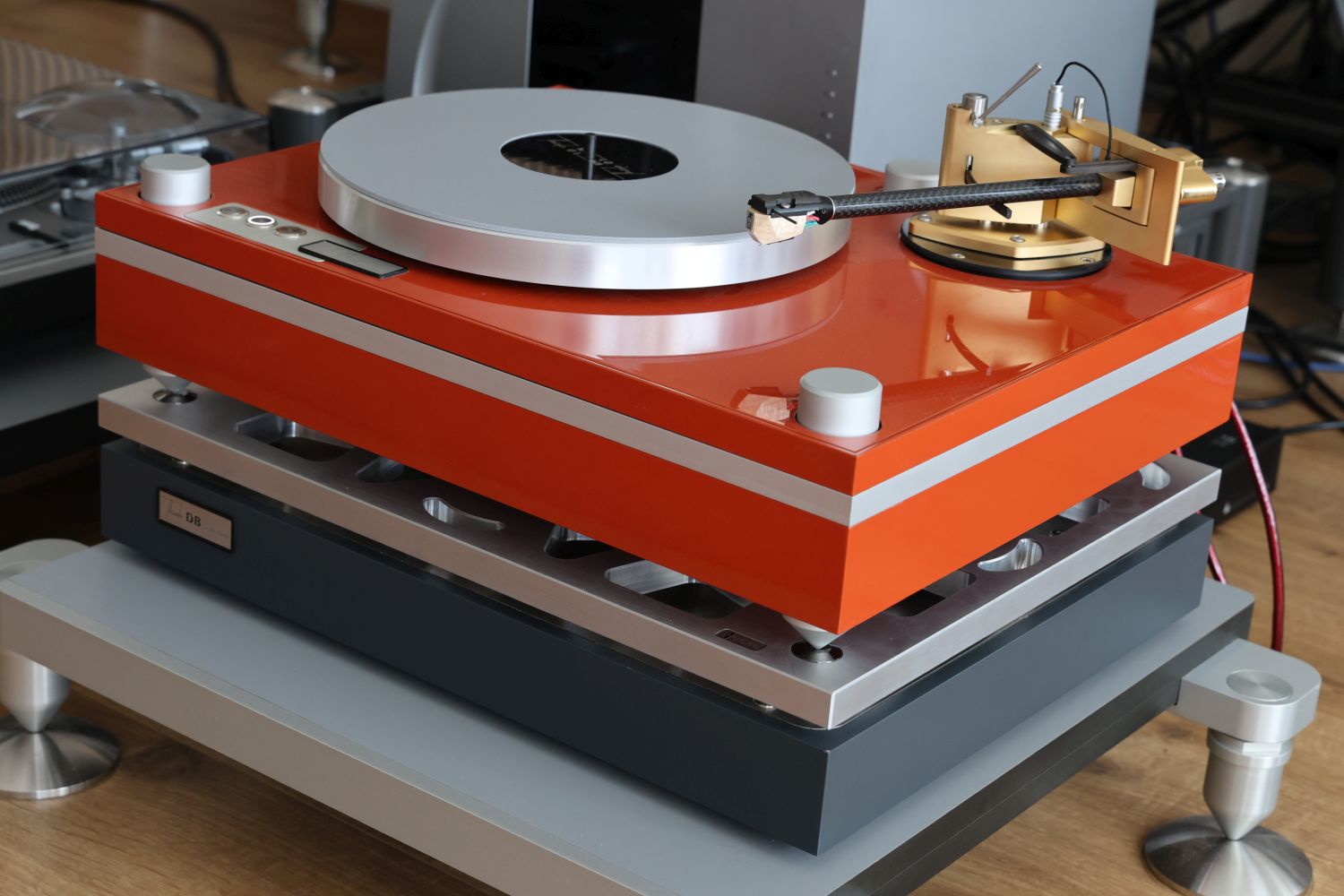
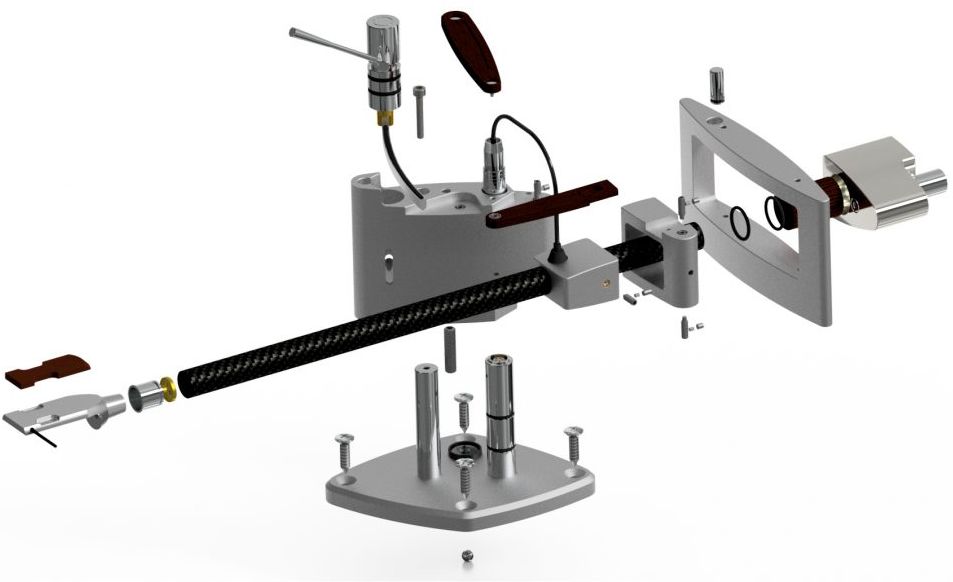
Tonearm height (VTA) can be adjusted conveniently with a hex screw in the arm base during playback and locked with another hex screw afterward. The armlift height can likewise be adjusted. The arm can also be locked in position to aid cartridge mounting.
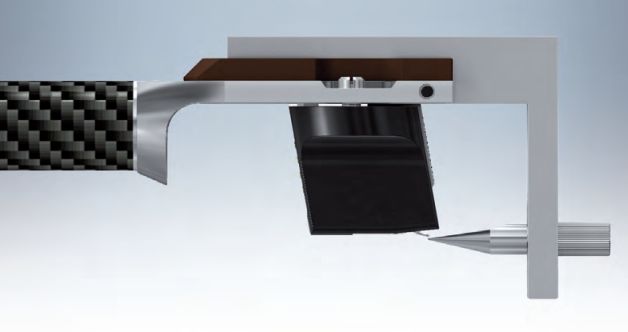
Because of its unique movement arc, a traditional single-point protractor such as the SMARTractor or Clearaudio IEC protractor cannot be used. Instead, a high-precision custom Thiele alignment protractor is supplied, consisting of an aluminum L-shaped base that slides on top of the headshell, with a height-adjustable pointer to which the cartridge’s stylus tip must be aligned.
The TA01 tonearm is available separately starting from €12.600 for use with a wide variety of turntables. It can also be supplied integrated into a custom Thiele body to facilitate use with another platter, such as the Technics SP10R drive.
The TA01 tonearm is also supplied as standard on the TT01 Zero Tracking Error Turntable and the IWD01 Dual Motor Idler Wheel Drive turntable.
TA01 Main Technical Specifications
- Azimuth adjustment at headshell
- Maximum lateral tracking angle error 0,036 °
- Effective mass approx. 14 g
- Recommended Dynamic Compliance (μm/mN) ~20
- Cartridge balance range 4 g – 12 g, with additional weight up to 20 g
- Zavfino Solid Pure Silver 34 AWG internal wiring
- Weight: 800 g
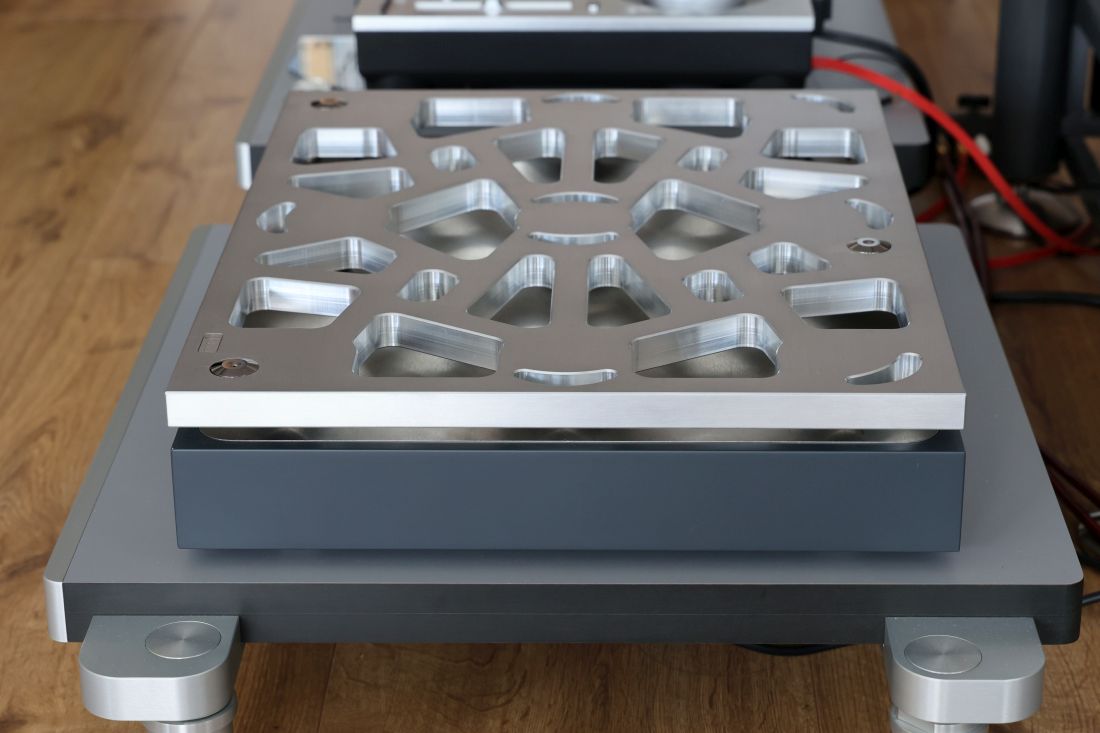
Thiele DB Damping Base
The TT01 enclosure does a great job of incrementally reducing resonances among its three internal sections. Meanwhile, most rooms are a major source of external vibrations that should also be addressed to achieve the quietest possible background in music reproduction.
The Thiele Damping Base was created in collaboration with ICTRA Design, specialists in developing racks and damping platforms using the latest engineering methods, based on optimally coordinated physical operating principles. There are multiple sources of vibration that contribute to a complex overall sound event:
- Interference from underneath the turntable, e.g., from soft flooring, unsuitable furniture, or boards.
- Airborne noise from the room.
- Interference from the drive motor.
- Noise from the turntable bearing.
- Energy that causes the record to vibrate during the scanning process and is transmitted directly into the drive.
Together, these sources create an energetic, broadband mixture of resonances. With suitable measures, such as constrained layer damping that converts vibrational energy to heat, the record player itself can partially suppress individual components of this mixture. In addition, the hard-coupling spikes integrated into the TT01 turntable optimize the transmission of mechanical vibration energy to the underlying base.
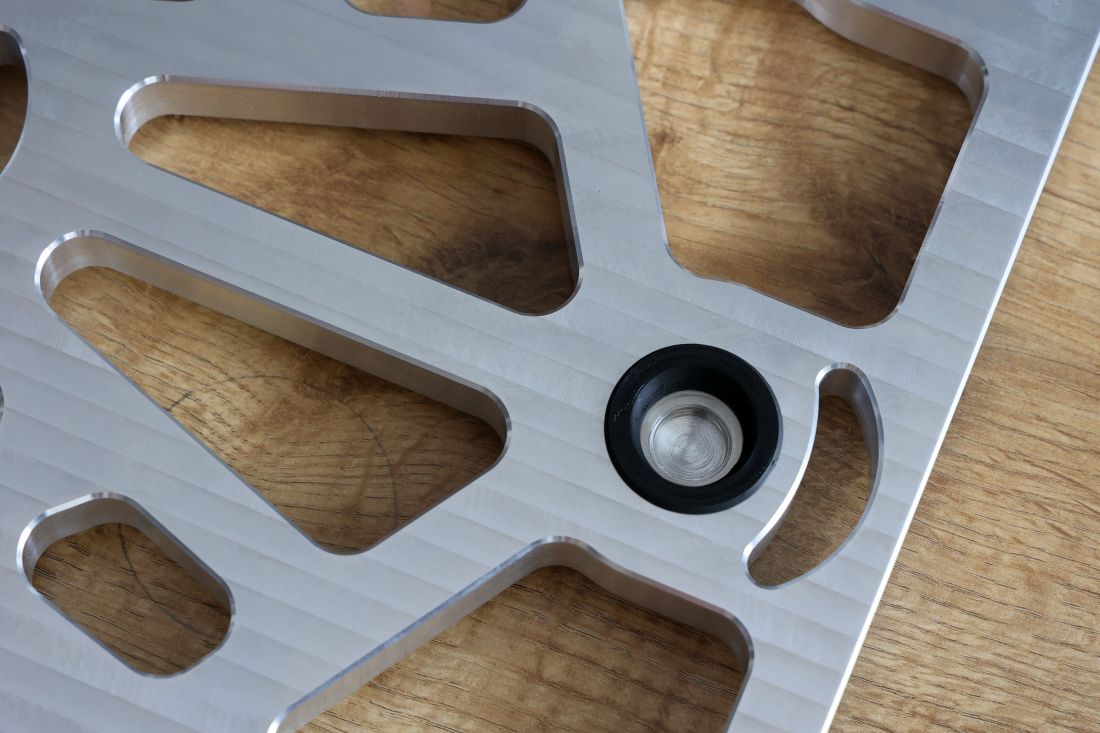
The top section rests solidly and friction-free on the 9 balls. Looking at the top panel’s underside, you can see that each of the 9 holes has individually calibrated inserts. In each cavity, these inserts are visually positioned slightly differently, presumably to achieve a perfectly even pressure across all the balls.
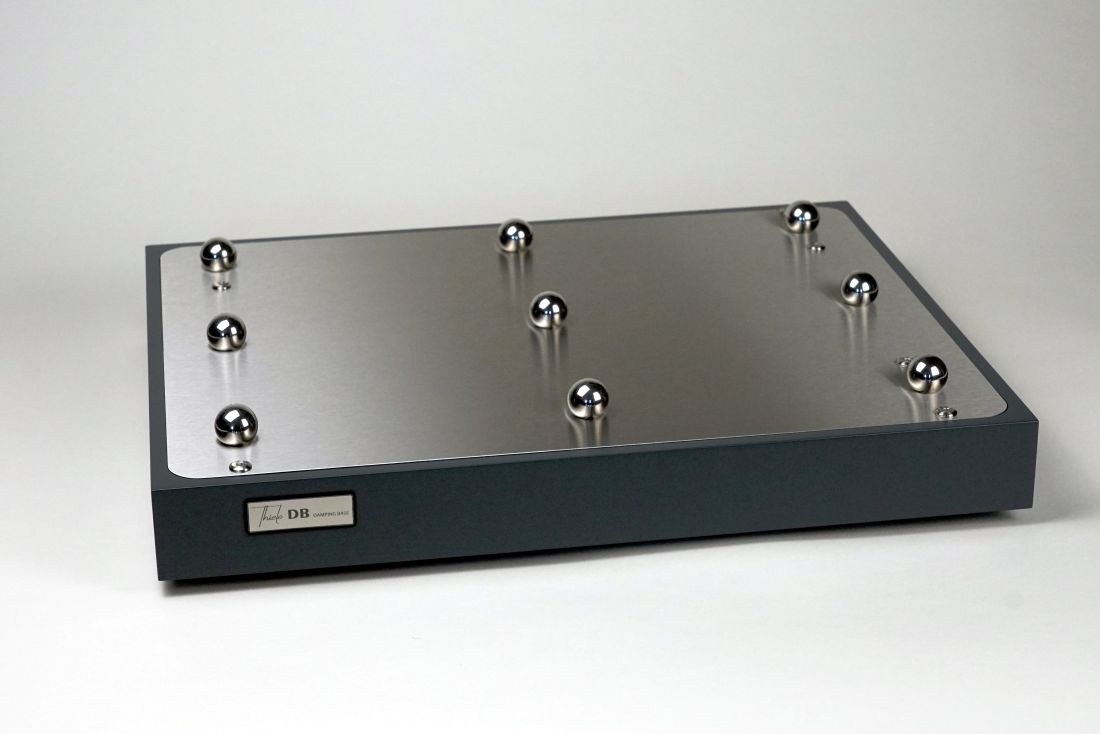
By combining materials with very different densities with specific geometries to target natural resonances, the DB damping base works as a mechanical filter. Its integrated air/spring dampers are specially adapted to the platform to dissipate low-frequency sound components, while optimized density transitions between hard and soft materials dissipate higher-frequency sound components.
Reducing Vinyl Resonances
With the measures mentioned above, one might assume that all resonance sources are now covered. However, as Helmut discovered, the stylus’s vibrations are actually coupled back into the record. These resonances add to the music signal, creating very audible distortions.
When I first read about this, I admit I glanced over the topic, thinking it would surely be a minor effect. However, Helmut showed me the magnitude of the effect in person using his custom resonance amplification device. With the device’s sensor resting on the record label, much to my surprise, I could clearly hear the music playing through a pair of connected headphones.
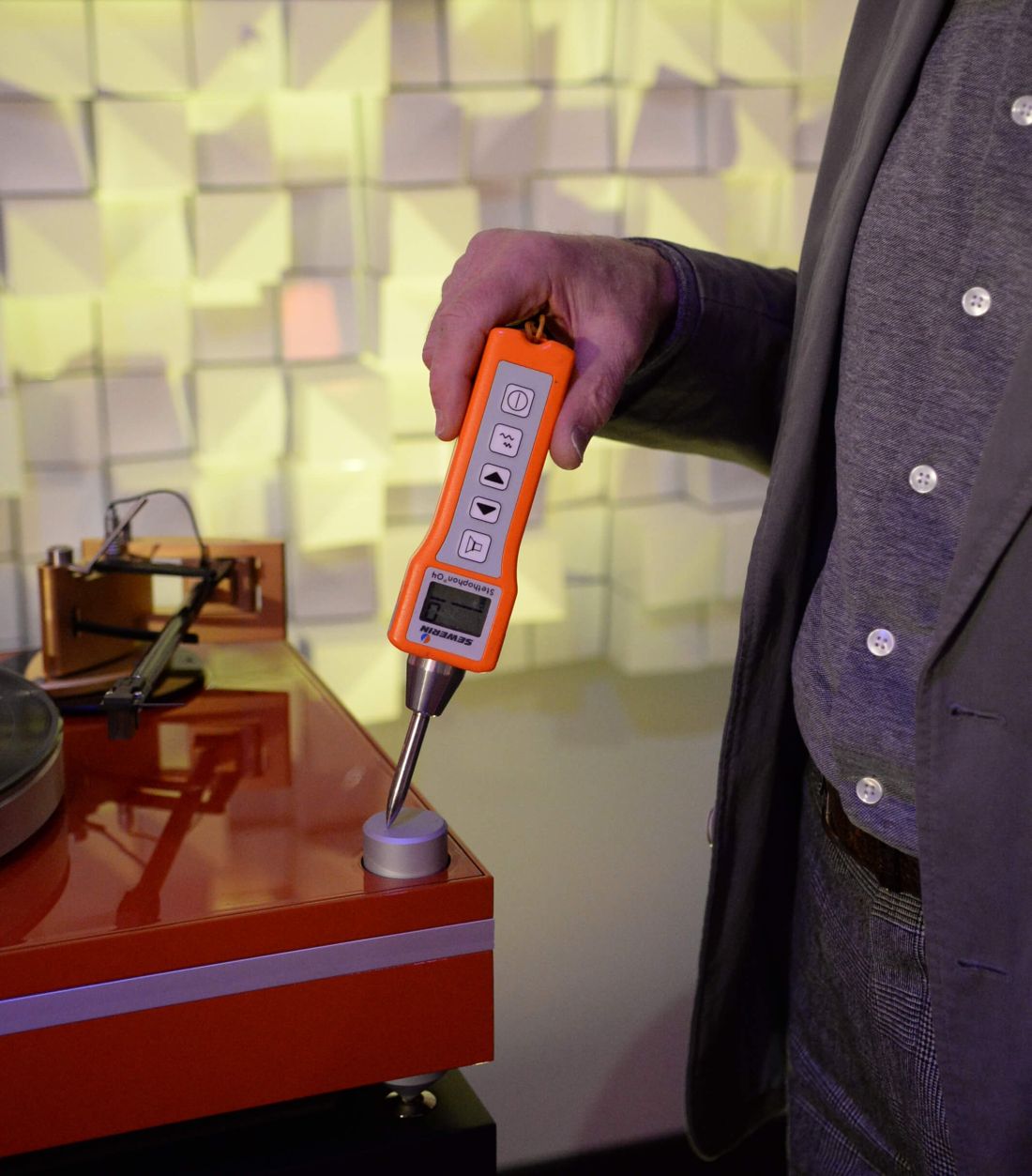
Photo courtesy of Ruud Jonker via Hifi.nl
As I experienced firsthand, the extremely fast movement of the needle carrier and the diamond in the groove causes the entire vinyl to vibrate, despite the stylus’s minimal mass. To combat these resonances, Thiele has developed two products that work ideally together: the RM01 Recordmat and the DW01 Damping Weight.
Thiele RM01 Recordmat
The RM01 Recordmat, made of a foamed PVC core with hard ABS top and bottom layers, dampens resonances from the underside of the vinyl. The mat is supplied as standard with the TT01 turntable but is also available separately for €225 for use with other turntables, replacing standard rubber or other material mats.
Thiele DW01 Damping Weight
The DW01 Damping Weight is an optional accessory for the TT01 turntable or other turntables. When placed on top of a record, the DW01 damping weight minimizes resonances from the top of the vinyl using a combination of aluminum and wooden parts, connected by a damping gel. This 2-component gel is also used in the tonearmtube of the TA01 tonearm in combination with carbon material. When combined with the RM01 Recordmat, resonances are effectively minimized from both the top and underside of the vinyl.
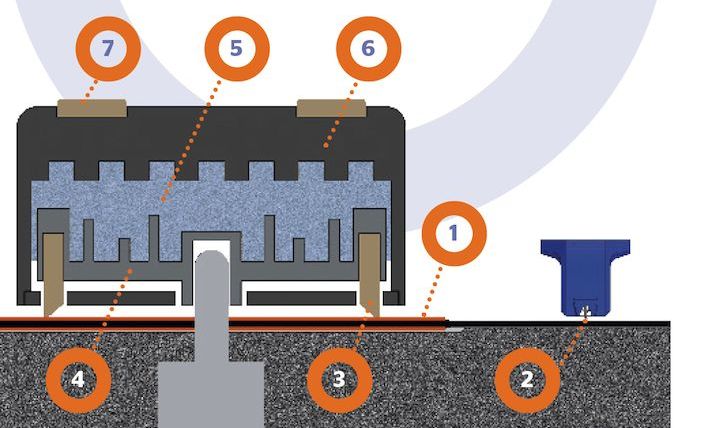
When an LP is played, the cartridge’s stylus (2) sets the entire record, including the paper labels (1), into vibration. These vibrations and resonances are superimposed on the music signal, producing an imprecise sound that impairs accurate reproduction and precise localization of the musical instruments in the virtual space.
To combat this, the Damping Weight contacts the vinyl on the top of the paper label via three ebony rods (3) and transmits the resonances to a multi-ribbed coupling disc (4) in the center of the unit. This coupling disc is connected to the body of the Damping Weight via a damping gel (5). The total housing (6) weight of approximately 400 grams generates the corresponding pressure on the vinyl disc and dampens all resonances via the gel. The body of the Damping Weight itself is further dampened by ebony inlays (7) on top.
The result is very effective silencing of the vinyl, delivering a clean sound image with precise localization and reproduction of the musical instruments.
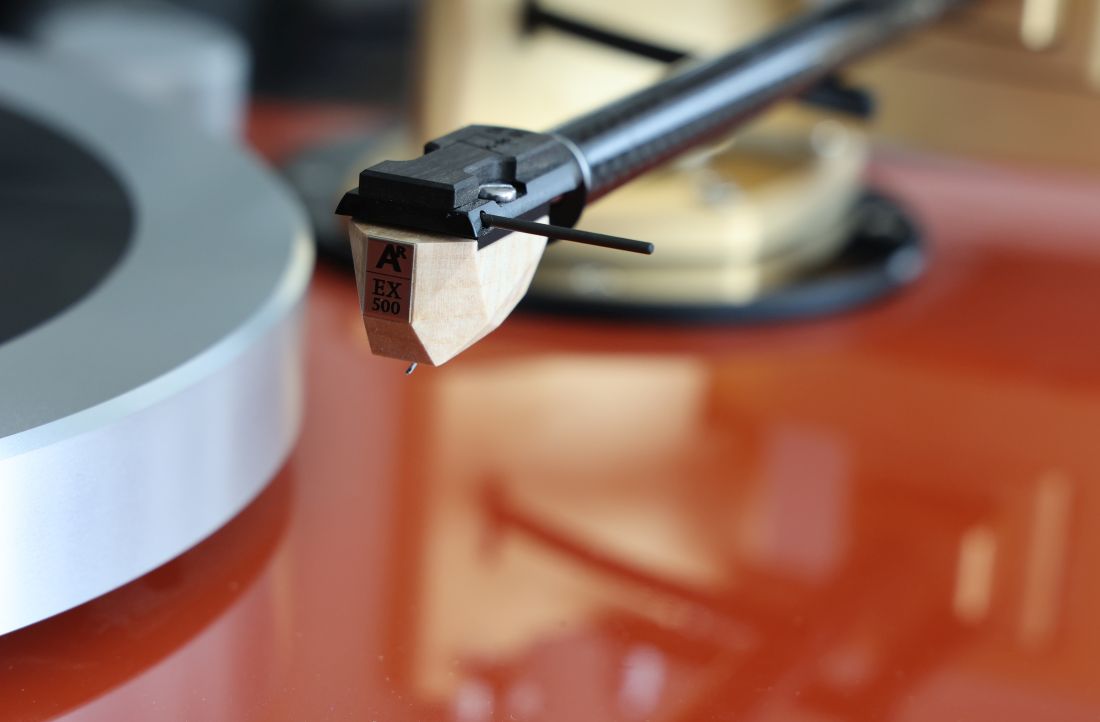
Analog Relax EX500 MC Cartridge
Rhapsody provided the TT01 with an Analog Relax EX-500 MC Cartridge, and I formed my initial impressions of the turntable using this cartridge. Later on, I mounted a Thorens TAS 1600 instead to enable a fair comparison with my other turntables.
Analog Relax isn’t as recognized in the cartridge scene as the major brands, but they have a longstanding presence. Founded in 2016 by Yasushi Yurugi, Analog Relax designs and manufactures artisanal handcrafted high-end moving coil (MC) phono cartridges and analog accessories.
The EX500 is the second model in the lineup, starting with the EX300 at 2.890 Euros and going all the way up into the stratosphere with the 12.490 Euro EX1000. The EX500 is 4.990 Euros. While that is far from peanuts, this is a realistic price for artisanally handmade cartridges by Japanese craftsmen these days.
Analog Relax does not use metals or resins. Instead, the company insists on using hand-selected tonewood. The EX500’s Hard Maple Solid Wood body looks absolutely beautiful. Still, at the price, I expected fancier specifications than what seems like a rather common aluminum cantilever with a Special Elliptical Solid Diamond Stylus. However, a deeper look reveals custom specifications such as thicker-walled aluminum for the cantilever, special bonding of the diamond, and more precise polishing of the diamond tip than usual.
According to the specs, the TA01 arm works well with low- to medium-mass cartridges. This includes “regular” medium-compliance cartridges as well as low-compliance cartridges. Analog Relax specifies a Dynamic Compliance of 6μm/mM @ 100Hz for the EX500, which is lower than typical. By comparison, the AT OC9XSL and Thorens TAS 1600 specify a Dynamic Compliance of 18 x 10 – 6 cm/dyne @ 100 Hz, which is the same as 18 μm/mM. Indeed, the EX500’s stylus feels stiffer than the other cartridges I have. However, since Rhapsody recommended this particular cartridge, I have no doubt it will work especially well with the TA01 arm.
As I describe further down in my listening tests, the EX500 proves once again that the tonearm and cartridge pairing matters more than the cartridge’s pedigree or stylus shape.
Next: Review Setup, Turntable setup by Michael van Polen of Rhapsody, and Listening


