• About
    • About HFA
    • HFA Awards
    • Associated Equipment
    • Banners on HFA
    • HFA Analytics Data
    • HFA Audio Setup History
    • HFA Audio Setup Snapshots
    • Sitemap
    • Contact
  • HFA Awards
  • Reviews
    • All Reviews
    • Amplifier
      • All Amplifier Reviews
      • Integrated Amplifier
      • Preamplifier
      • Power Amplifier
      • Phono Preamp
    • Loudspeaker
      • All Loudspeaker Reviews
      • Passive Speaker
      • Active Analog Speaker
      • Active Digital Speaker
    • Digital
      • All Digital Reviews
      • CD Player
      • SPDIF DAC
      • USB DAC
      • Music Server
      • Network Player
      • Digital Recorder
      • Digital Interface
      • Audio Software
    • Turntable and Accessories
      • All Turntable and Accessories Reviews
      • Turntable
      • Tonearm
      • Phono Cartridge
      • Turntable Accessories
    • Cable
      • All Cable Reviews
      • Analog Interlink
      • Phono Interlink
      • Speaker Cable
      • Power Cable
      • Digital Cable
    • Accessories
      • All Accessories Reviews
      • Racks / Stands / Feet
      • Tuning / Tweaks
      • Power Connector
    • Industry Update
  • Insights
    • All Insights
    • Analog Insights
    • Cable Insights
    • Connector Insights
    • Digital Insights
    • Extensionblocks / Filters Insights
    • Generic Insights
    • System Synergy Q&A
  • Specials
  • Show Reports
    • All Show Reports
    • Alkmaar Audio Show
    • Chattelin Audio Systems
    • Dutch Audio Event
    • Enosound
    • HifiDeluxe
    • HifiLive
    • Munich High End
    • XFi
  • Classics
    • All Classics
    • Analog Classics
    • Digital Classics
  • Links
  • About
    • About HFA
    • HFA Awards
    • Associated Equipment
    • Banners on HFA
    • HFA Analytics Data
    • HFA Audio Setup History
    • HFA Audio Setup Snapshots
    • Sitemap
    • Contact
  • HFA Awards
  • Reviews
    • All Reviews
    • Amplifier
      • All Amplifier Reviews
      • Integrated Amplifier
      • Preamplifier
      • Power Amplifier
      • Phono Preamp
    • Loudspeaker
      • All Loudspeaker Reviews
      • Passive Speaker
      • Active Analog Speaker
      • Active Digital Speaker
    • Digital
      • All Digital Reviews
      • CD Player
      • SPDIF DAC
      • USB DAC
      • Music Server
      • Network Player
      • Digital Recorder
      • Digital Interface
      • Audio Software
    • Turntable and Accessories
      • All Turntable and Accessories Reviews
      • Turntable
      • Tonearm
      • Phono Cartridge
      • Turntable Accessories
    • Cable
      • All Cable Reviews
      • Analog Interlink
      • Phono Interlink
      • Speaker Cable
      • Power Cable
      • Digital Cable
    • Accessories
      • All Accessories Reviews
      • Racks / Stands / Feet
      • Tuning / Tweaks
      • Power Connector
    • Industry Update
  • Insights
    • All Insights
    • Analog Insights
    • Cable Insights
    • Connector Insights
    • Digital Insights
    • Extensionblocks / Filters Insights
    • Generic Insights
    • System Synergy Q&A
  • Specials
  • Show Reports
    • All Show Reports
    • Alkmaar Audio Show
    • Chattelin Audio Systems
    • Dutch Audio Event
    • Enosound
    • HifiDeluxe
    • HifiLive
    • Munich High End
    • XFi
  • Classics
    • All Classics
    • Analog Classics
    • Digital Classics
  • Links
scroll down for more
Phono Preamp Reviews

Apertura Armonia Evo, Edena Evo, and Adamante

Christiaan Punter 23 July 2026 No Comments
  • Facebook
  • Twitter
  • LinkedIn
  • Pinterest
  • Email

The DRIM crossover technology minimizes intermodulation and maintains time alignment. This filter technology has an ellipse on one of its branches, with three different slopes: 6dB, 12dB, and 24dB per octave. Low-pass and High-pass circuits are independent. The components are hand-wired on a high-power PCB (with 210 µm-thick copper traces), with 37 high-end components per speaker.

The Adamante uses the same special cabinet shape as the other models: two curved sides of different lengths and no symmetrical faces. This choice is dictated by cosmetic and technical issues. The panels’ varying sizes, radii, angles, and lengths lead to a desirable non-uniform resonance distribution and reduced sound radiation for the most excited ones. The enclosure panels consist of several thin layers of high-density MDF, bonded and pressure-molded to reach a final thickness of 28 to 44mm. This sandwich construction helps diminish and break down vibration waves within the material. The laminar structure is assembled around a sophisticated framework of eight heavy bracing panels. Internal damping employs innovative methods and a blend of four materials to eliminate standing waves.
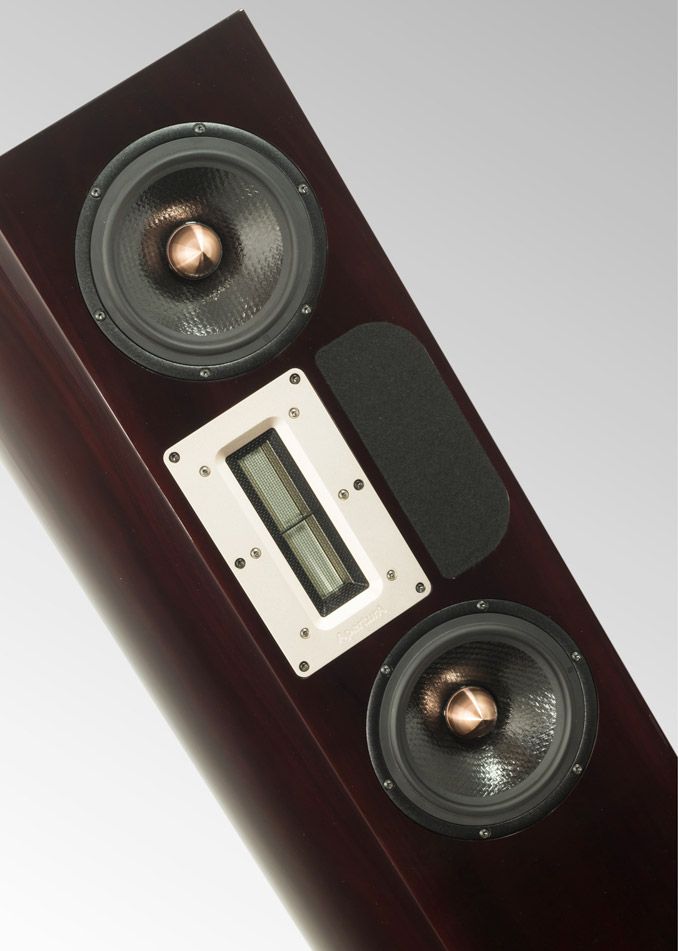
To achieve optimal mechanical inertia in the Adamante, a 10 mm steel coupling plate is used to fasten the front and back metal stands, in Anodized black for all speaker finishes. As with all Apertura models, the Adamante is mechanically grounded using 5 footers.

The Adamante’s acoustic load principle is similar to the one used for Enigma. It’s a hybrid load, mixing an acoustic line and a bass-reflex. Thanks to its large diameter, the bass reflex port tube mounted on the underside of the loudspeaker reduces airflow noise, improves room interaction, and lowers non-linearity.

However, there’s a lot more to the port than meets the eye!

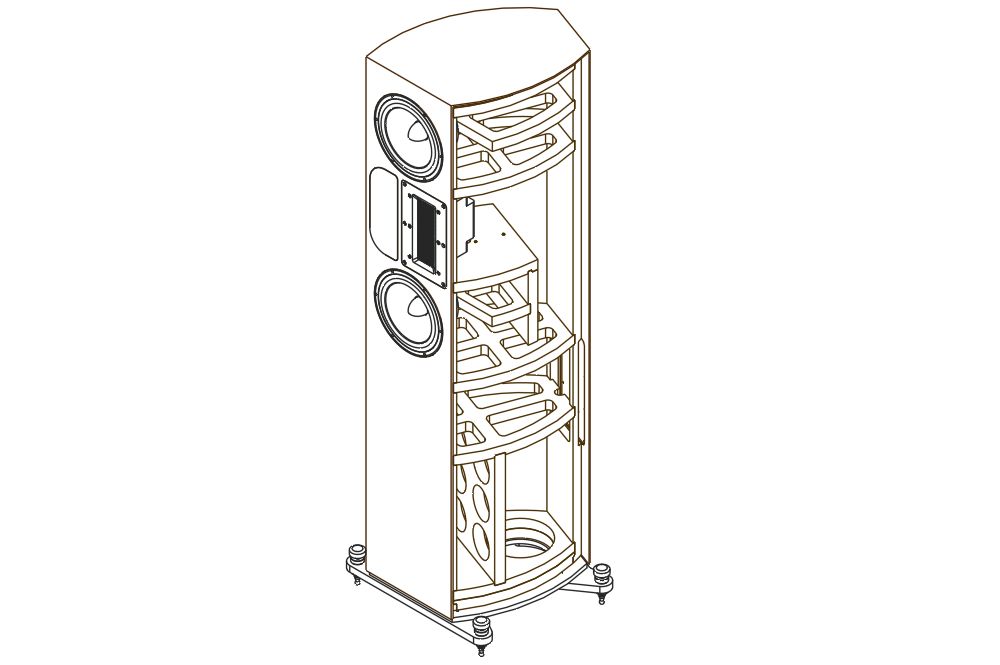
In a bass-reflex loading enclosure, there is an acoustic interaction among a driver, an internal volume, and an opening to the outside via a tube. If you have a single bass driver in an enclosure, the driver “sees” the full internal volume, and the bass reflex behavior should align with the calculation. Now, what happens if you have two bass drivers or more? There is still a single internal volume and, in most cases, a single port tube. If the port tube is positioned between the two drivers, each driver will interact with the same internal volume and be tuned in the same way by the tube. However, if the port tube is off-center, the two drivers are no longer at equal distances from the vent output, meaning they should have different tuned performance compared to the other driver. To achieve the lowest airflow noise and distortion, a 120mm port was used, and, due to its large size, the only possible location was on the bottom. This leads to the top driver interacting with the full internal volume, while the bottom one interacts with only a fraction of it. Apertura’s solution uses horizontal and vertical bracing panels to create two separate cavities, so each driver perceives roughly half of the internal volume. The diagram below illustrates the internal sections.
Adamante specifications:

Five different standard finishes are available:
High Gloss: Figured Maple, American Walnut, Rosewood,  Piano Black, White Cream (RAL 9010)

Frequency range: 32Hz – 30kHz +-3dB
Sensitivity: 93dB/2,83v/1m
Impedance: 4Ω
Load: Hybrid Bass-Reflex / Acoustic line
Drive units: 2 x 18 cm Isotactic Matrix cone Bass/Mid range unit, 15 x 145 cm ribbon tweeter
Crossover frequency: 1.8 kHz
Dimensions with metal stands: 360 x 391 x 1211 mm (W x D x H)
Weight: 52 kg

Running In

All three speakers were run in for at least 150 hours prior to delivery. During the review, each speaker was used in several sessions over a 6-week period. No change in sound was observed during the review period.

Build quality

All three models feature a high-quality cabinet construction with a sleek high-gloss lacquer finish. The lacquer is so smooth that it has an almost liquid appearance. The cabinets are extremely sturdy and perfectly assembled, with no hard edges, gaps, or imperfections anywhere.

Footer considerations and Mechanical Grounding

Before I discovered how significant the sonic impact of the mechanical grounding is, I had decided to make it easy for myself and first compare the three models using only the four outrigger footers.

Well into my listening comparisons, it became very clear that Apertura’s mechanical grounding principle, which primarily rests the speaker on a central cone, is not just a nice addition but an integral part of the speaker’s design, with an impact that should not be underestimated. The Edena, in particular, benefits so massively from being set up this way that it should not be auditioned using only the four balancing footers.

Review Context

The speakers were listened to in the main system, comprising the CH Precision C1.2 DAC, L1 preamplifier, and A1.5 power amplifier. Digital sources include the Aqua La Diva M2 CD Transport, Antipodes Oladra, and Grimm MU1 music servers. Speakers used for comparison are the Apogee Duetta Signature (recently refurbished and fitted with new foils) and the Driade Premium Model 9. All interlinks are Driade Flow Link Reference 808, and the speaker cables are Driade Flow Reference 808. All components (including review components) are powered by the PS Audio P20 PowerPlant.
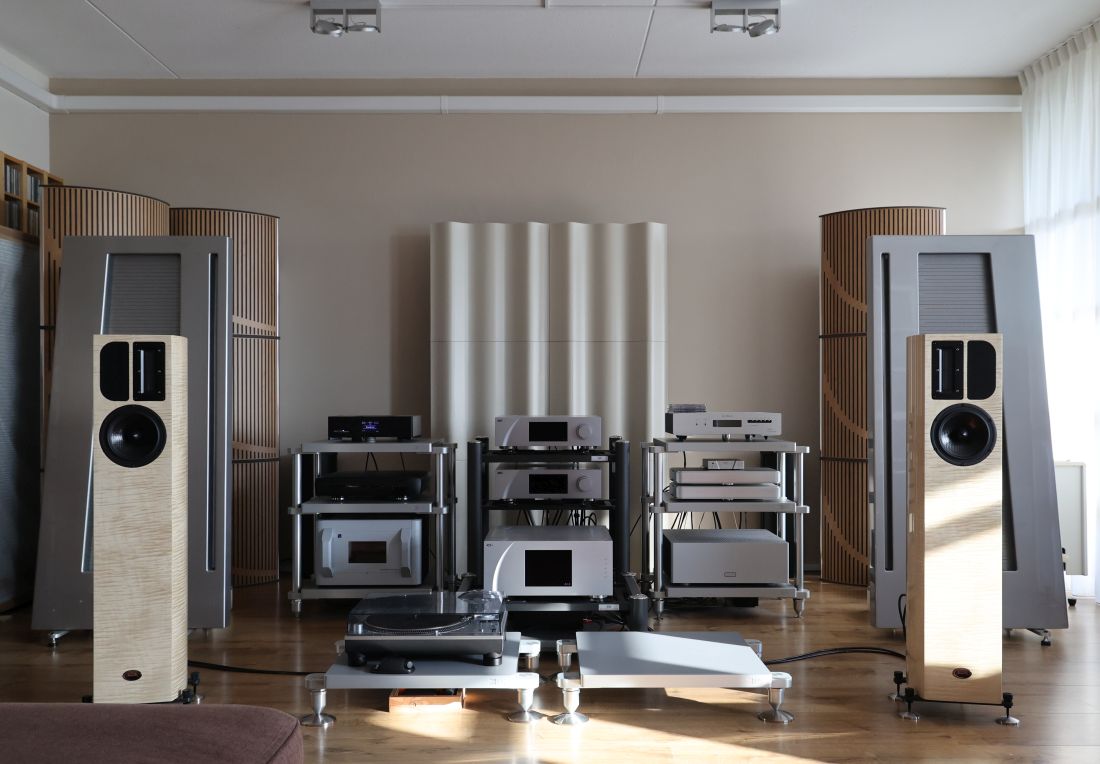
Listening – Armonia Evolution

The slender, modestly sized Armonia Evolution instantly charmed its way into my heart with its well-balanced, engaging sound. These speakers sound deliciously fluid, delicate, refined, and slightly sweet yet confident, with foot-tapping upbeat pacing. Given the modest internal volume and the small bass driver, the bass understandably does not dive as deep as that of the larger models. But you only really notice this when comparing to larger models, or when playing tracks with particularly low frequencies, such as R&B or electronic music. Until it rolls off, the bass is strong, has bite, propulsion, drive, and solidity. The speaker also doesn’t sound thin at all; they’re surprisingly full and mature, capable of rich harmonics, without sounding ripe or harmonically saturated. There’s a touch of warmth in the midrange and a subtle, forgiving smoothness overall. The midrange and treble are highly refined, subtly sweet, and particularly easy on the ear, while still providing truly excellent resolution.

These speakers are undemanding and sound beautiful and captivating with minimal effort. However, they generously reward extra care taken in positioning. To achieve the best bass, presence, focus, and soundstaging, the speakers should not be too far apart, too far from the listener, or too close to the walls. With any speaker, when placed too close to rear walls and/or too far from the listener, the bass can become a little muddy or indistinct. This is where the center-cone is highly beneficial, as it greatly improves bass precision, control, and overall clarity.

The Armonia Evo sounds delightful even when supported only on its four outrigger footers. However, when using it as intended, resting primarily on its central cone and using the four outrigger footers only for balancing the speaker, the sound became noticeably tighter, crisper, more open, more direct, and more expressive. It’s important to finely adjust the tightness of the outrigger footers’ nuts. The speaker never sounds edgy or hard, even when little care is given to its setup, but if you tighten the outer four spikes too much, you’ll lose some of the speaker’s delicacy, flow, and lyrical nature. For the ideal balance between technical accuracy and emotion-inducing flow, I found it best to tighten only one of the two nuts per spike, so either on top of the outrigger, or on the bottom, not on both sides.

The ribbon tweeter is really well integrated and seamlessly mated to the woofer, and unlike some ribbons, there is no hardness and absolutely no metallic nature to the treble. You never hear it as a separate entity, but you do notice its advantages, such as super high resolution and incredible refinement. It’s simply gorgeously natural.

The speakers provide excellent imaging and focus, a wide, lush, free-flowing stage, and a very good portrayal of depth within that stage. Instruments positioned deeper in the mix are also projected onto the stage in that way.
Related Posts
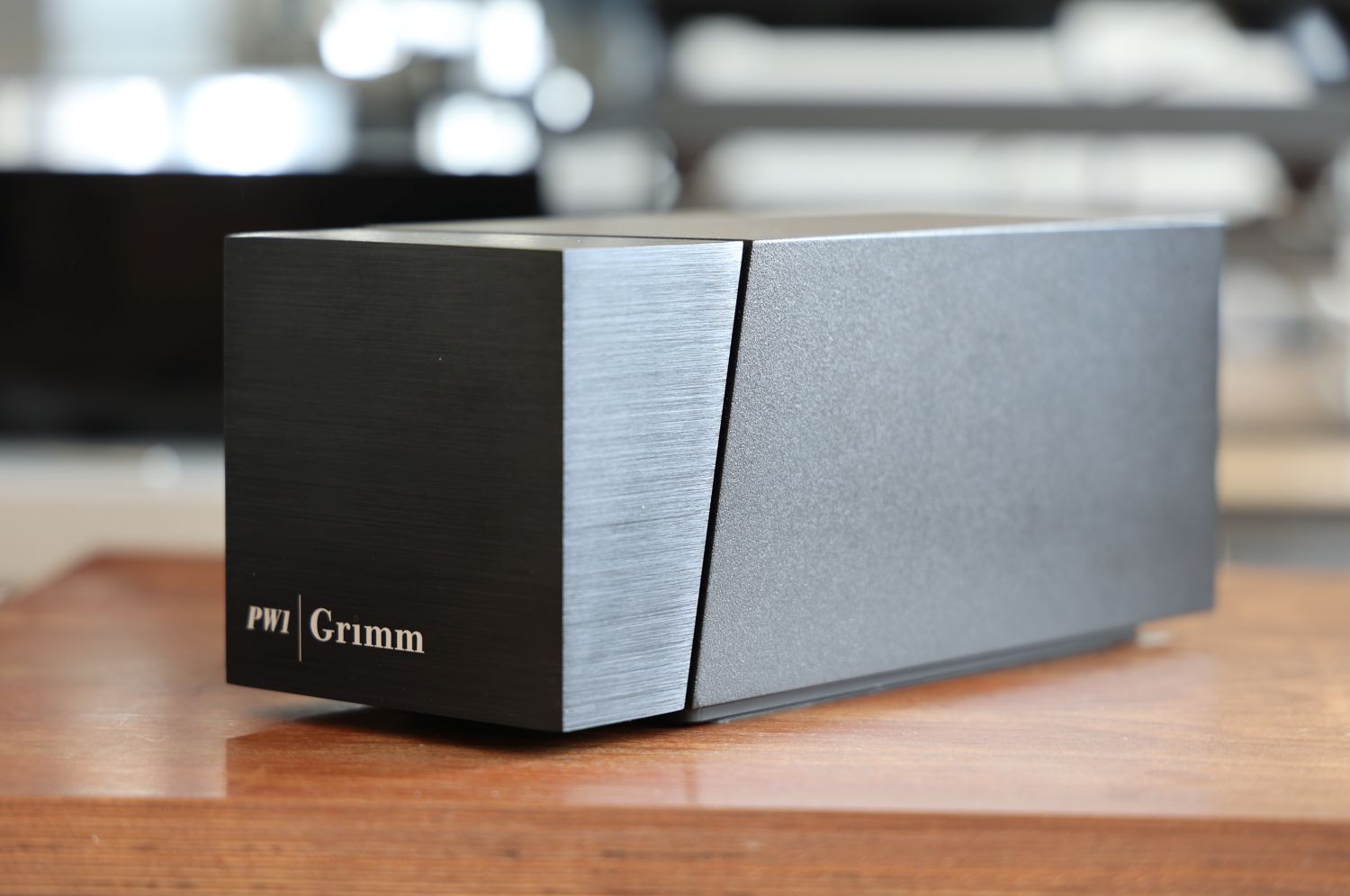
Grimm PW1 MM/MC Phono Preamp
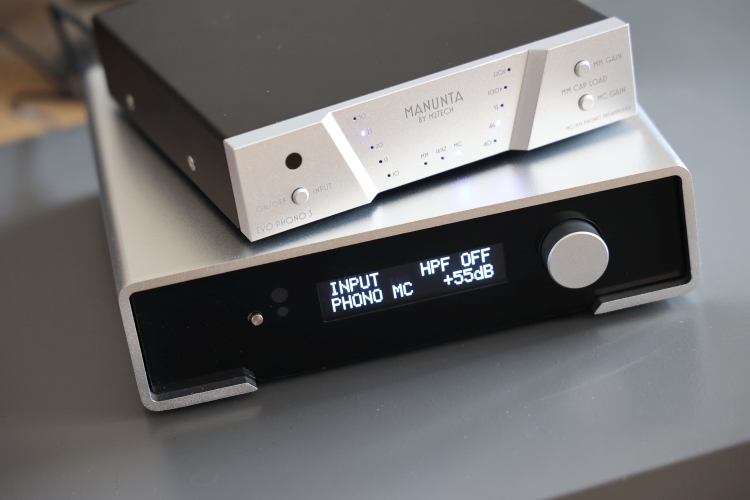
Manunta EVO Phono 3 and M2Tech Nash – Round 2
Manunta EVO Phono 3 and M2Tech Nash
Lejonklou Entity 1.2 MC Phono Stage
atm-audio Migjorn Phono Stage
COS D10 DAC, preamp, and network player
AVID Pellar, Pulsus, Pellere, and Pulsare II Phono Stages
Lejonklou Entity MC Phono Stage
Page 3 of 6 3
Apertura
  • Share This:
  • Facebook
  • Twitter
  • LinkedIn
  • Pinterest
  • Email
Christiaan Punter Owner of Hifi-Advice.com

Your comment Cancel reply

All comments are welcome, but please stay on-topic. First-time comments need manual approval which causes the post to appear a little later. Avoid using links to prevent marking as spam.


Categories

  • Accessories Reviews
  • Active Analog Speakers Reviews
  • Active Digital Speakers Reviews
  • Alkmaar Audio Show
  • Amplifier Reviews
  • Analog Classics
  • Analog Insights
  • Analog Interlink Reviews
  • Analogy Records
  • Apogee Acoustics Company Special
  • Audio Software Reviews
  • Audiophile Insights
  • Cables Insights
  • CD Player Reviews
  • Chattelin Audio Systems
  • Connectors Insights
  • Digital Cable Reviews
  • Digital Classics
  • Digital Insights
  • Digital Interface Reviews
  • Digital Recorder Reviews
  • Digital Reviews
  • Dutch Audio Event
  • Enosound
  • Extensionblocks / Filters Insights
  • Generic Insights
  • HFA Audio Setup History
  • HFA Audio Setup Snapshots
  • HifiDeluxe
  • HifiLive
  • Industry Update
  • Integrated Amplifier Reviews
  • Marantz & Philips Classics
  • Munich High End
  • Music Server Reviews
  • Network Player Reviews
  • Passive Speakers Reviews
  • Phono Cartridge Reviews
  • Phono Interlink Reviews
  • Phono Preamp Reviews
  • Power Amplifier Reviews
  • Power Cable Reviews
  • Power Conditioning
  • Power Connector Reviews
  • Preamplifier Reviews
  • Racks / Stands / Feet Reviews
  • Rhapsody
  • Show Reports
  • SPDIF DAC Reviews
  • Speaker Cable Reviews
  • Specials
  • System Synergy Q&A
  • Tonearm Reviews
  • Tuning / Tweaks Reviews
  • Turntable Accessories Reviews
  • Turntable and Accessories Reviews
  • Turntable Reviews
  • Uncategorized
  • USB DAC Reviews
  • Vienna High End
  • XFi

BRANDS

  • A&B Systems
  • A10 Audio
  • Aavik
  • Acapella
  • Accuphase
  • AcousticMatters
  • Acustica Applicata
  • Admire Audio
  • Aequo Audio
  • AG Lifter
  • Aidas
  • Akiko Audio
  • Analog Domain
  • Analogy Records
  • Analysis Audio
  • Analysis Plus
  • Ansuz
  • Anthem
  • Anti-Cables
  • Antipodes Audio
  • Apertura
  • APL
  • Apogee
  • Apogee Acoustics
  • Aqua
  • Arcam
  • Aries Cerat
  • Artesania
  • ASI
  • Astin Trew
  • atm audio
  • A Tube High Fidelity
  • Audeze
  • AudioAanZee
  • Audio Aero
  • Audio Club Premier
  • Audio GD
  • Audiolab
  • Audiolympic
  • Audiomeca
  • Audio Note
  • Audionote
  • Audio Note (UK)
  • Audio Origami
  • Audio Physic
  • AudioQuest
  • Audio Research
  • Audio Synthesis
  • Audio Technica
  • Auer Acoustics
  • Auralic
  • Aurender
  • Aurum Cantus
  • Avalon
  • AvantGarde
  • AVID
  • AVIDHIFI
  • AVM
  • Ayon
  • Ayre Acoustics
  • B&W
  • Bals
  • Bang & Olufsen
  • Behringer
  • Belden
  • Benz
  • Bergmann
  • Black Rhodium
  • Boenicke Audio
  • Bowers & Wilkins
  • Bricasti
  • Brodmann
  • Bryston
  • Burmester
  • Børresen
  • CAD
  • Cardas
  • Care Orchestra
  • CAT
  • CEC
  • Chord Electronics
  • CH Precision
  • Clarisys Audio
  • Classé
  • Clearaudio
  • Concert Fidelity
  • Conrad Johnson
  • Consonance
  • COS
  • Curious Cables
  • D'Agostino
  • DAD
  • Dali
  • Daniël Hertz
  • Daudio
  • dCS
  • Degritter
  • Denafrips
  • Denon
  • Devialet
  • Devore
  • Diptyque
  • Doepke
  • Driade
  • DS Audio
  • Dynavector
  • Dynavox
  • E&T
  • EC-Designs
  • Echole
  • Elac
  • Electrocompaniet
  • Elijah Audio
  • EMAG
  • EMMLabs
  • Emotiva
  • EMU
  • Enosound
  • Ensemble
  • Esoteric
  • Estelon
  • Euphony
  • Exogal
  • Fadel Art
  • Fezz Audio
  • FIM Gold
  • Final
  • Final Touch Audio
  • Finite Elemente
  • FoilFlex
  • Franco Serblin
  • Furutech
  • Fusion Audio
  • Gauder Akustik
  • Genelec
  • Gigawatt
  • GiK
  • Goldmund
  • Graham Audio
  • Grandinote
  • Grimm Audio
  • Gryphon
  • Gustavson Audio
  • Halcro
  • Hanze Hifi
  • Harman/Kardon
  • Harmonic Resolution Systems
  • Harmonic Technology
  • Harmonix
  • Heaven's Gate
  • Hifi-Tuning
  • HiFi.nl
  • HifiMan
  • High Fidelity Cables
  • Hofa
  • Holo Audio
  • Home Audio Fidelity
  • HRS
  • IeGO
  • Ikigai
  • IMF
  • Isotek
  • Jadis
  • Jay's Audio
  • JCAT
  • Jeff Rowland
  • Jena Labs
  • JMF Audio
  • Jorma Audio
  • Jorma Design
  • Joseph Audio
  • JPLAY
  • JVC
  • Kemp
  • Kharma
  • Kimber
  • KingRex
  • Kinki Studio
  • KlinktBeter
  • Kora
  • Krell
  • Kroma Atelier
  • Kupp
  • LAiV Audio
  • Lampizator
  • Lapp
  • LAST
  • Lector
  • Leema
  • Lejonklou
  • LessLoss
  • Line Magnetic
  • Linn
  • Logitech
  • LOK
  • Loudness War
  • Lumin
  • Luxman
  • M2Tech
  • Mad Scientist
  • Magico
  • Magnan
  • Magnepan
  • Mamba Audio
  • Manley Labs
  • Manunta
  • Marantz
  • Mark Levinson
  • Marten
  • Martin Logan
  • Master
  • Matrix
  • MBL
  • McIntosh
  • Melco
  • Melody
  • Meridian
  • Metrum Acoustics
  • Michell
  • MIT
  • MJ Acoustics
  • Modus Audio
  • Mogami
  • Mola-Mola
  • Monitor Audio
  • Monrio
  • Moon
  • Morel Hifi
  • MP&S-Klangwelten
  • Munich High End
  • Musetec
  • Musical Fidelity
  • Mytek
  • Nagaoka
  • Naim
  • Naiu Laboratory
  • Nakamichi
  • NBS
  • Network Acoustics
  • Niels Setup
  • Nordost
  • NuPrime
  • Ohm Audio
  • Oladra
  • Olive
  • Onkyo
  • Onzow
  • Origin Live
  • Ortofon
  • Oyaide
  • Panasonic
  • Paradigm
  • Parasound
  • Pass Labs
  • Peak Consult
  • Philips
  • Pink Faun
  • Pioneer
  • Playback Designs
  • Precision Audio
  • PrimaLuna
  • Proceed
  • Prodigio Audio
  • PS Audio
  • PSI Audio
  • PUUR AVD
  • PUUR hifidelity
  • Pylon Audio
  • Qln
  • Qobuz
  • Quad
  • R.T.F.S.
  • RAAL Requisite
  • Raidho
  • Reference Sounds
  • Reference Tweaks
  • Rega
  • Rein Audio
  • REL
  • Resonator Stockholm
  • Revel
  • Ricable
  • Roon
  • RTFS
  • SAEQ
  • SAT
  • Schiit
  • Seawave Acoustic
  • Sennheiser
  • Shakti
  • Shuguang
  • Shunyata
  • Shure
  • Signal Projects
  • Silent Angel
  • Siltech
  • SME
  • SolidSteel
  • Solid Tech
  • Sonic Frontiers
  • Sonos
  • Sonus Faber
  • Sony
  • Sooloos
  • SOtM
  • Soulution
  • Sound Anchor
  • Sound Lab
  • Spectral
  • Spotify
  • Stack Audio
  • Stealth
  • Stenheim
  • Stillpoints
  • Straight Wire
  • SW1X Audio Design
  • Symo
  • Synergistic Research
  • Synology
  • Synthese
  • T+A
  • Taiko Audio
  • Tascam
  • Teac
  • TechDAS
  • Technics
  • The Chord Company
  • Thorens
  • Transparent Audio
  • Trends
  • Tung Sol
  • Unison Research
  • UpTone Audio
  • VAIC
  • van Damme
  • van den Hul
  • van Medevoort
  • Vermeer Audio
  • Vermouth Audio
  • Vibex
  • Vifa
  • Vincent
  • ViRa High End
  • Viva
  • Vivid Audio
  • VTL
  • Wadax
  • Wadia
  • Wattgate
  • Wattson
  • Way Cables
  • Weiss
  • Western Electric
  • WestminsterLab
  • Widealab
  • Wilson Audio
  • Wilson Benesch
  • Winyl
  • Wires 4 Music
  • Wireworld
  • Wolf von Langa
  • Wooden Bull
  • XACT
  • Xavian
  • xFyro
  • Xindak
  • XLO
  • Yamaha
  • Zanden
  • Zellaton
  • Zesto
  • ZYX

Follow HFA on Social Media

Facebook

LEGAL

Privacy Policy

This site is protected by reCAPTCHA. Google Privacy Policy and Terms of Service apply. All rights reserved © 2026 - hifi-advice.com.
  • Contact
  • Home