
For those unfamiliar with planar dipoles, the DP 140 MkII’s bass behavior reminds me of the Quad ESL 988 Electrostatics and arguably has more in common with an excellent pair of headphones than the average dynamic speaker in its price range. With “excellent”, I mean at least a Sennheiser HD 650 or similar, but in many respects, the Diptyques are considerably better than these headphones. For instance, by not having even a trace of synthesis or artifice and having even higher resolution. From the midrange up, they actually remind me of the superlative performance of the RAAL requisite CA-1a headphones. As conoisseurs will know, these headphones contain pure ribbon drivers which, of course, explains a lot.
As with most headphones with the exception of the RAALs, the DP 140 MkII’s bass is smooth and relaxed and the pacing holds the perfect middle between laidback and fast. But the low end and especially the mid-bass and lower midrange are not as impactful or as incisive as that of a cone driver. While listening to all kinds of music, a preference emerged for soulful and intimate music where they unveil never-heard-before low-level textures, sounds and ambient clues while allowing the music to pour into your ears with delicious fluidity. Don’t get me wrong, the speakers do not have any trouble with loud or busy recordings, actually, they excell in unravelling the inner working of anything you play.
Admittedly, these speakers do not have the kind of midbass punch that you get with dynamic speakers, and they do not excel at offering edge-of-seat excitement. But most really visceral and impactful speakers do not sound as intimate, resolving, refined and transparent as these Diptyques, especially not at low listening levels. Magicos S1’s or hybrid Martin Logan ESL11A’s with their active bass section both have more punch down below and rock harder, but the Magicos are less crisp, pure and transparent and the Martin Logans fall behind in terms of coherence, focus, staging and naturalness. That is just the way it is in speaker design, it’s always a balance of virtues.

Let’s jump over all the way to the other end of the spectrum. The DP 140 MkII’s treble is amazingly open, airy and ultra-refined. Compared to the Magicos, the DP 140 MkII’s treble feels tilted up, but one might also say the S1’s treble is sloped down. In any case, I think it is fair to state that the DP 140 MkII’s have more open treble than most other speakers I heard, be they dynamic, electrostatic or planar magnetic designs, but it is of such superb quality than one can only remain seated and let the music wash over. By the way, I recall the DP 107’s were also bright, but I don’t remember their treble being as crisp and detailed as I hear now.
As one might expect from a ribbon speaker, the level of transparency, precision and resolution leaves nothing to desire. As a point of reference, returning to the S1’s after listening to the DP 140 MkII, the treble is relatively dark. This certainly takes some getting used to every time I swap between the speakers, especially when done very quickly. But more pressingly, I can’t help but notice that the Diptyques sound cleaner, more transparent and more revealing than the S1’s, even though the DP 140 MkII’s are positioned 1,5 meters further back. Now, that is something that really made me gulp.
Oh, importantly, the Diptyques do not have even the slightest trace of artifice. Not only do they not color the sound, but their timbre is spot on neutral and beguilingly natural.
No matter how explicitly detailed they are, the treble remains fluid and effortlessly relaxed, and there’s never any harshness or edge. Seriously, I don’t think treble performance can get much better even if you spend a fortune, only different.
Now, we arrive at the all-important midrange and I’m happy to report that the two frequency extremes are married perfectly. The crossover frequency between the treble/midrange foid and the woofers is inaudible. And just like the treble, the midrange is so perfectly neutral and natural, as well as addictively lyrical and emotion-inducing, that it’s hard to come up with any criticism. Anything I play is rendered precisely as the recording requires. There’s no coloration, hardness or edge but also no added warmth, just pure, liquid, lush, and organic music. But if I’m really critical, although I cannot hear the transition from treble to bass, I do hear that the bass panels are not quite as articulate and expressive as the midrange/treble ribbon. But otherwise, the coherence between the drivers is simply superb, and of huge importance, as mentioned, the bass is perfectly timed with the rest of the frequency spectrum.

Soundstaging is another forte. While some people will always prefer a point source over a line source, I have to say the DP 140MkII’s image remarkably well. The speakers sound royally spacious and beautifully liquid and at the same time they are very well-focused. They achieve a stable and well-defined center image with little trouble. Just ensure that both speakers’ toe-in and tilt are exactly the same. Unlike with some larger planar designs, the soundstage appears with just the right size, not too tall but most certainly also not too small.
In fairness, a well-designed point source will always provide a more vividly layered depth rendition than a large planar speaker but what the DP 140 MkII’s achieve is already fantastic. More to the point, the focus and soundstaging capabilities these speakers present in my room are absolutely on par with the level of the very best ribbon speakers I heard, in my own room or anywhere else, and at any cost.
As I quickly found, the DP 140 MkII’s work equally well with the CH Precision system and powered by the A1.5 as the Accuphase E-270 integrated amplifier used all by itself. Make no mistake, the speakers illustrate the relative differences of these systems to perfection but they make beautiful music just the same. All the same, they have no problems with the tight control of the CH nor with the modest power of the Accuphase.
As mentioned, I am no stranger to dipole magnetostatics. I’ve owned most Apogee models, two Magnepans, and several Martin Logans, both passive and active designs. But the only speakers I heard that spring to mind that mirror what the DP 140 MkII’s achieve in terms of transparency, resolution and neutrality, are the Clarisys Minuet, the Magico Q5, and to some extent, the Magico S3 MkIII. These speakers actually do some things even better, such as overall dynamics and firmness, incisiveness and punch in the bass, but cost a small fortune. Of course, there is no such thing as a perfect speaker. As mentioned, every speaker is a balance of virtues but if I have to resort to speakers costing multiples of the Diptyque’s price to make my point, that really says it all.

Conclusion
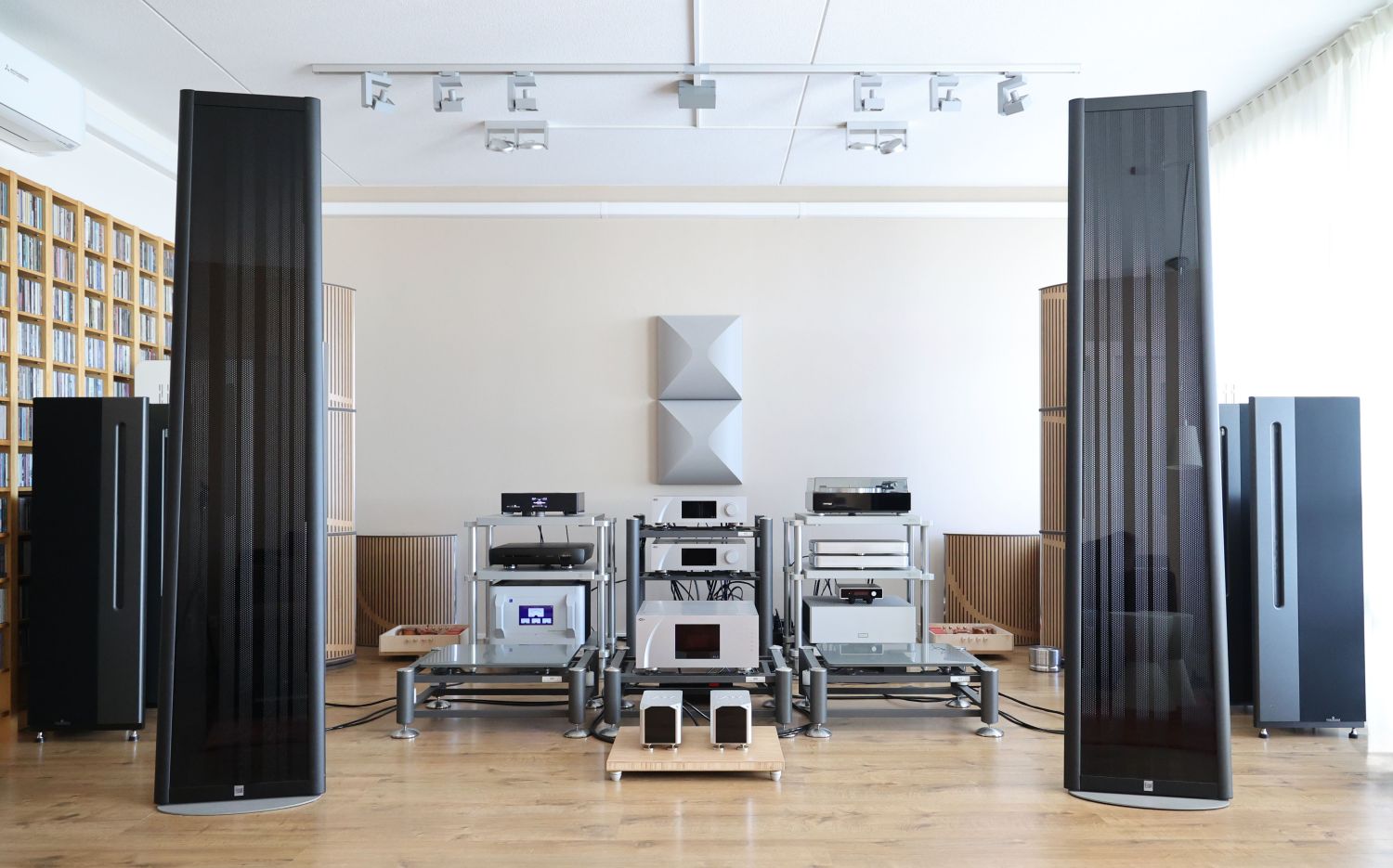
Even though I am very familiar with planar magnetic designs, the DP 140 MkII’s resolution, clarity and transparency took me by surprise. The Diptyque DP 140 MkII are moderately-sized for a full-range planar magnetic speaker and their clean lines and clever minimalistic construction make them visually inobtrusive. Yet, they are capable of full-strength bass output to well below 40Hz.
These speakers combine royal spaciousness with immense resolution and great focus. They perform in an engagingly upbeat, crystal-clear, and highly communicative manner but, paradoxically, despite their revealing nature, they always sound deliciously delicate, refined, intimate, and wholly unforced.
Every speaker is a compromise, offering a balance of virtues. The DP 140 MkII’s are remarkable in so many ways that it becomes hard to provide any criticism. But on balance, I’d say their only flaws are that they do not excel at offering edge-of-seat excitement and do not have the kind of midbass punch that you get with dynamic speakers. But most really visceral and impactful speakers do not sound as intimate, resolving, refined and transparent as these Diptyques, especially not at low listening levels.
With that in mind, if you are looking for speakers that approach state-of-the-art headphone performance and work in almost any room, the DP 140 MkII’s are highly recommended!

HFA Awards
Associated Equipment
External Links
Manufacturer’s website: diptyqueaudio
Distributor for the BeNeLux: Dimex


“… the bass is perfectly timed with the reat of the frequency spectrum.”
“reat” –> “rest”
Thank you very much for letting me know. The typo has been corrected.
Hi, when paired with a high-quality subwoofer—something truly worthy of the name, such as the REL Carbon Special Black Label or the new No. 35 or 36 models—could these Dyptique speakers represent a kind of musical perfection, the best of both worlds? What do you think ?
Best Regards
Pairing a sub with a dipole panel can be very hard. It would need to be time-aligned, and when avoiding processing for the main speakers, the only way to do this is to set uit up in line with the speakers or more forward and then delay is, if possible. In my experience, this will often be only a partial solution because the sub has to deal with the same room issues as the main speakers. The thing is: a crossover is not a brick wall. There’s a curve, meaning that the sub will also output much higher frequencies, albeit at much reduced output. But this can be enough to add coloration, thickness, and comb-filtering effects at higher bass frequencies. A solution I found recently, is to use a subwoofer behind the listening position. This only became possible after I repositioned the listening sofa not that long ago. Now, the sub “sees” very different room conditions than the main speakers, and it sounds much cleaner and more precise than if it were used at the wall behind the speakers. The only caveat is that the sub needs to be either at the same physical distance as the main speakers, or have a precise delay feature on board to compensate. To summarize, I think that a really good sub can definitely be beneficial, and can even yield better results in a difficuly room than using full-range speakers. But it can take a lot of effort to integrate perfectly. BTW, I have a feeling that the DP 170-EVO, with its separate midrange ribbon, might be very special. I hope to get it for review. Lastly, my room is very difficult, and despite extensive effort and using multiple types of bass trap mechanisms simultaneously, it still has a bass dip around 40-50Hz, which some speakers more or less fill in, but the DP 140 does not because it is very clean and linear. In a more typical room, it’s likely that these speakers will have fuller bass than I described.