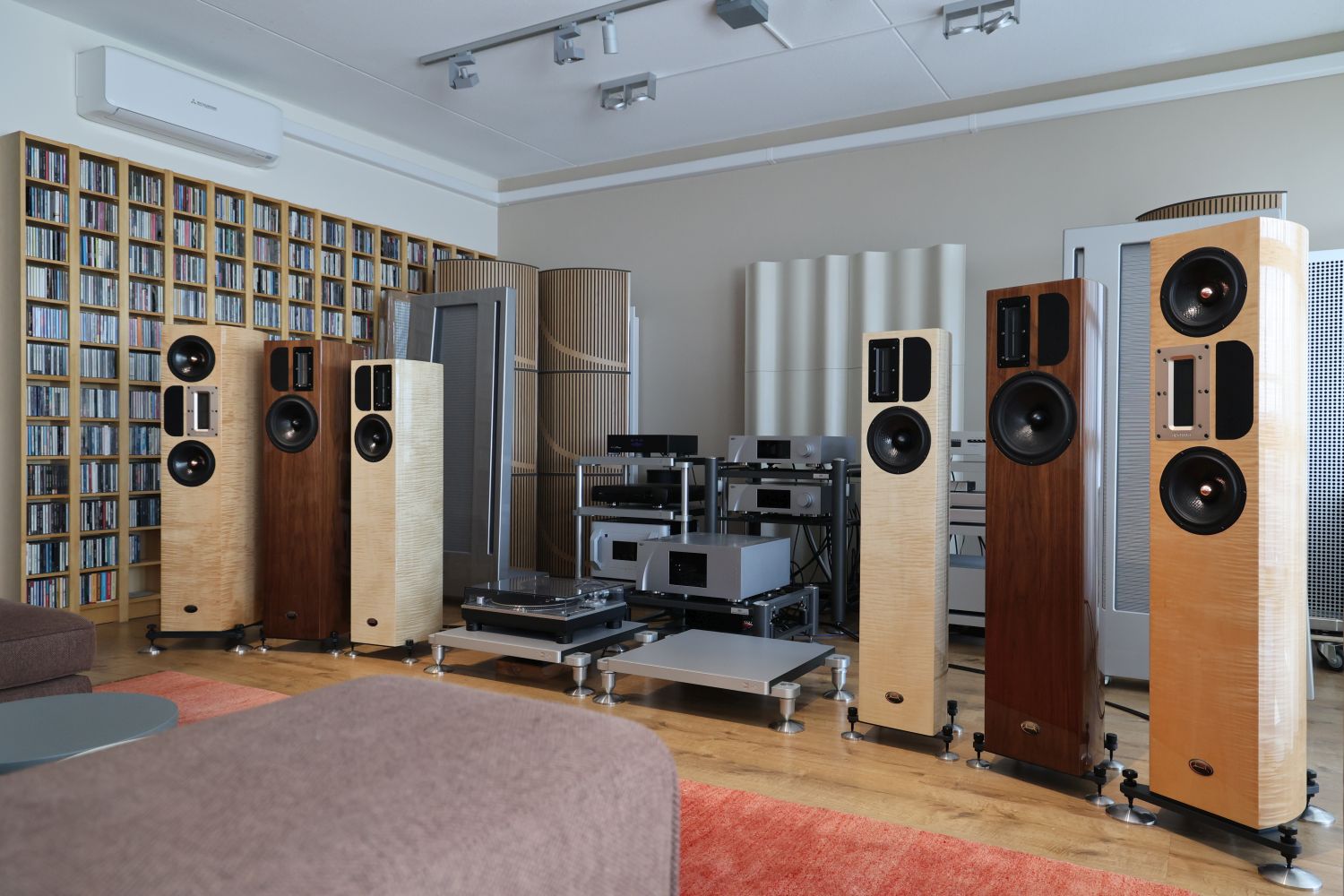
An interesting aspect of all three speakers is that they are generally relaxed and highly refined, yet they can still be surprisingly expressive when the music calls for it. With the Armonia Evo and Edena Evo, this is most evident in the midrange and treble, while the bass is comparatively more mellow. With the Adamante, however, the bass is every bit as dynamic and expressive as the midrange and treble.
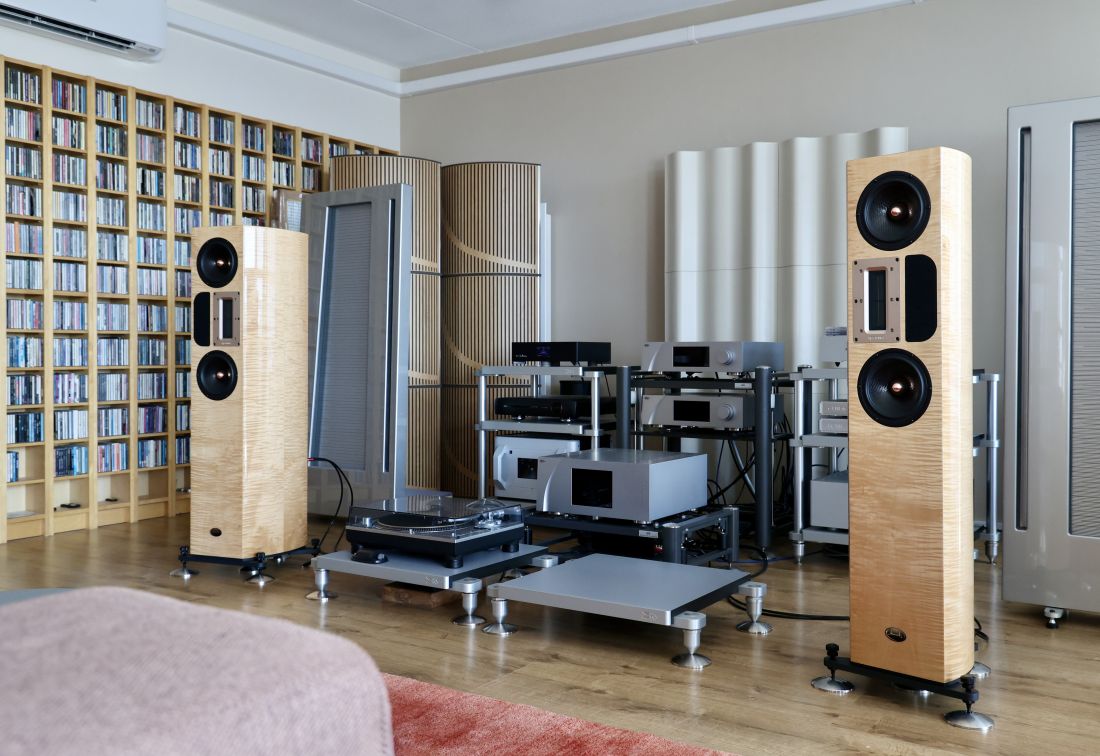
I use relatively large 6-cm diameter Artesania Audio floor discs (delivered with Artesania Prestige Racks) because I know them well and they make it easy to slide speakers across the floor with confidence. As I did not have enough of them to facilitate three pairs of speakers, I used larger 10-cm ones (delivered with Artesania Exoteryc racks) for the Adamante. That proved to be a mistake.
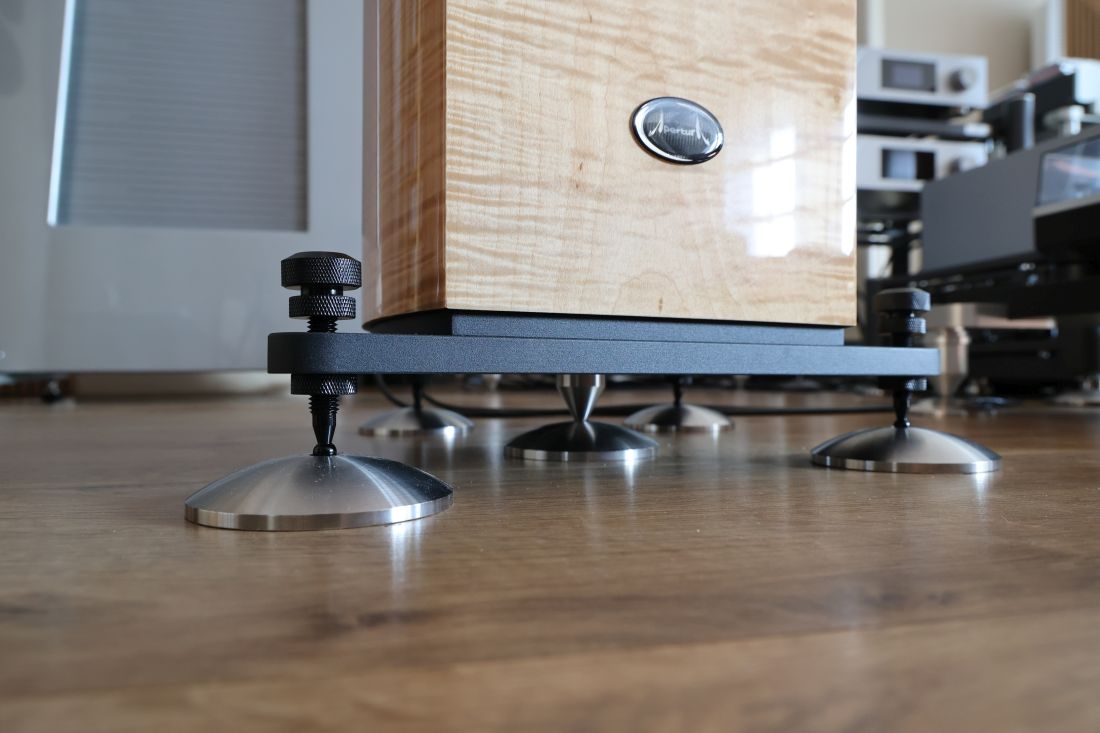
As I found, the smaller Artesania discs sound better with all three Aperturas than the larger ones: more linear overall, nimbler and more elegant in the bass, and more open and transparent on top. The big discs (delivered with Artesania Exoteryc racks) make the speakers sound lumpy and bombastic, and they seem unsuited for speakers unless they are bass-shy.
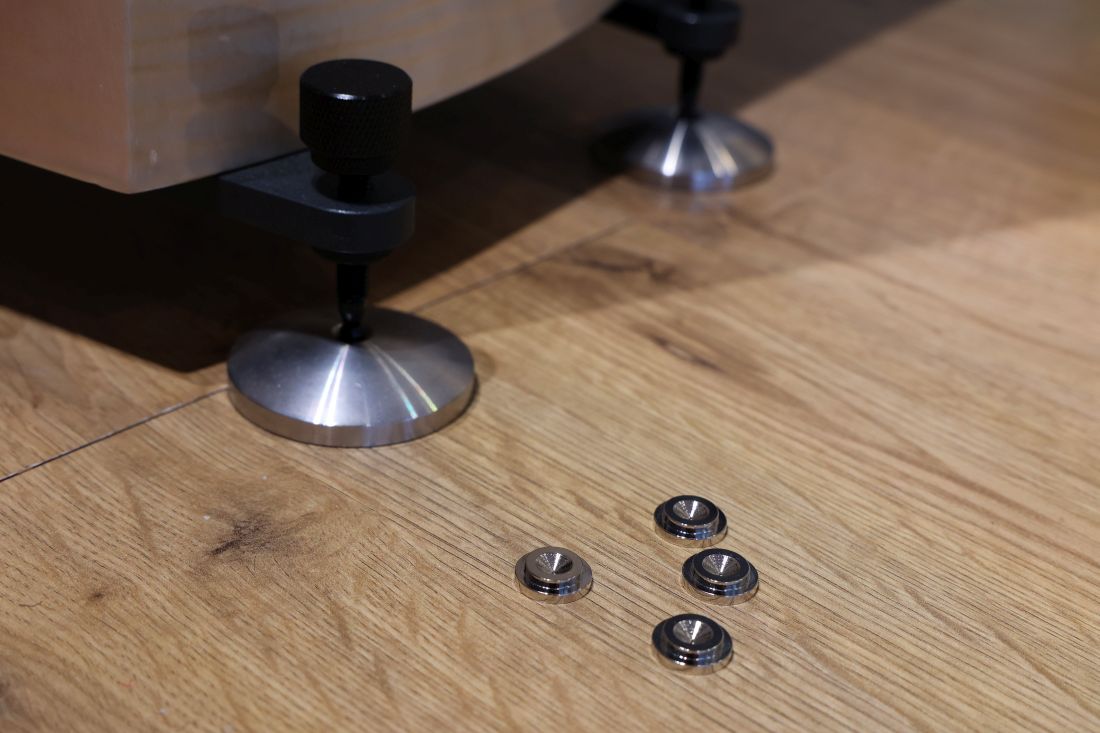
Adamante on 6-cm Artesania Floor Discs, with the included Apertura Floor Discs on the right.
Armed with this knowledge, I could not very well omit a comparison with the tiny ~1.5-cm discs included with each Apertura speaker. In line with expectations, they provide a balance that goes in the other direction: leaner in the bass, tonally less deeply saturated, and brighter in the treble.
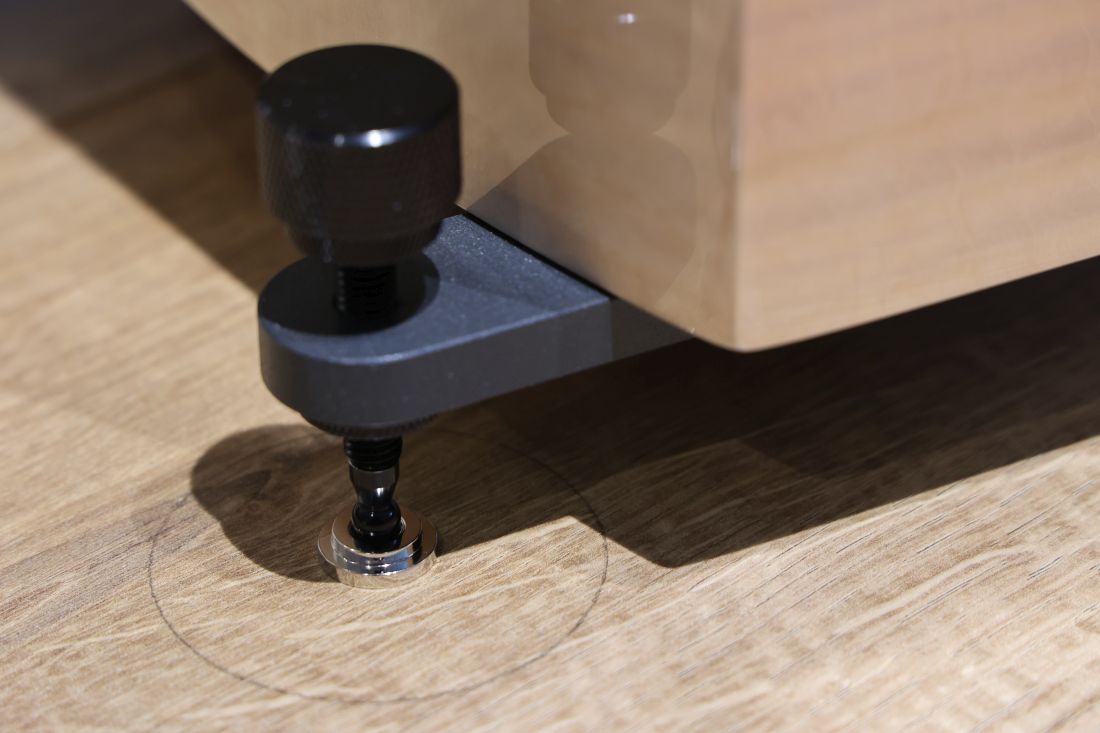
While I can’t say which of these footers is “best” for all intents and purposes, I found the 6-cm Artesania discs to provide the best balance for my taste and situation. In any case, it is well worth experimenting with various discs to find the ideal balance in a given system.
Using the recommended mechanical grounding system and adding the central cone most assuredly further improved performance but, presumably thanks to its much more solid outrigger system, does not yield quite as transformative a result as it did with the Edena. Nevertheless, the bass becomes tighter and more controlled, and the speaker’s overall precision and transparency are further improved. Because of this speaker’s higher inherent precision, one needs to adjust the four-footers even more carefully than with the other two models. Simply leaving the outrigger footer’s nuts loosely tightened is not enough, because the speaker’s honesty and immediacy will leave no doubt about whether everything is set up just so and perfectly symmetrical for both speakers. The speaker tilt (vertical angle) is particularly important to get right so the two woofers align perfectly and sound as one.
If all that sounds like a lot of effort, I should note that this goes for all reference-class loudspeakers. I had to go to the same lengths for the Wilsons, Martin Logans, Kromas, Magicos, and the Apogees, to get the best out of them. After I had positioned the Adamantes with millimeter precision in all dimensions, including careful tilting, the bass was superbly clean and free of roughness and boxiness, and the speakers were beautifully transparent, entirely coherent, and perfectly flat. Moreover, the midrange now truly sang, and the speakers were every bit as lyrical as the Armonia Evo and Edena Evo, while retaining their technical precision and highly expressive behavior, and I was absolutely loving it.
Honestly, I could see myself living with the Adamantes!
Conclusion
Regular readers know of my love for ribbons, and I can confirm that all three Apertura models meet my expectations: they all offer superb resolution, transparency, delicacy, fluidity, and air. Despite their different drivers, all three models sound utterly coherent. Given how hard it is to mate a ribbon midrange/tweeter with a dynamic woofer, that is a wonderful accomplishment.
The Armonia Evo is an excellent all-rounder, easy to incorporate into various setups, that delivers a musically engaging, lyrical, and emotionally involving experience with minimal effort. But with attentive tuning, its audiophile qualities can be substantially enhanced, easily surpassing the quality you’d normally expect at this price point.
The Edena Evo provides deeper and fuller bass, a considerably more organic, lusher midrange, and even more liquid treble. Besides this, it also has a sweeter, warmer, and more relaxed presentation than the Armonia Evo, making it not just a matter of performance but also one of personal taste.
Both the Armonia Evo and Edena Evo provide excellent value for money, and the significantly higher price of the Adamante may be harder to accept. Nonetheless, it should be noted that reference-class speaker prices in general have increased considerably in recent years. Compared to quite a few other speakers in the Adamante’s performance class, American speakers in particular, a price of 50.000 euros or more seems to have become the norm.
All three models perform splendidly, and I highly recommend each of them, but the Adamante pulls ahead by quite a distance in terms of timbre, dynamics, and sheer realism. Vocals, acoustic instruments, percussion, and even electronic music are all presented with great conviction. The Adamante exudes much more raw energy and stands out as the most direct and dynamic among the three.
Its sonic properties add up to an incomparably more realistic delivery, combining emotion-inducing musicality with a healthy lust to rock, whereas the Armonia Evo and Edena Evo are less “slamming” and more suited for introspective listening. When it comes to vitality, authority, and slam, the Adamante even reminds me of the kind of performance typically linked with brands like Wilson Audio or JBL. But then, there’s the immensely detailed, open, and airy midrange and treble, which take all the qualities of the Armonia Evo and Edena Evo and add a healthy dose of energetic directness and bite, balancing the speaker out just perfectly.
Don’t underestimate the Adamante. This is a precision speaker that can be every bit as liquid, delicate, and refined as the Edena Evo, but it is considerably more demanding, as it does not mask recording deficiencies, system mismatches, or room issues. But with careful setup and in the right room, the Adamante is one of the best sub-30,000-euro speakers I have reviewed and one of the very few that I could see myself living with long term.
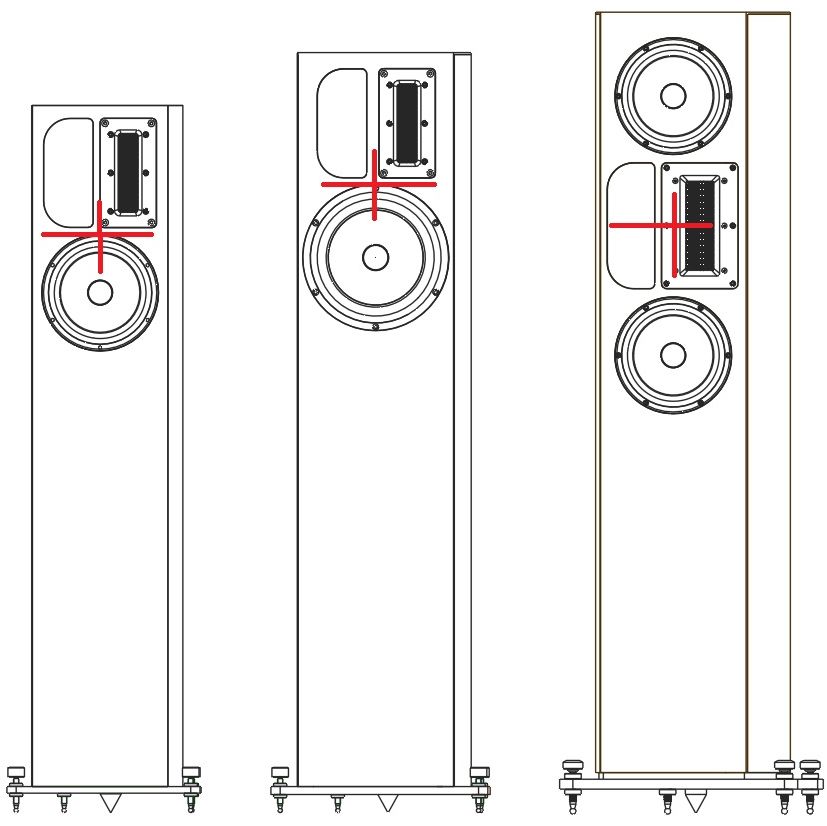
Manufacturer’s comments
Eric Poyer of Stentor SAS – Apertura raised an important point:
“An important factor to consider is the acoustic center position, which differs for each of the three speakers.” (see the illustration above)
I used all three speakers in a perfectly straight position and adjusted my ear height “on the fly” by sitting lower or higher to achieve the flattest balance, but for final installations, it is recommended to tilt the speakers as needed to accommodate the seating height, as this directly affects the tonal balance. For instance, if the acoustic center is lower than the ears, the speakers can be angled slightly back to compensate.
Eric added: “Every room is different, but based on experience, as a starting point for finding the right position, I try to maximize the distance between the two speakers while keeping a reasonable distance from the side walls and the speaker front facing the listening position.”
While my room dictates that speakers be positioned well away from the back wall and sidewalls, as Eric rightly mentions, every room is indeed different. It is always advisable to experiment with all variables!

- Armonia Evo for its fantastic price-to-performance ratio.
- Edena Evo for its successful combination of lush liquidity, utter refinement, and high resolution.
- Adamante for its benchmark-setting performance across all variables within its price class.
External Links
Distributor for The Netherlands, Belgium and Luxembourg: hexagonaudio
Manufacturer’s website: Stentor SAS – Apertura