AVM PA 8.3 Preamp, SA 8.3 Power Amp, A 8.3 Integrated Amp

Solid-State preamp output board
The preamplifier’s solid-state output board arrived approximately two weeks after I started this review. Having achieved a solid understanding of how the preamp behaved with its tube output, I fully expected the solid-state output to sound leaner, tighter, and crisper, and perhaps even more impactful. However, contrary to expectations, it sounded less articulate and distinct in the bass, less expressive in the midrange, and dynamically flatter. How about that? Scratching my head, I figured the card might be new and need some running in. So, I allowed it to bed in for a few days, switching the preamp on in the mornings and off in the evenings. After three days, the difference was smaller, and the solid-state output had become more fluid and engaging. As with all AVM products I have heard, the solid-state output has a well-balanced presentation with excellent resolution combined with a natural tonality. However, switching to the tube output (which is always on and available right away) quickly confirmed that I still preferred it.
As tube aficionados will surely confirm, tubes tend to provide a harmonically richer sound with a more natural balance, and to an extent, the PA 8.3 tube output delivers precisely this. However, from my experience, tubes can sound lush and warm, tight and fast, or anywhere in between, depending on how they are implemented. And indeed, the implementation on the PA 8.3 board creates a remarkably articulate, lively, and expressive rendition, rather than a stereotypically thick and mellow rendition one might expect. As a bonus, the tube output even provides a more realistic rendition of textures. For instance, piano sounds more wooden and percussive via the tube output, and comparatively a little more synthetic via the solid-state output. Moreover, the tube output is actually more propulsive, lively, and expressive than the solid-state output!
Strictly speaking, the tube output adds a touch of fullness and character, which I usually prefer to avoid, but in this case, it also better captures the musical intent and feels more exciting and alive, providing a more involving experience. And after all, that’s what matters most.
If the solid-state output had been all I had heard, I would have given it good marks, but hearing the tube output has spoiled me. Unless the prospect of having to replace the tubes at some point is off-putting, I would definitely recommend going for this option over the solid-state output.
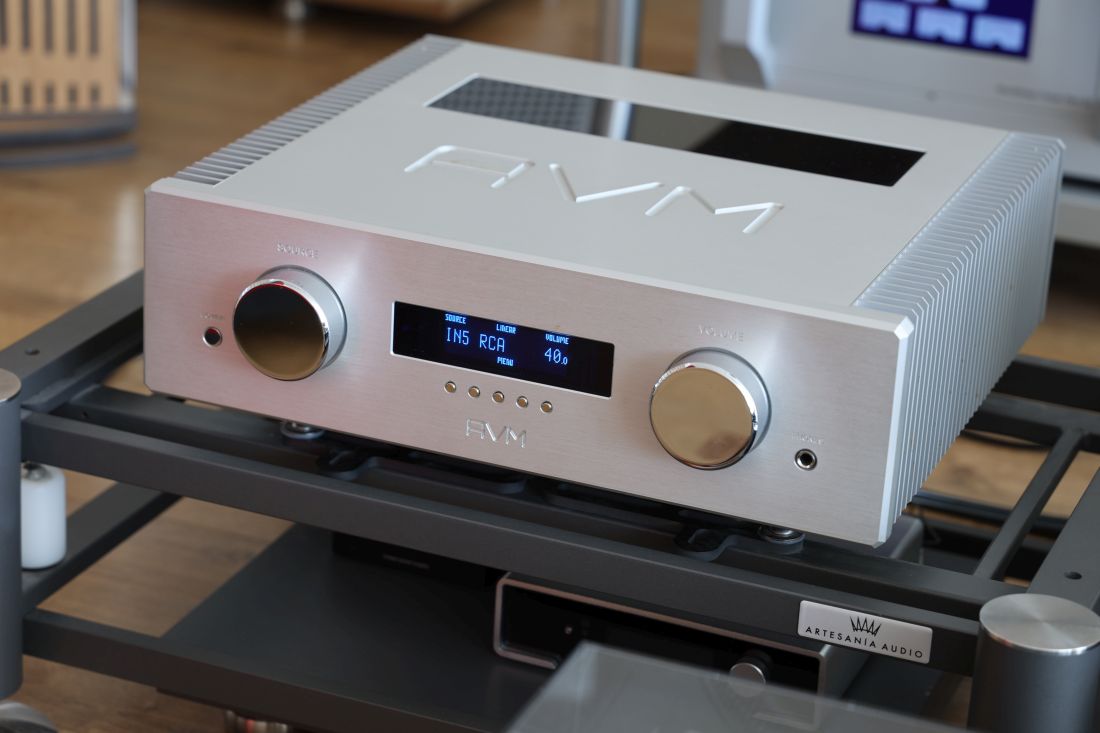
A 8.3 Integrated Amplifier
In 2017, I had an AVM A 6.2 integrated amplifier on loan, along with Martin Logan ESL11A electrostatic speakers that I was reviewing at the time, and I vividly recall how it sounded compared to the Brystons I was also reviewing during the same period. I used Apogee Divas at the time, and the 6.2 was particularly fast, tight, and well controlled. In addition, it was very clean, precise, and transparent.
The A 6.2 has been succeeded by the A 6.3. In essence, the A 8.3 I am reviewing right now is an A 6.3 with the addition of Ovation 803 T-tube technology. Assuming the A 6.3 shares a similar sonic balance with the A 6.2, one might expect a compromise between typical transistor strengths such as speed, tightness, and control, and the appealing qualities of tubes such as harmonic richness and liquidity. However, this was not the case at all. Like the SA 8.3 preamp and PA 8.3 power amp, AVM has thoughtfully integrated the tube sections to capture their advantages without compromising the amplifier’s fundamental qualities.
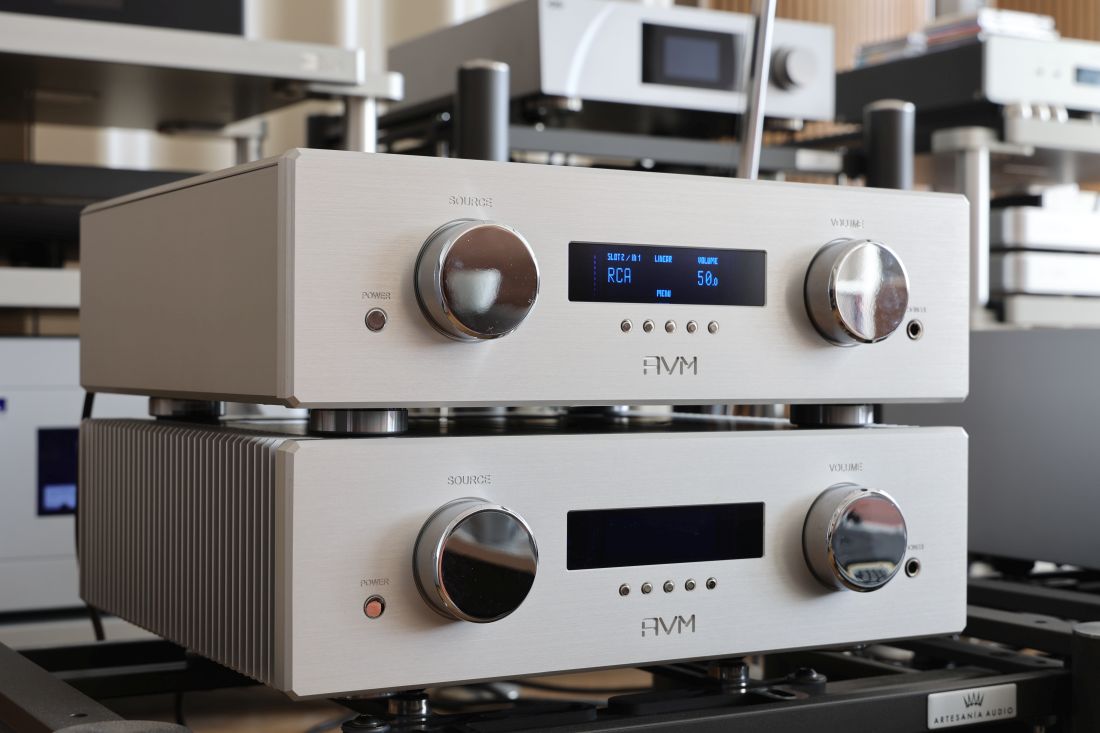
The PA 8.3 (top) and A 8.3 (bottom) share the same high build quality, differing only in the cooling fins on the side of the integrated amplifier.
At the outset of this review, I posed the question of how much of the separates’ performance is preserved in the single-chassis solution. To assess this as fairly as possible, I positioned the A 8.3 integrated amplifier on the same Artesania Aire rack as the separates, supported directly on the Carbon Fiber Linear Arms‘ beechwood footers, and using the same interlinks and power cables.
As it turns out, when stepping down from the separates to the integrated amplifier, a surprising amount of quality remains. Resolution, transparency, and bass control: it’s all there. The integrated amplifier even sounds slightly more neutral, as it does not have the seductive richness of the big amp. Moreover, I initially felt that the integrated sounded a little bland and dynamically restrained compared to the pre-power combo.
First, I assumed that the difference must be in the power amplifier section. After all, although the A 8.3 with 200 Watts in 8 Ohms seems almost as powerful as the SA 8.3 with 250 Watts in 8 Ohms, the 4-Ohm values reveal a more profound difference: the big SA 8.3 increases its output to nearly double, at 450 Watts, whereas the integrated A 8.3 provides 330 Watts. But then, the thought occurred that, although the PA 8.3 preamp features fully balanced, DC-coupled signal paths, the A 8.3 integrated is not specced as such. So, perhaps the integrated’s single-ended internal path might favor unbalanced connections.
Moments after swapping the Driade Flow Link Reference 808 XLR cable for its RCA equivalent (which sounds exactly the same), my suspicion was confirmed. RCA was indeed the answer! It seems that the integrated is indeed not fully balanced, or, at least, it treats a balanced signal differently. With RCA, it sounds so much better. It’s still not as bold and enthusiastic, as full-bodied, or as dynamic as the pre-power combo, but it gets a lot closer.
The A 8.3 is leaner than the combo but has excellent bass control and articulation, at least as good as the power amplifier. Although the integrated also has a tube input stage, it sounds more like the PA 8.3 and SA 8.3 combo did when using the preamp’s solid-state output stage. It’s still performing at an audiophile level, but it’s hard to go back to coming from the big combo’s majorly propulsive, enthusiastic, and communicative nature. Ultimately, the A 8.3 is not an exact equivalent of the big boys, but it shares the same DNA and performs very nearly at the same level.
Addendum:
The A 8.3 has just been discontinued and replaced by the A 8.3 S. The PA 8.3 will remain in production unchanged. The SA 8.3 will become the SA 8.3 S version. The rest of the new Ovation S Line consists of the CS 8.3 S All-in-One, AS 8.3 S Streaming Integrated Amplifier, and PAS 8.3 S Analog Preamp with Streamer and DAC, and the MP 8.3 S Media Player/DAC.
AVM also just announced the AS XL Ultimate Streaming Integrated Amplifier at High End Vienna, combining the SA 8.3 S with an analog preamplifier.
Conclusion
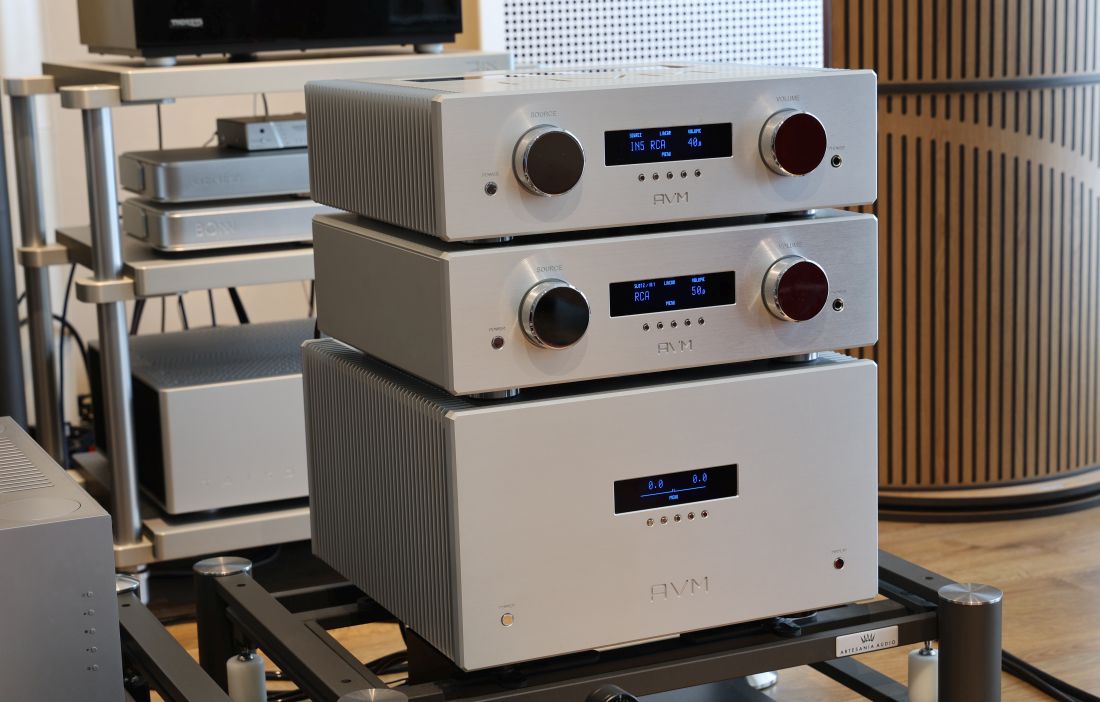
AVM might fly under the audiophile radar, but the brand is not to be underestimated! As I find time and again, they consistently offer excellent value for money at every price point. The Ovation range may seem costly compared to their more cost-effective product lines, but that’s for good reason!
The PA 8.3 is confidently better than anything I heard anywhere close to its 10.299 Euro retail price. In terms of ultimate audiophile performance, it can be beaten, but it will be hard to beat it for realism, engagement, and all-out musicality. Given its excellent sound quality and its flexible modular design, I can only conclude that the preamp is very reasonably priced. Additionally, it even features bass, treble, and loudness controls! I’ve forgotten to test this, but the important takeaway is that the preamp sounds as good as it does, despite these facilities.
At 20.649 Euros, the SA 8.3 Power Amp is not the bargain of the week. However, it performs so uniformly well across all parameters that I can confidently recommend it to anyone shopping in the price range up to 30.000 Euros. It simply does not set a foot wrong, and I have yet to hear a power amplifier at any price point that can beat it in drive, expression, or dynamics. However, this amplifier is not just about power; it is also infectiously lively, foot-tapping, and engaging, and, most importantly, effortlessly lyrical and emotionally involving.
The integrated A 8.3, finally, offers a large portion of what the separates achieve, and it does so at a price point that can only be considered very reasonable for what’s offered. That’s not just performance close to that of the twice-as-costly separates, but also a built-in DAC and an expansion slot for additional features.
All three products are Highly Recommended!

External Links
Manufacturer: AVM
Distributor for the Benelux: Mafico

So appreciate your reviews,your reviews of the solution and CH amplifiers have been incredibly useful to me. I sincerely hope you will have the opportunity to review the Orpheus Lab H TWO 33BD Opus II preamplifier and its matching power amplifier; despite being products that deserve to be stars, there are virtually no reviews of them online. I hope you can help lift the veil of mystery surrounding them,thank you,