Review organized by Marc Loubeau / Prestige Audio Diffusion
Review samples supplied by Aequoaudio.com
Retail prices in the NL including 21% VAT:
Adamantis (passive): € TBC
Ensium Hybrid (bass-assisted): €44.900 (as reviewed) TBC
Ensium Fully Active: € TBC
Brief history
With Aequo Audio, the focus has always been on what the company’s founders, Ivo and Paul, consider the most important factor in loudspeaker performance: realism. The more real the music sounds, the better the emotional impact, and the more you feel like being present at the actual performance. Hence the name ‘Aequo Audio’, which is Latin for ‘I hear the same’.
The first Aequo Audio speaker was the Ensis, introduced in 2015. Building on the foundations of this speaker, the Stilla was introduced in 2018 (see the review). Now, the level of realism has been taken to new heights with the introduction of the Adamantis and Ensium, in large part, thanks to the company’s proprietary new castable ultra-dense material, Diluvite.
Diluvite
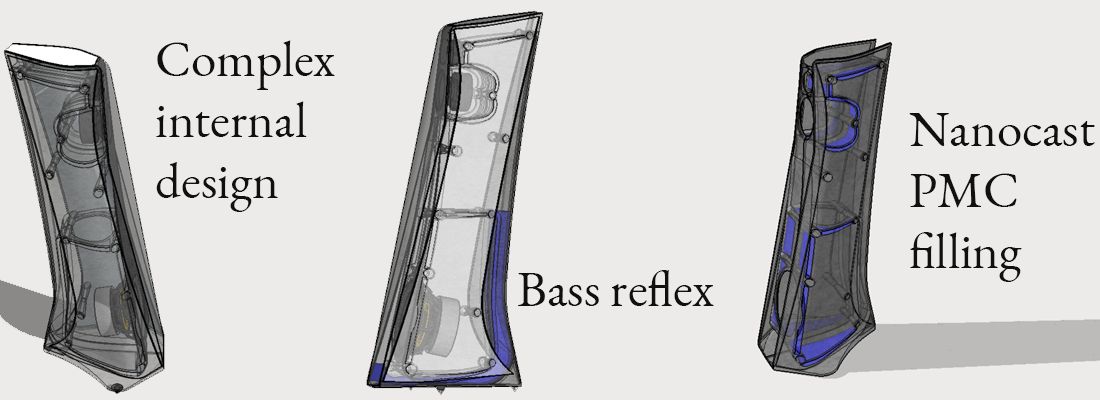
The basis for the leap in performance of these new speakers is in the proprietary material used for the cabinets. Rather than relying on popular materials such as wood, aluminum, or fiberglass, Aequo Audio developed its own nanotech composite material, Diluvite.
Stiffness and Damping are both desired when fighting off unwanted vibration. However, improving stiffness almost always means simultaneously lowering damping, and vice versa. For instance, extremely stiff carbon-ply epoxy laminates and engineered ceramics can provide double or triple the stiffness of steel at much lower density, but fail to dissipate energy when put into resonance.
Diluvite is a castable material twice as stiff as aluminum, yet it offers ten times better damping. It is also extremely resistant to vibration. And even when the material is excited, it immediately converts vibration into heat. Moreover, Diluvite is the first material in the world able to eliminate any resonance, as measured from 0,1 to 100.000 Hz, with complete consistency across the entire frequency range. This uniformity in damping is very important for achieving uncolored, natural music reproduction.
Next to its superb acoustic qualities, the Diluvite material enabled a truly ‘form follows function’ 3D design method so many loudspeaker designers rave about, but very few actually have the luxury to implement. Starting the design with an optimal acoustic shape and perfect driver time alignment, Aequo ended up with a complex organic shape, ultra-low baffle diffraction, and greatly increased acoustic-, phase-, distortion-, and dynamic linearity.

Adamantis and Ensium
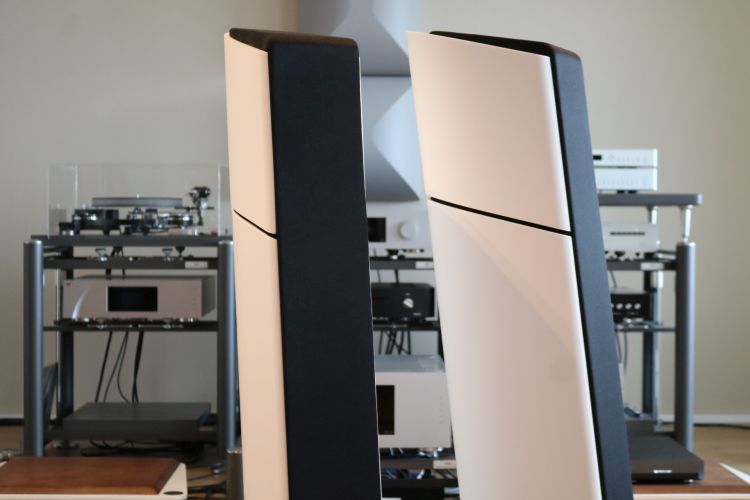
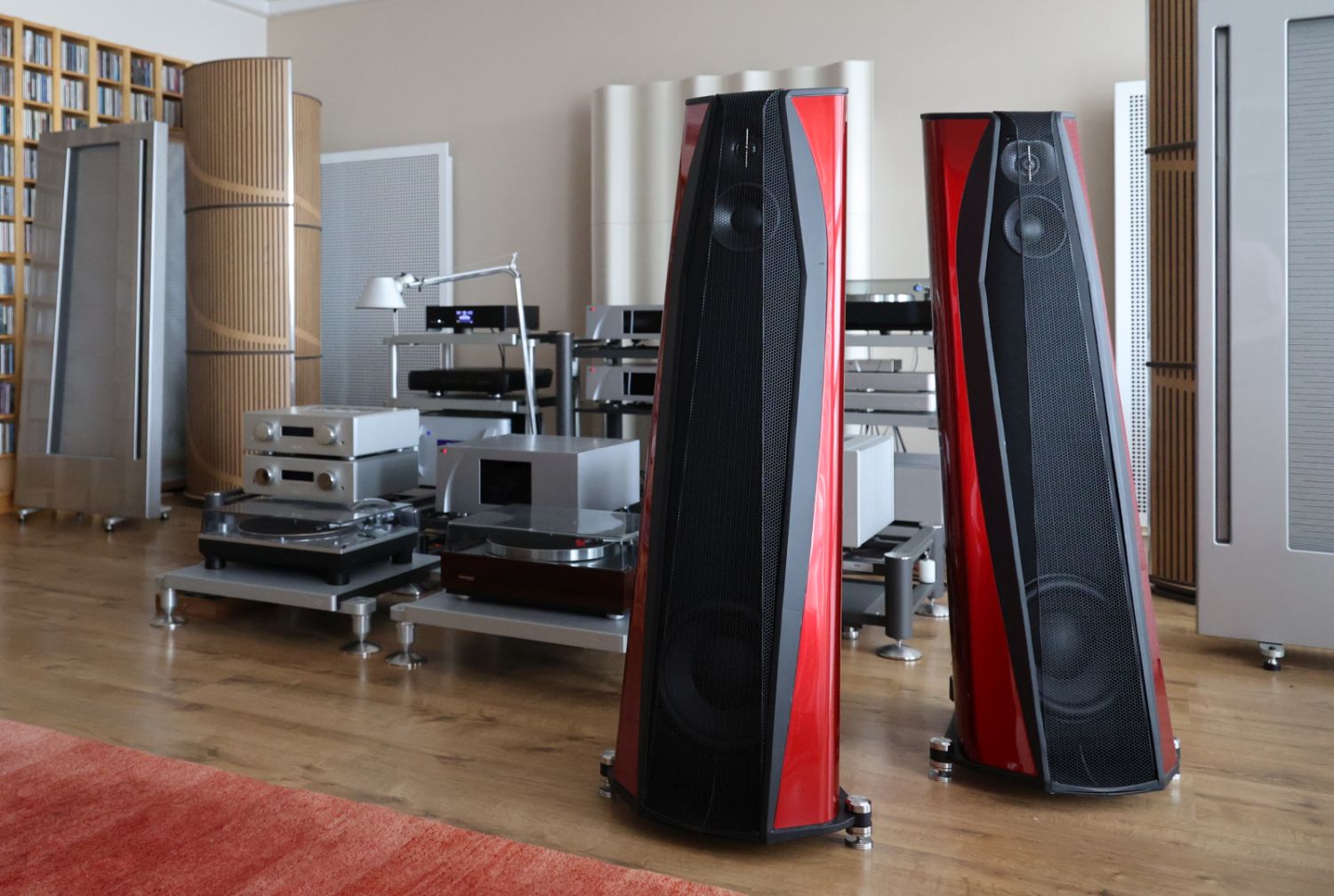
The Adamantis and Ensium look almost identical, and they are tuned to achieve the same sonic ideals, but with a very significant difference. Adamantis is passive, while Ensium has ARPEC (Analog Room and Placement Extension Controller) assisted bass. (see the ARPEC section further below for more information). Both speakers are connected to an amplifier like regular passive speakers, but Ensium has an additional power cable and active bass. They use the same cabinet, tweeter, and woofer, but the midrange driver differs.
Adamantis uses a “Mega-fast 5-inch Nomex-coated paper pulp composite” driver, while Ensium uses a “Mega-fast 5-inch mineral-filled PP composite” driver, to ensure optimal sensitivity matching for both models. According to Aequo Audio, the two drivers actually sound very similar.
Both models are 3-way designs with super-wideband phase alignment, using similar crossovers in separate enclosures made with high-quality Danish and German components, including special-order precision-value air-coils in a symmetric topology, with only audiophile PP (super)-caps and low-tolerance Danish super-resistors.
The Adamantis’s frequency response is specified to achieve an already amazing 20 Hz – 45 kHz -3 dB in-room response, with a nominal impedance of 4 Ohms. The bass-assisted Ensium is specified to achieve an even more ludicrous 16 Hz – 45 kHz -3 dB in-room response, with a super-amplifier-friendly nominal impedance of 8 ohms.
The Ensium has a power input and single-wiring speaker terminals. The Adamantis has no power input but supports bi-wiring and bi-amping.
Both models are 116 cm tall, 42 cm wide (including footers), and 52 cm deep, and both weigh 129 kg.
ARPEC
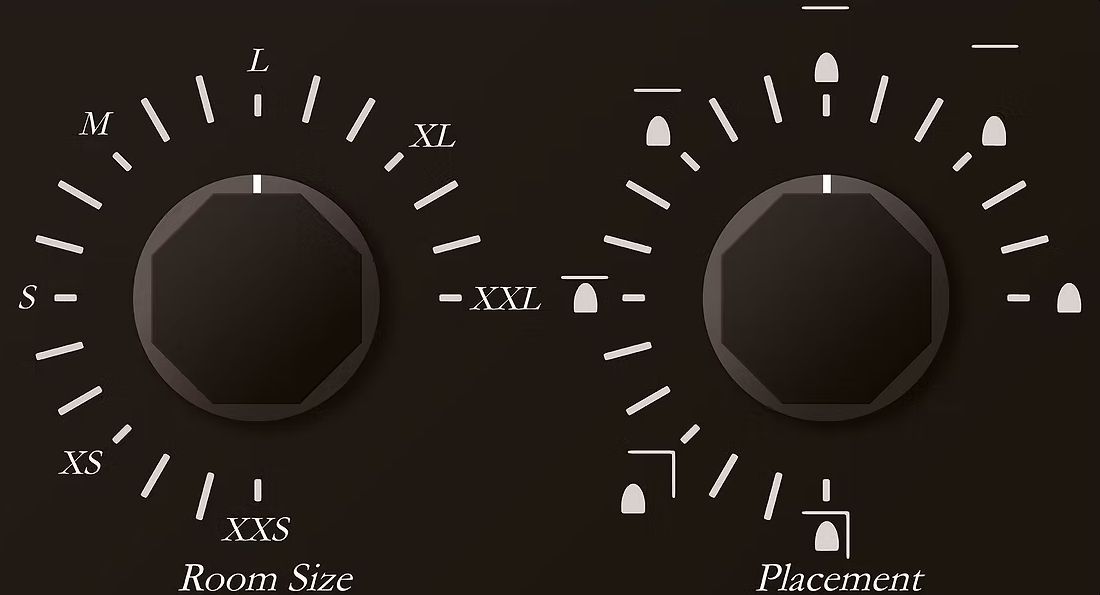
ARPEC (Analog Room and Placement Extension Controller) is Aequo Audio’s audiophile solution for addressing bass issues in any room size or shape, and it goes far beyond a simple EQ. The incoming full-range signal is used by the analog ARPEC system to add current (Amperes) to the input voltage at low and bass frequencies, allowing easy optimization for room size and placement. Without DSP or any digital component in the signal path, ARPEC maintains perfect time and phase alignment and improves time alignment in any room.
Room and placement adjustments are easy and intuitive, made by turning two stepless rotators on each loudspeaker. In essence, the two complex, dynamic crossover curves are steered by the ARPEC’s two intuitive rotary dials.
One rotator adjusts the room size, ranging from XXS to XXL; the other adjusts for speaker placement, ranging from standing in a corner to a position completely free of walls. These powerful adjustments allow the speakers to be much more freely positioned while still achieving excellent sound in virtually any room, even in very difficult or asymmetrical rooms.
Ensium Description
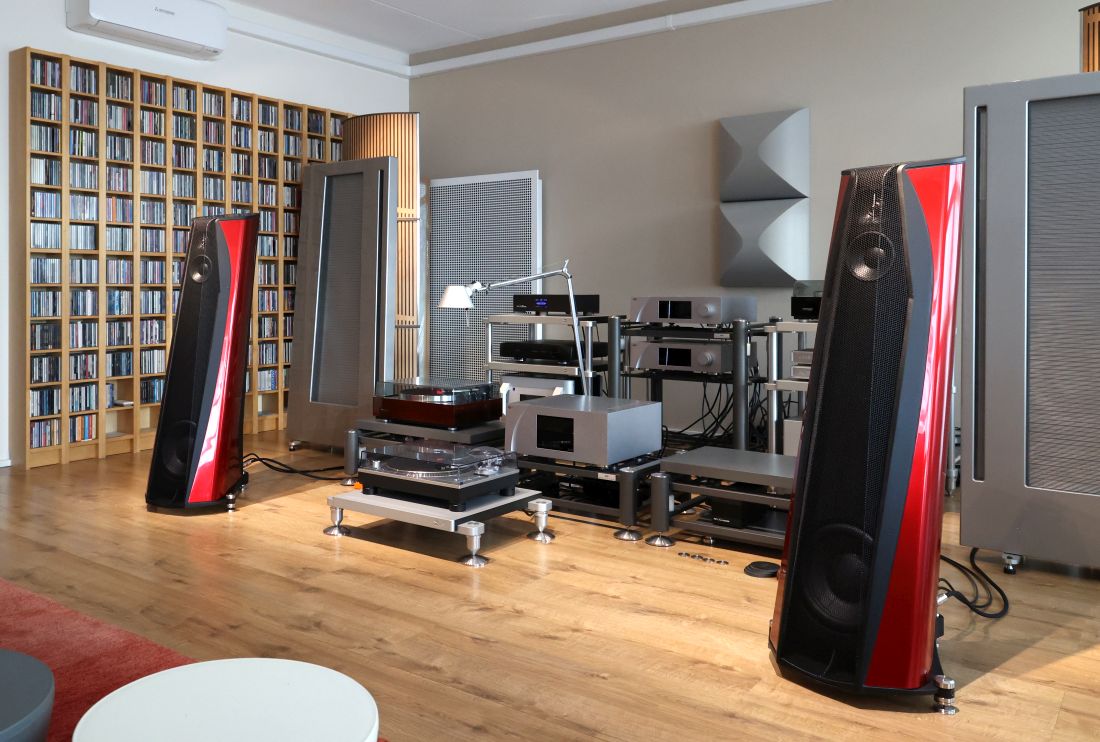
The bass-assisted Ensium is an even bigger powerhouse than its passive sibling, Adamantis. With an efficiency of 91dB at 8 ohms (vs 89dB at 4 ohms), it is bolder, more sensitive, and more advanced.
Armed with Aequo Audio’s proprietary ARPEC active analog bass system, Ensium offers placement flexibility and seamless integration into any listening space in minutes. ARPEC allows tuning the speakers to be as neutral as one might expect from a top-level mastering studio, without needing subwoofers or the typically complex room treatments. And best of all, without the use of sonically harmful, complex DSP solutions. The speaker operates entirely in the analog domain, thus effectively avoiding any signal delay. Besides offering full control over bass behavior, the Ensiums are very easy to drive and do not require a hugely powerful amplifier to deliver their best.
The built-in power amplifiers are very powerful yet very neutral, allowing the speakers to bring out the best in over-forgiving or slower amplifiers, as well as in more analytical equipment. The amplifier sections switch on and off automatically in response to the input signal. The review pair switches on within 3 seconds of the music starting, and switches off again after 8 minutes. Paul of Aequo Audio indicated that they are considering increasing the standby window to about an hour.
The midrange and treble operate purely passively and are directly connected to the speaker terminals, while the bass driver is driven by the ARPEC system, powered by the internal power amplifier. The result: loudspeakers capable of achieving excellent performance and room integration in virtually any room.
The drivers are developed in close cooperation with AudioTechnology – by Skaaning. The collaboration led to various prototype combinations of motor designs, both underhung and overhung, suspensions, and cone configurations, which ultimately led to the current drivers that are produced in controlled batches in accordance with Aequo Audio’s precise specs.
More information about Per Skaaning and AudioTechnology can be found here: https://audiotechnology.dk/
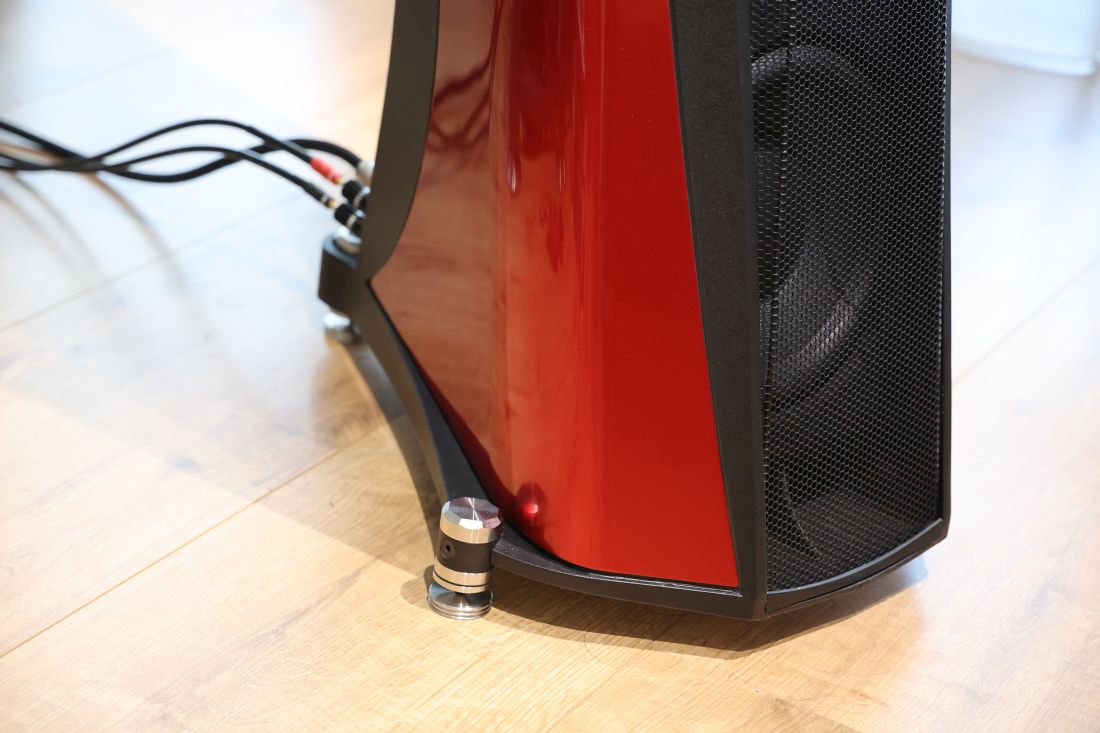
The woofer section employs a lightweight, super-fast, low-inductance 10.5-inch (sub)woofer with a mineral-coated alloy cone. It has a very low-distortion motor with a heat-resistant, anodized voice coil on a temperature-regulating titanium voice coil former, and a custom ultra-light fiber dustcap. All of this reduces self-induction and eddy-current losses, saves weight, and increases speed by 20%. The woofer can travel up to 28 mm peak-to-peak in a symmetric magnetic field, and it stays clean up to 900Hz, with the first breakup at 2kHz, well above its active region. A bass-reflex port tuned to 19Hz delivers deep bass while avoiding the chuffing of higher-tuned ports. Special attention was paid to time alignment to achieve ideal coherence between the bass and the midrange.
When designing a speaker with a strong focus on coherence, the assumption might be that the best position for the woofer would be as close to the midrange as possible. However, as Ivo explained, the speakers behave much more predictably across a wide range of rooms when the woofer is positioned near the floor. This is because room modes become twice as severe with equal wall distances, and if a woofer is placed at the top (where the midrange and treble need to be to produce the proper stage height), it’s also almost halfway up the room’s height. Thus, it would excite far more severe room modes in that position than if it were vertically asymmetrical. Careful attention was paid to the crossover and the speaker’s phase behavior. To time-align the drivers relative to the listening position, the midrange and tweeter are positioned farther back than the woofer. To accommodate various seating heights and listening distances, the rear spike is height-adjustable.
According to Aequo Audio, the Ensium’s maximum linear output is higher than that of a typical dual-10-inch closed-cabinet speaker or even a triple-9-inch ported speaker, and in practice, more comparable to a closed-cabinet speaker with three 10-inch bass drivers. While it’s tempting to take such claims with a grain of salt, I can confirm that the bass does actually dive right down into what’s normally considered subwoofer territory with utter authority. The Ensium is specified at an absolutely ludicrous 16 Hz – 45 kHz (-3 dB in-room response), with a nominal impedance of 8 ohms.
You read that right: 16 Hz at -3 dB! Even for a subwoofer, this kind of performance is not a given. Such output at the extreme end of the frequency spectrum is achieved only by the biggest and best of the breed.
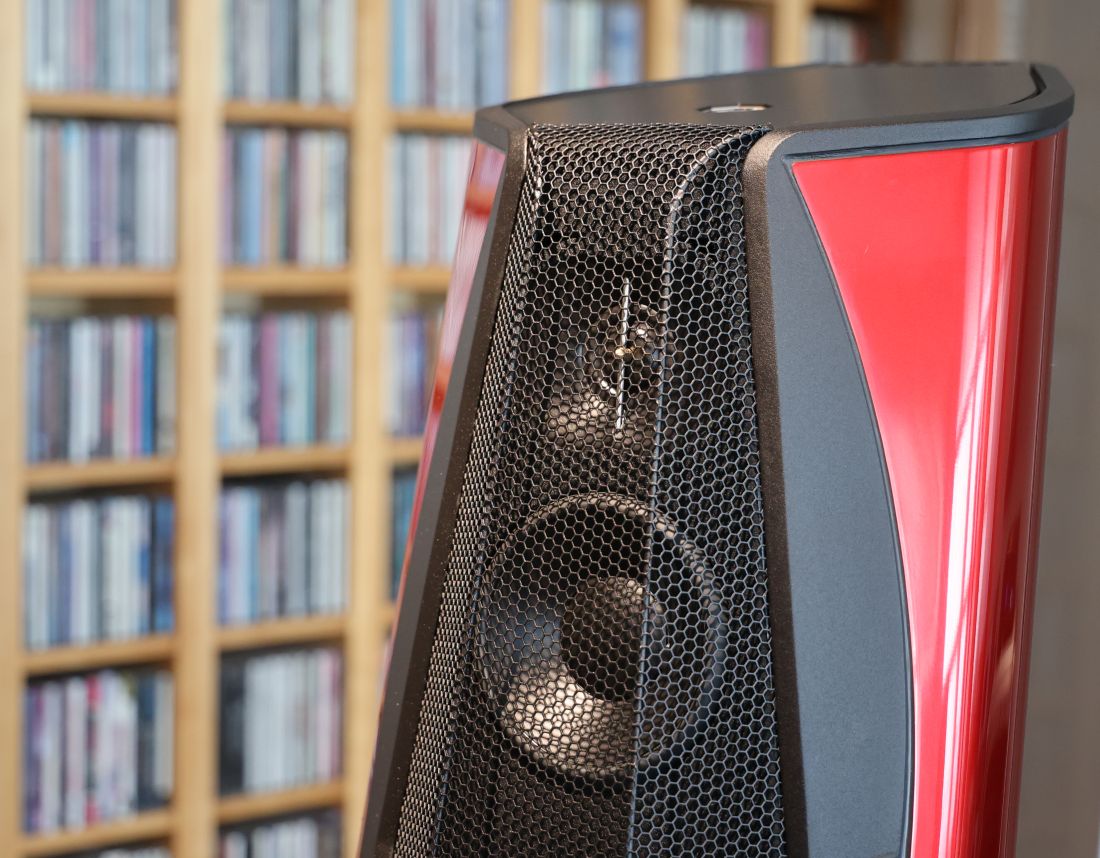
For the upper bass and midrange, a fully symmetric, super-fast 5-inch mineral-filled PP composite cone driver is used, identical to the one used in the Stilla. It operates within a closed box inside a 3D-optimized enclosure.
The -6dB crossover point where the midrange driver starts to take over from the subwoofer was at 100Hz with the Ensis. With the Stilla, this was raised to 130Hz, and with the Ensium, it is at 170Hz.
This frequency was chosen for the following reasons:
- It allows incorporating all affected frequencies for boundary gain more effectively.
- This achieves full, correct time and phase alignment by positioning the woofer at the same distance from the listener as the midrange, allowing a crossover at higher frequencies without loss of point-source quality.
- Thanks to the woofer’s high inherent speed, the resolution at 100-170Hz does not diminish.
- The midrange now needs less excursion and remains much cleaner at high volumes, with significantly less distortion overall in the upper bass/lower midrange area.
- It’s great to be able to move more volume more quickly, with better timing, and with more upper-bass slam, power, and realism.
- The overall system now has a higher linear dynamic output, where otherwise the midrange would have been the weakest link.
- In various asymmetrical rooms and with the corresponding ARPEC Room-size and Placement settings, the acoustic phase in the upper bass is now better adjusted, so little to no difference remains in asymmetry regarding the reproduction of, for example, cello, deep male voices, etc. Further, after calibration, it no longer disrupts the ultimate imaging and realism of these instruments, including their relationship to higher harmonics, although these may be less affected by the asymmetry of room/wall boundaries that mainly influence lower frequencies.
- The 170Hz range is probably not coincidental, as it also falls within the crossover region of many of the world’s best three-way speakers. And it falls within the range where it is desirable for the ceiling to serve as a boundary as well.
Next: Description continued, Available Finishes, and Listening