Listening
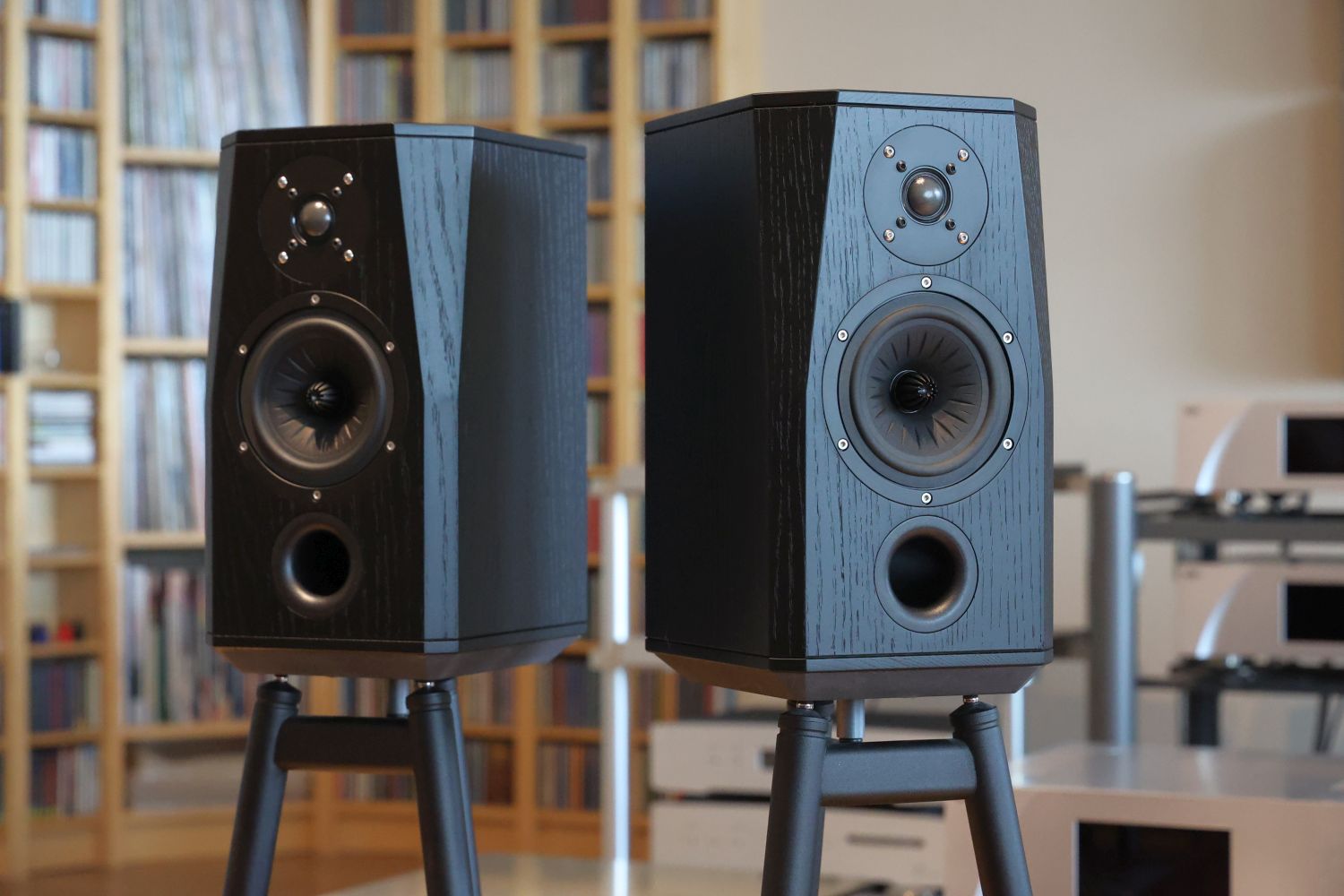
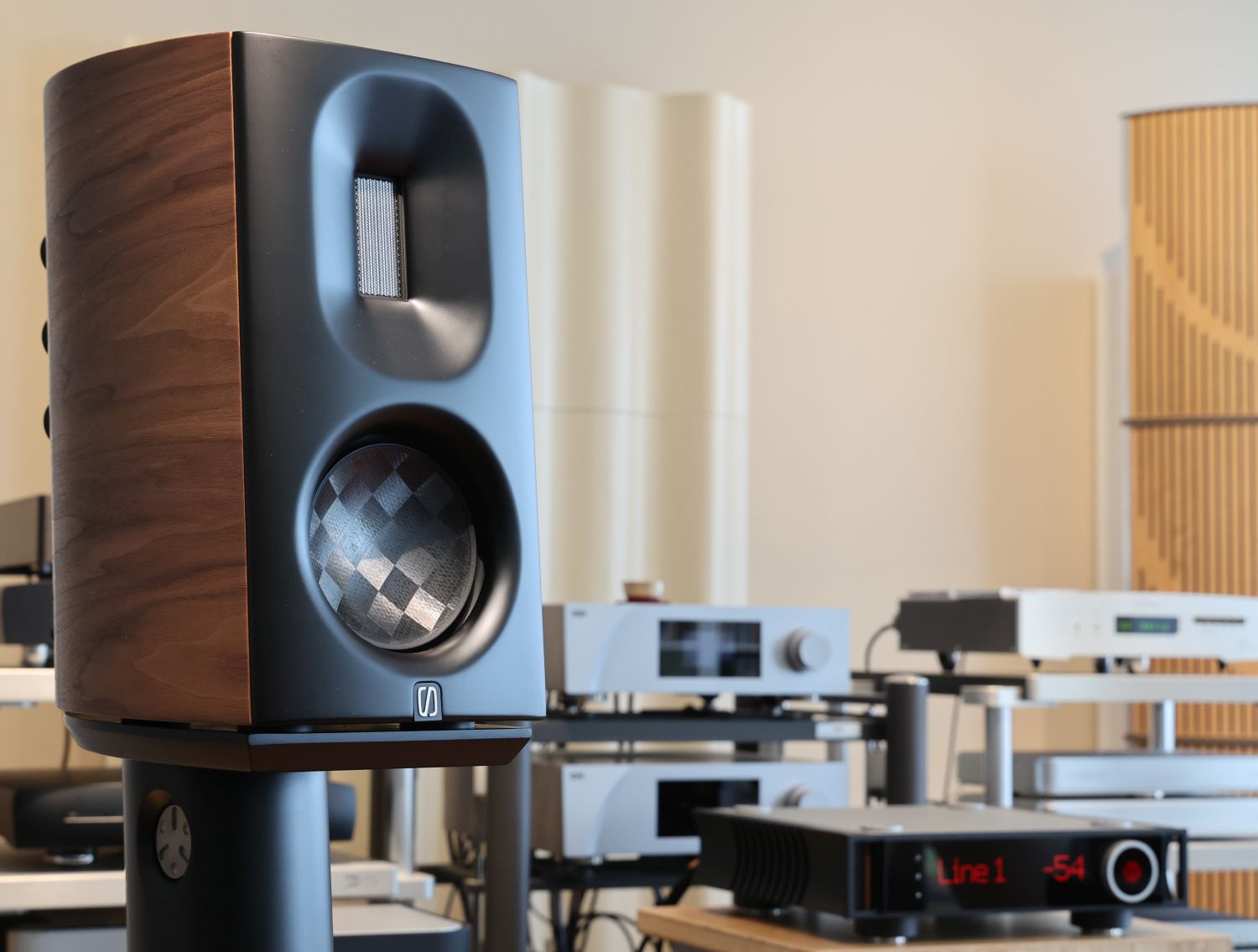
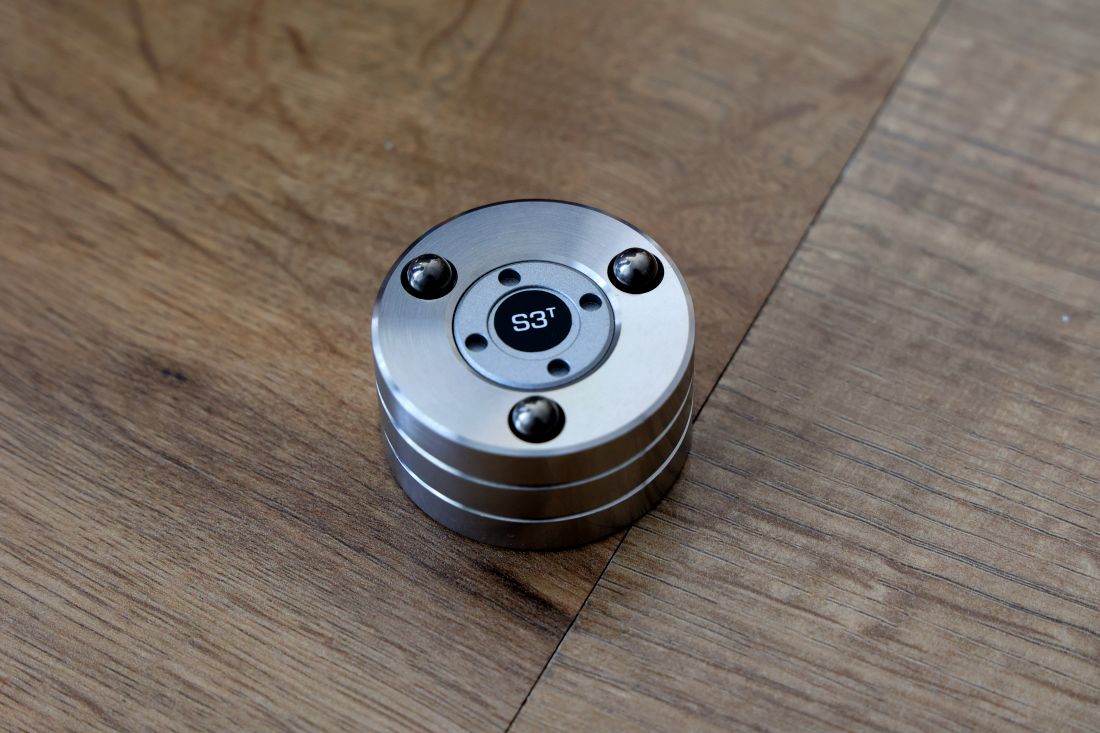
I used the A1s with the included Axxess Noir Resonance Control devices that fit into recesses between the speakers and stands. Ohm Audio also supplied two sets of Ansuz S3T Darkz footers and Titanium Balls to use between the stands and the floor. You can also place the stands directly on the floor, without Darkz, but I will start with the ideal scenario and report on the differences without Darkz later.
The Darkz S3T is the most affordable Darkz model, but it’s a strong performer. Depending on the model, higher-tier models deliver a progressively more refined, warmer, and richer sound. Instead of Titanium balls with Darkz, you can also use the more upscale Tungsten balls for a fuller, lusher sound. Darkz and Axxess Noir Resonance Control devices are interchangeable, and you can achieve a considerable upgrade by also using Darkz between the speakers and stands.
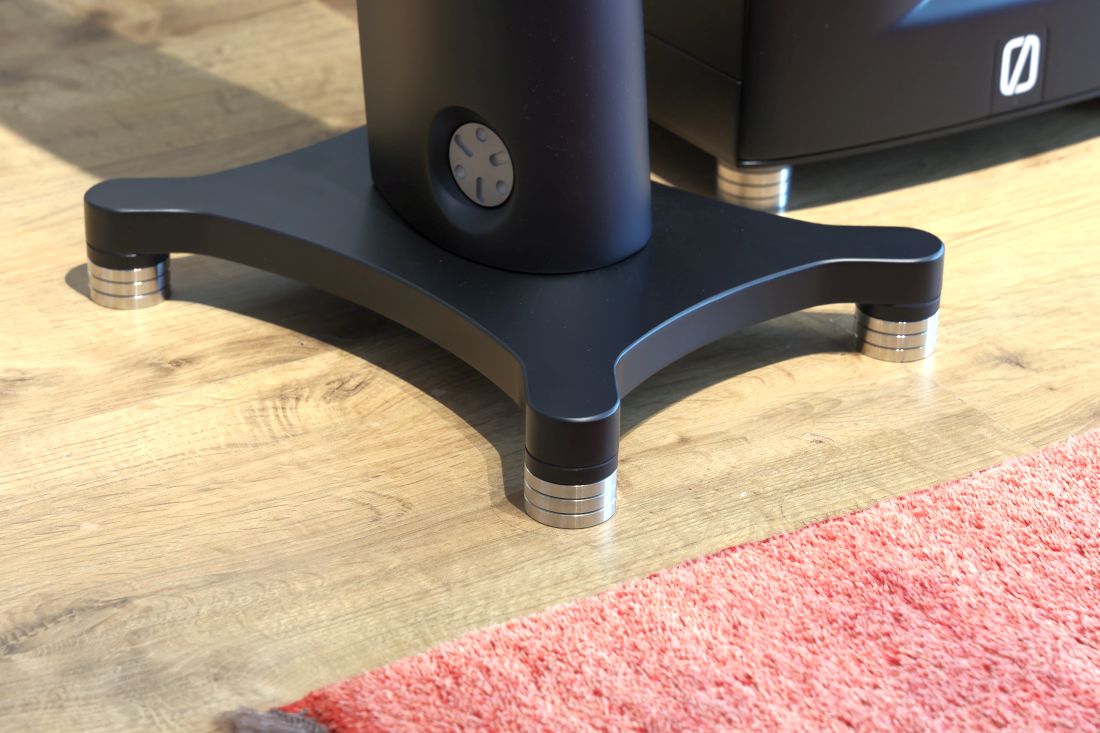
With Ansuz Darkz S3T and Titanium Balls between stands and floor
After using many speakers in my listening space, ideal average speaker positions emerged, and new speakers rarely end up in a different position. Full-range dipoles such as the Apogees behave a little differently and have their ideal positions a little closer to the back wall. But to get the flattest, cleanest response from dynamic speakers in this space, they usually need to be relatively close to one another, and I need to sit relatively close to them. I still experiment with new speakers around these ideal positions, but the Børresen A1s behaved very predictably, and their ideal positions were exactly in the regular sweet spot: 226 cm tweeter-to-tweeter and 277 cm tweeter-to-ear. That’s a ratio of 81,5%, very close to the theoretical ideal of 82-83% for the best focus and imaging. And sure enough, these speakers focus exceedingly well, easily on par with the very best speakers I have heard in that regard.
Starting with my default Driade Premium Flow speaker cables connected to the Grimm Audio PA1 monos, the speakers made a great impression from the very first notes. Within minutes, they had me convinced of their excellence. They sound beautifully uniform and very well balanced. They are uncolored and technically impressive, but not bland or clinical, and emotionally captivating.
Regular readers know I am especially fond of ribbons, and that’s one reason my main speakers are Apogee Duetta Signature magnetostats, but the mere presence of a ribbon tweeter doesn’t guarantee good sound. The driver also has to match the woofer seamlessly, and the cabinet and crossover can make or break the outcome. Also, the ribbon itself can still spoil the end result by sounding metallic or whitish. The A1, however, does not drop the ball anywhere.
A few years ago, I reviewed the 12.000-euro Børresen Z1 Cryo and the 43.000-euro 01 Silver Supreme Edition. Although I was impressed by the 01, I felt the Z1 had a few flaws, most noticeably coloration and a phase-shift effect in the midrange. Nevertheless, at its price, I still found it offered good performance.
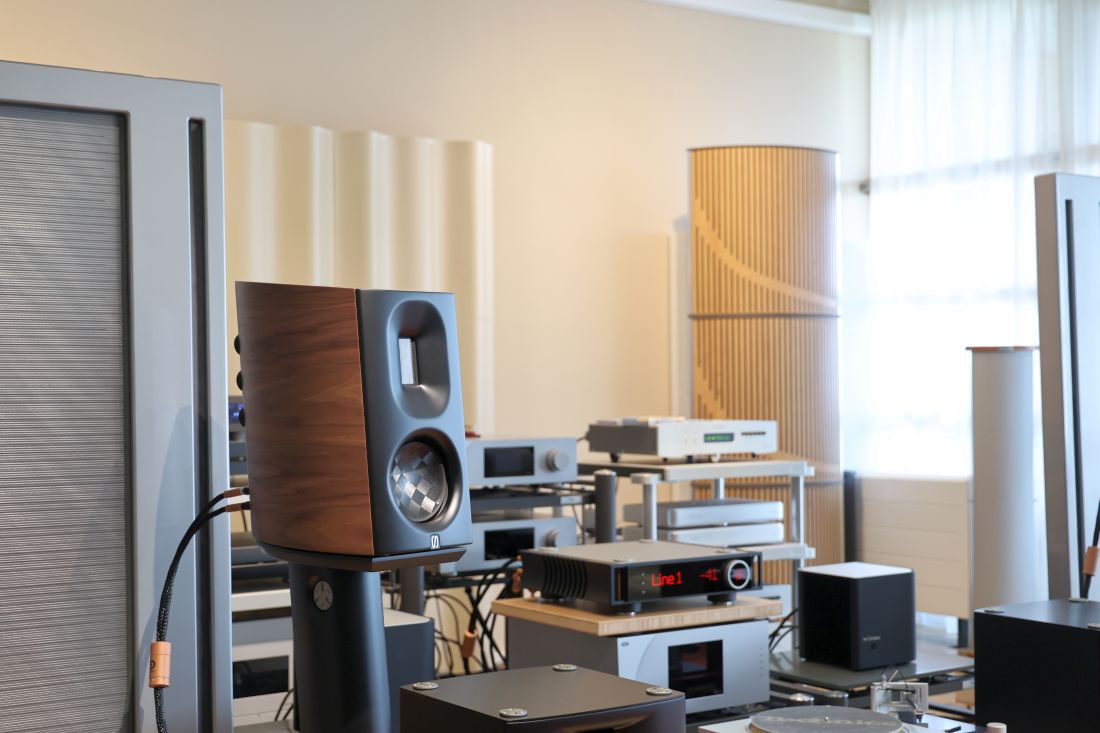
With the A1, however, there are no ifs or buts, no coloration, and no cupped-hands effect, just great performance that had me convinced right from the start. The treble and midrange are simply beautiful. Few speakers have such detailed, open, transparent, lively, and expressive treble that is simultaneously so delicate and refined. More often than not, when the treble is sweet, it’s also dull, lacking bite or excitement, or masking information, but that’s absolutely not the case here. The speakers are actually very revealing but without becoming fatiguing, harsh, or edgy.
The treble is easily as good as from my Apogee Duettas or Centaurs. I know these are old speakers (although the Duettas were recently refoiled), but for some reason, even expensive speakers struggle to match the treble performance of these classics. Of the current speakers I’ve owned or reviewed, only a few match this treble performance, such as the Magico S1 MkII (as well as all other current Magicos), the Apertura ribbon models, several Marten models, Diptyque, some Magnepans, and Analysis.
Naturally, the A1 monitors fall a little short on deep bass compared with the Apogee Duettas, which you notice most in the 30 Hz to 60 Hz range. Otherwise, the A1s hold their own remarkably well. They don’t provide exactly the same experience as the Duettas, but I don’t miss anything except authority and scale, which isn’t surprising given their beautiful ribbon tweeter.
Even more important than treble performance by itself is how the unit transitions to the bass driver. The ribbon unit covers the treble and upper midrange, but the lower midrange is divided between the ribbon and the bass driver, and this can still let an otherwise great design down. But here, too, the A1s perform splendidly. The crossover provides a seamless transition between the drivers, with zero phase issues as I observed with the Z1. The two drivers really sound like one, and that’s not a given when using two such very different materials.
As mentioned, my speaker placement and listening position are optimized to minimize room influence and allow full-range speakers to sound as clean as possible. This also means that, unlike in most regular households (which aren’t thoroughly treated single-purpose rooms like mine), this room isn’t adding gain to a speaker’s bass output. With full-range speakers, that is desirable. Smaller monitor speakers, however, usually rely on some sympathetic room gain to fill out the bass response.
Even if the bass doesn’t extend as deeply as a typical floor-standing speaker, the compact A1s deliver full-strength, high-quality, mature bass down to 50 Hz, then taper off while still extending below 40 Hz. Even without room gain, the careful balance of tonal fullness, body, and neutrality keeps the speaker from sounding thin. That is, unless they are used in a massive space, I presume. That’s where the Børresen BM2 Bass Modules come in, but I’ll cover that in a separate review.
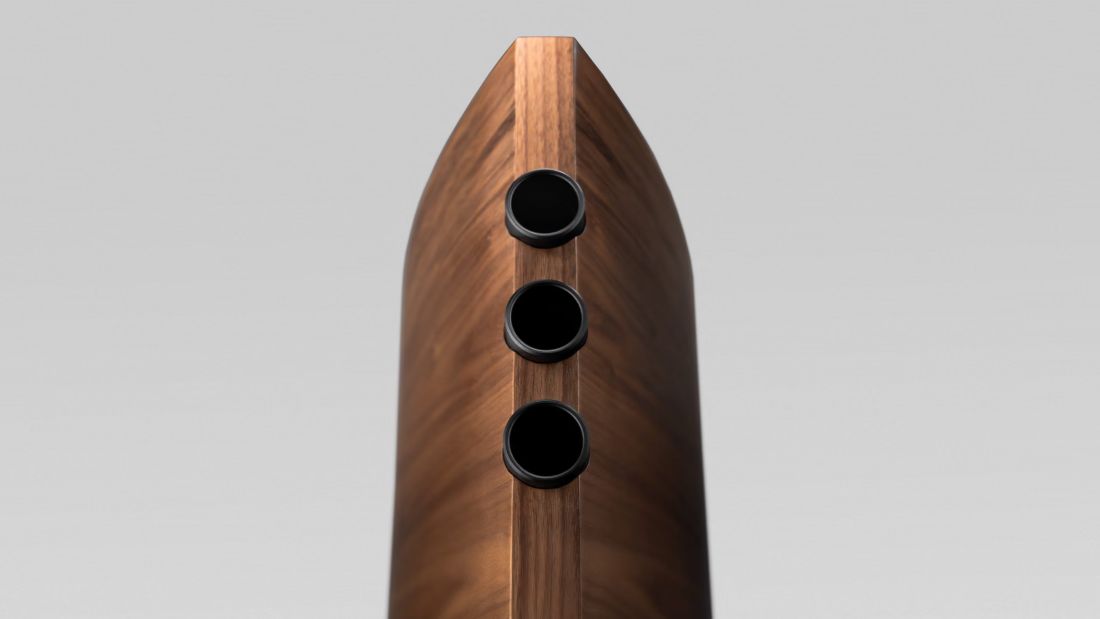
The A1’s bass is propulsive and fast, crisp, nimble, and agile, with a sensible amount of body that is uniform throughout the entire bass range. As a result, the bass is neither lean nor fat or thumpy, and it feels complete, without an artificial bump to create the illusion of deep bass.
If I have to choose between excellent bass that doesn’t go extremely deep, or deeper bass that in turn is thumpy, thick, or colored, I always choose the former. Sure enough, a powerful bass thump at 60Hz can be tempting with some tracks, but sooner or later, it becomes annoying. With the A1, the bass is very fast, linear, and precise, and pretty much the opposite of fat, and yet it is not shy, thanks to its robustness.
Even without a direct comparison, it’s crystal clear to me that the A1s comfortably outperform the Z1s. And not just by a little, it’s a different ball game! I’d say the new A1 actually sounds much closer to the considerably more expensive 01, yet it costs 2.000 euros less than the Z1 Cryo.
No matter what aspect I focus on, the speakers perform so uniformly well that there’s simply nothing to nitpick, and that is quite a rarity.
Both the Grimm PA1 and CH A1.5 drive the speakers beautifully and effortlessly. The A1s don’t seem demanding, though I probably wouldn’t notice if they were with these amplifiers. The Grimm PA1s maximize the speakers’ soundstaging with superb layering and 3D depth, delivering a compellingly organic, free-flowing presentation. The CH A1.5, on the other hand, provides even better woofer control, delivering crisper bass, along with greater overall robustness and authority.
Compared to the Apogees (or other dipole magnetostats such as Analysis, Diptyques, or Magnepans), if I’m being strict, the A1s have just the slightest bit of wooden character throughout the bass and midrange, but I need to stress that it’s very subtle and absolutely no problem. And of course, it’s not fair to compare them to a speaker that essentially has no cabinet. In any case, this tiny bit of character enhances the music’s naturalness and realism in timbre, and I honestly forget about it already during the first track. In fact, these speakers are so well-balanced, revealing, and engaging that I left them connected after finishing the assessments, used them for a few casual listening sessions, and even used them to make assessments during another review.
After getting a good sense of the speakers’ performance in my system, it was time to see how they paired with an amplifier from the same parent company: the Aavik I-188.
Next: Aavik I-188 and Ansuz A3 Speakz