Apogee Duetta Signature – Part 1

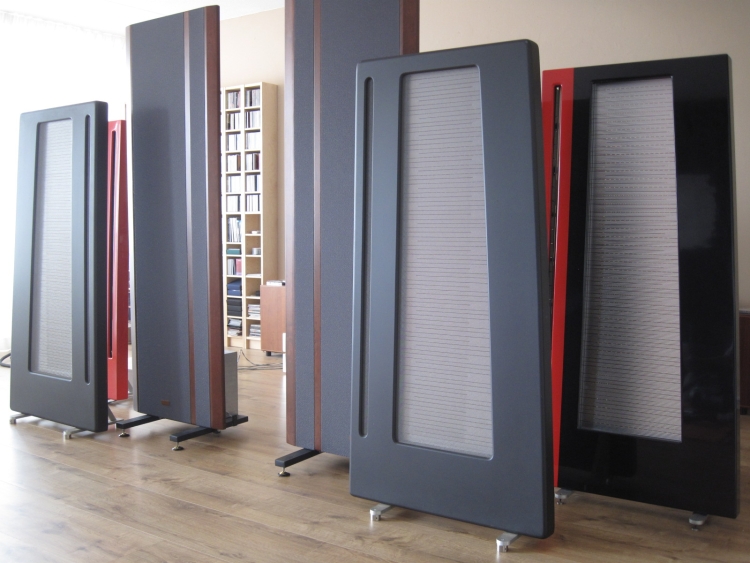
Van Den Hul Skyline Hybrid
Toine chose to use van den Hul carbon-lined speaker cable (Skyline Hybrid) and hard-soldered this to both ends of the crossovers, which meant that at first I could not connect my usual Transparent Reference XL speaker cables and had to just use the cheap vdH cables. Listening to the speakers like this made me rethink loudspeaker cables in general. With the Duettas playing so well, would you really need exotic cables to get the best from a system? I left further experiments for later while I pondered about adding terminals to the crossovers in order to enable adding my Transparent Loudspeaker cables to the mix. More about that further below.
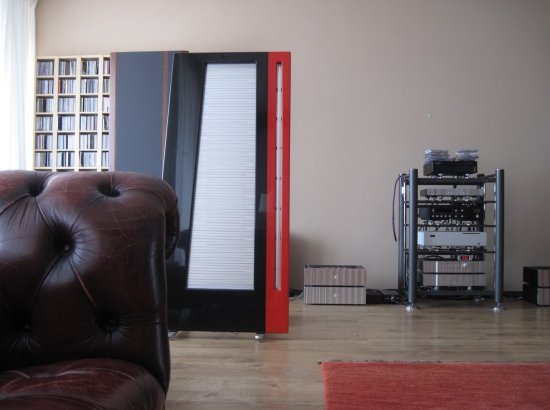
Compared to Magnepan MG3.6R
Comparing these Apogees to the Magnepans makes for some very interesting observations, because in spite of similar underlying technology, the models sound very different and have different strong and weak areas. The Apogees were listened to with their captive, biwired van den Hul Skyline Hybrid cables and the Magnepans were used with their usual Transparent Reference XL speaker cables. This may seem unfair, but things are a little different than one might expect. I’ll explain further below.
Please keep in mind that we are still dealing with Duetta Signatures with unofficially modified crossovers, and that by now (months after this review was written) I feel that using these incorrect crossovers the midrange and lower treble has a hard edge and is too forward.
The first difference between the Duettas and Maggies lies in their dynamic behavior: while the Magnepans are easy on the ear and smoothly restrained, the Apogees are much more expressive, both dynamically and rhythmically, sounding much more akin to a live concert. On the other hand, the Apogees can sound a little overenthusiastic, and can even sound hard, edgy, and sometimes metallic in the midrange and treble. The Magnepans clearly have the advantage with their true ribbon tweeters. The Apogees’ treble is still better than that of most dynamic tweeters, but compared to that of the Magnepans, it is coarse and edgy and lacks fine detail and air. That was a surprise because while I always knew that the Magnepans were very airy, I did not expect the Apogees to be any less in terms of finesse and resolving power.
But smooth and airy treble isn’t the only thing in the audiophile world, and what the Apogees give in return more than makes up for this. Firstly, their unbridled enthusiasm and live-like sound. Second: their bass! Really, I swear that these speakers have the sort of bass that makes one think that the subwoofers are on. Not only did I fall for that: all my friends and visitors did as well. Without exception, they asked if the subs were still on. You will probably not believe what Restored Duetta Sigs are capable of until you hear a pair for yourself. At least I did not believe what they told me prior to my personal experience.
The Duetta’s bass is powerful, fast, articulate, and very deep. The manual states that they go as low as 30 Hz, and you better believe it! Not only do they go that deep; they also manage to have a lot of power that low. Switching to the Magnepans without subs makes them sound like small standmount speakers! Really, this is not an exaggeration: while the Magnepans are very articulate in the bass and also go quite deep, their foils just are not allowed enough excursion to really make waves. The Apogees’ bass foils, on the contrary, can move lots of air and are quite fascinating to observe while playing loud house tracks. Speaking of which: the Duettas love Deep-House and encourage louder and louder playing. The speakers go amazingly loud but do have limits. If you push them too hard, the foil will break up and start to flabber in an uncontrolled manner, not unlike the effect with normal dynamic speakers. The Magnepans handle that differently and like Martin Logans just seem to dynamically compress without any apparent distortion. Apparently, if you then push them further, the Magnepans will blow their midrange and or treble fuses, but I haven’t had that happen to me yet.
But there’s another important difference between the Apogees and Magnepans: forgiveness. The restored Duetta Sigs are very, very picky and not forgiving of mediocre recordings. I suspect that their treble and midrange is more honest than that of the Magnepans. But with roughly half my collection standing out that way, there’s bound to be something else, too. So, while the Magnepans may have some additional treble smoothing going on, the Apogees do add some roughness, in addition to working like a magnifying glass for recorded imperfections. They seem to enhance sharpness similar to the way that is possible using image software like Photoshop. Artificially sharpening an image doesn’t really make it sharper; it just adds edge. While on balance the effect in reality isn’t nearly as bad as I now make it sound, this does have annoying consequences: virtually my entire collection sounds fabulous on the Magnepans, but on the Apogees a lot of CD’s are just not enjoyable anymore. But this goes both ways: loudly recorded, clipped R&B sounds remarkably well-mannered and very enjoyable through the Magnepans and unlistenable through the Apogees while the simplest live recordings consisting only of guitar, piano and vocals can be truly captivating through the Apogees and mildly boring through the Magnepans.
Ultimately I think the Magnepans add some refinement that isn’t really in the recording, but is very pleasant nevertheless. They’re incredibly easy on the ear, as also evidenced by one friend with old, warm-sounding B&W DM6 speakers and another with Sonus Fabers, who both very much enjoyed my Magnepan sound and are both now a little let down with the more accurate/more aggressive Apogee sound. But for me that doesn’t matter. I like what I like. But there’s no denying that the Magnepan’s mild manners can definitely add to the enjoyment. Their restraint, however, can also work against them, turning to a slightly veiled quality and the sense that music isn’t really set free. However, the Magnepans do sound bigger than the Apogees, in all dimensions: they easily fill the room with ambient sound, and they have a very, very wide soundstage. The Apogees have a smaller, more concentrated soundstage but with better focus and depth layering.
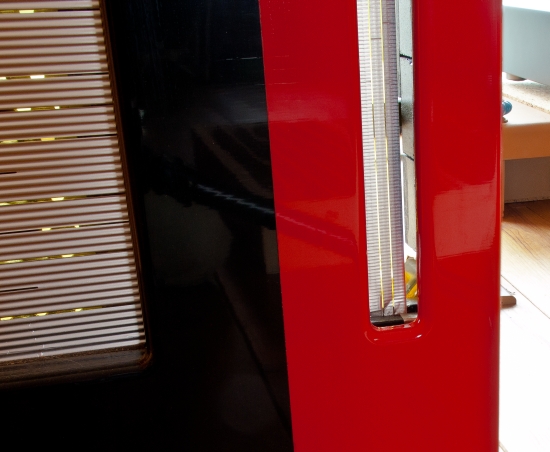
Update January 2014
Compared to original (not modified or refurbished) Duetta Signatures, still the MG3.6R’s are gentler and more fluid in the treble. Soundstaging was indeed sometimes wider on the Magnepans, but not more focused or better layered. On all other accounts, I’d say that the Duetta Sigs totally cream the Magnepans. Importantly, the Maggies aren’t really more forgiving than the original Duetta Sigs at all. It’s just that it can seem this way due to non-standard modified crossovers in the refurbished models.
Amp Matters
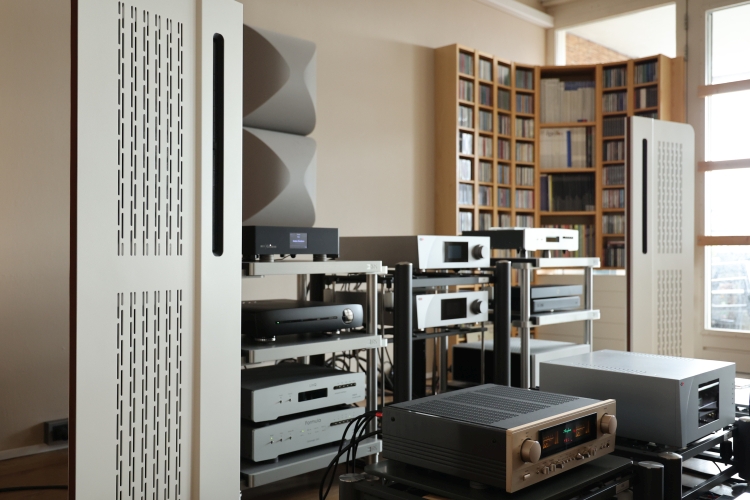
The picture above shows the new Rowland 725 power amps that I had on visit for a review. Read more about it here. But, as you have by now probably gathered, the Duetta Sigs also work splendidly with the Jeff Rowland model 6 power amps. With 16 transistors per monoblock and up to 50 amps of peak power, they have more than enough current to drive the Apogees well. And Rowlands are just what the Apogee-doctor ordered, it seems, because they have absolutely zero grain. A common misconception is that Apogees must be used with Krell amplification. But in my experience using Krells like the KSA250 and KSA400, this will only add more grain and aggression to what already are quite explicit-sounding speakers while not helping in other areas at all. On the contrary: the Krells I compared my model sixes with had less definition, less transparency, and less articulate bass. They did have bass power, but not a whole lot more than the Rowlands. Maybe their bass was thicker, fatter, but not better. Go figure! Naturally I should add that the Duetta Signatures with their purely resistive 3-ohm load aren’t really difficult speakers to drive. But they are quite inefficient, so a good current source never hurts.
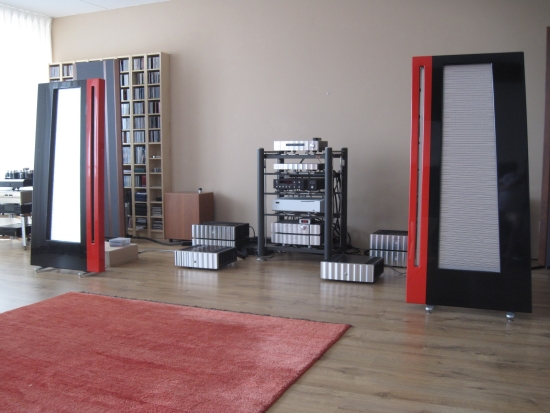
Speaker cable experiments
I assumed that the vDH cable wouldn’t be ‘high-end ‘ enough, so I cut it off at the receiving end of the crossovers, connected some nice terminals and inserted my usual Transparent Reference XL speaker cables. I was in for a surprise: even though I’ve been advocating system synergy for a long time now, as well as the relativity of it all, still the outcome this time was entirely unexpected! Would you believe that the Transparent dulled the sound down to a level where it just wasn’t enjoyable anymore? Sure, there was a richer texture, smoother treble, and a larger, better-layered soundstage, but at the expense of speed and dynamics. I know that all Transparent cables need to be used with care, as some equipment can’t cope well, but since the Magnepans work so well with them, I assumed that the Apogees would do even better. Surely there are better cables than the vdH, but for the moment the Skyline Hybrid performs so well that well after this review was written, I was not in a hurry to try other cables.
Update January 2014
By now I have conducted comparisons with other speaker cables as well as some single wire/bi-wire/ bi-amping experiments.
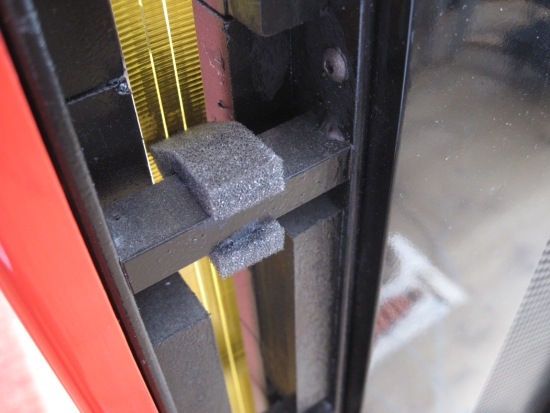
Above: The MRTW ribbon is tilted halfway using a foam piece. This improves treble response when standing up and walking around.
Apogee refurbished versus Apogee original
Lots of friends commented when they were over on how much better the Apogees sounded than my Magnepans. Only one friend (Jan) found that the midrange was simply too rough and hard and preferred my Magnepans. While I can’t deny that this can be the case, they offer a lot in return and mostly they sound fantastic, so at that time I had just settled with their roughness. Jan had had original Apogee Duetta Signatures before, three times even, but never had he heard them the way they sounded at my place. Of course, the refurb has a hand in them being so impressive now, but amplification also plays a very large role. All Apogees are brutally honest, and I think it is safe to say that most models can also sound aggressive when ill-partnered. Jan had a Krell KSA250 at the time. By now I know how the Krell sounds compared to the Rowlands: rough, forward, edgy and lacking finesse and resolution. While the refurbished Duetta Sigs were surely forward and a little hard at times, this wasn’t to the extent of Krell-ness. So, Jan went off to search for a pair of model sixes. Oh, and he proceeded to search for, and buy a pair of Duetta Signatures for the fourth time in a row!
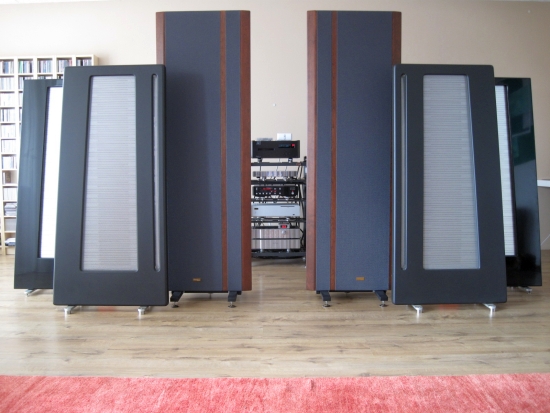
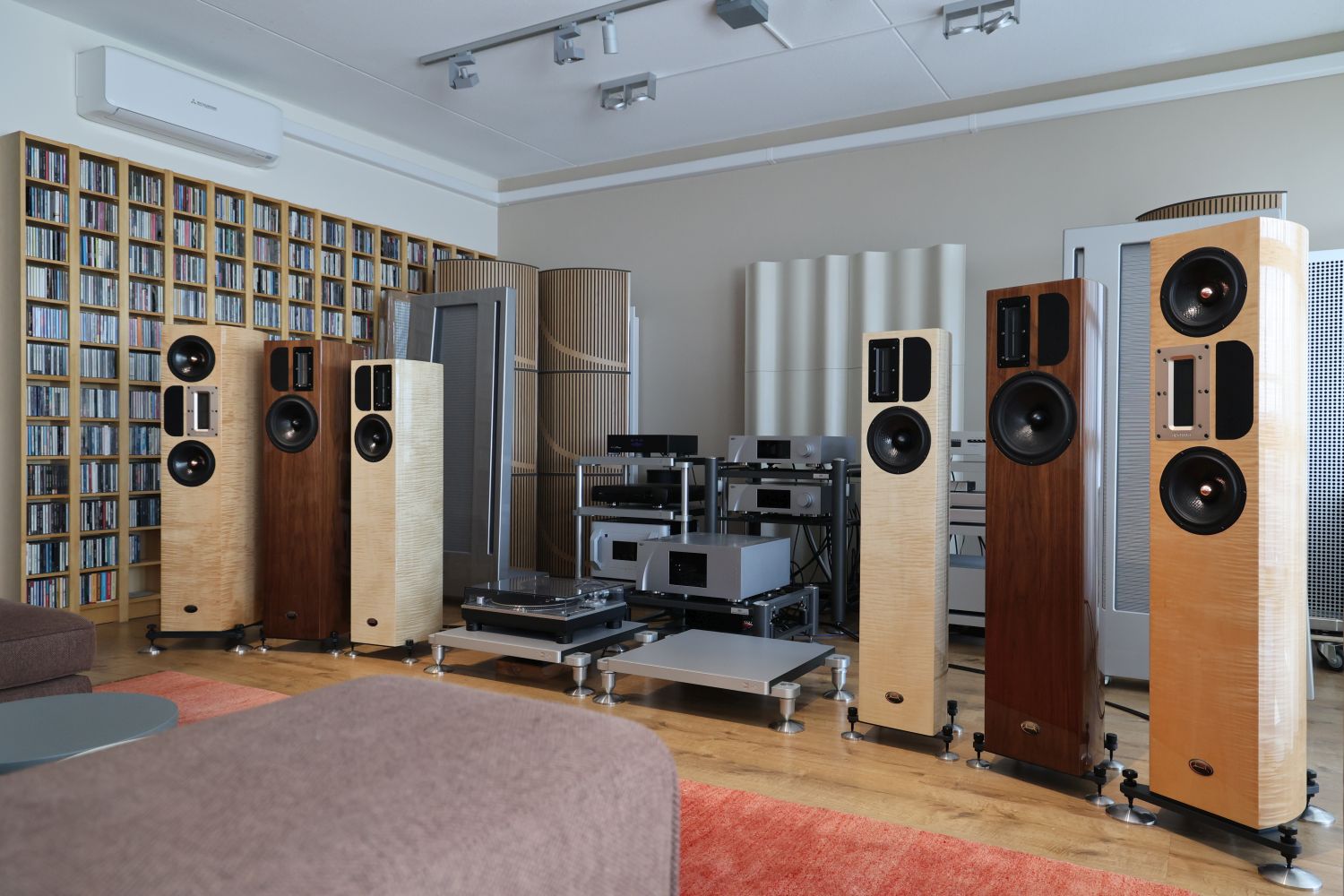
Jan’s set of original Duetta Signatures was the first to be compared to the refurbished ones from JW. I would later get my own pair of original Duetta Signatures, and further below you’ll find a comparison of all three models.

Are companies still doing Apogee Duetta signature repair on the east coast of usa
See this page for the Apogee Acoustics Endorsed Installers: https://www.hifi-advice.com/blog/specials-graz-endorsed-installers/
Dear Christiaan,
thank you for an exceptionally informative review / article on your journey with Apogee Duetta Signature.
One question, just to make sure I understand correctly:
The infamous risk of some “buzz” from the woofer foils on the Apogee Duetta Signature (and other full range Apogees) seem to be present at – high volume levels – *no matter* if it is the refurbished ones with newer woofer foils, or the original speakers with the original woofer foils. Is that understood right?
(In the text it said. “However, I quickly found that JW’s refurbished Duetta Sigs behaved exactly the same way, and also it was mainly the right hand speaker. I later found that even my Divas do buzz somewhat but only when pushed even harder. So I must conclude that with Apogees some buzz is apparently unavoidable. “)
Again, it is really great to have such detailed 1.st hand experience on both original and refurbished Apogee DS from your article.
(Short on tne background: I made a DIY version of the Apogee Duetta back in 1987. (All that budget allowed being a student at that time!) It survived the years, by some stroke of luck and although living a quiet life for prolonged periods – still play well until this day. Recently however I’ve acqiuired a set of the “originals” – Apogee DS (and a large Krell power amp to drive them from about the same time). Although I really liked my home cooked DIY Duetta version… getting the “real thing” (of course) is a serious step up and has, in short, simply re-ignited this crazy HiFi hobby. Truly a lot of fun, and what a joý these speakers are!
Thanks in advance!
Peter
How cool that you made your own magnetostatic speaker! Kudos!
The Apogee buzz applies to the full-range models, not the hybrids. Or, at least, not in my experience. The potential for buzz is offset by Apogee speakers’ immense bass power, and their relatively large foil travel may well be a factor in this. The thing with the buzz is that, when the speakers are in great shape, it is usually inaudible unless you play certain music styles loudly, and actively search for it. Typically, if it is there, the buzz will be evident when playing loud transients followed by silence. In that case, you will hear the transient, a bass stab or drum whack, for example, followed shortly by a fading buzz than sounds like a muffled rattle. My theory is that the buzz is made (more) audible when the foil is allowed to resonate by itself, and it is masked, reduced, mitigated, or maybe even eliminated when there are other sounds reproduced by the foil.
Interestingly, the state of the foam is not a great indicator for whether or not a speaker will have buzz. A friend has Full-range Apogees that, when excited above a certain volume level, buzz at a certain frequency. He has been unable to eradicate this even after refurbishing with new bass foils twice. However, when I listen in his system, I never hear it, unless he uses certain recordings and points it out. I understand one can get fixated on these things, but it is a relative matter.
In any case, this is just a risk that comes with these otherwise quite amazing speakers. However, my refurbished Divas never buzzed, and a friend’s original Duetta Sigs with foam that is totally gone (smudges and sort of melts when touched) have also never buzzed, unless played unreasonably loudly.