Apogee Duetta Signature – Part 1

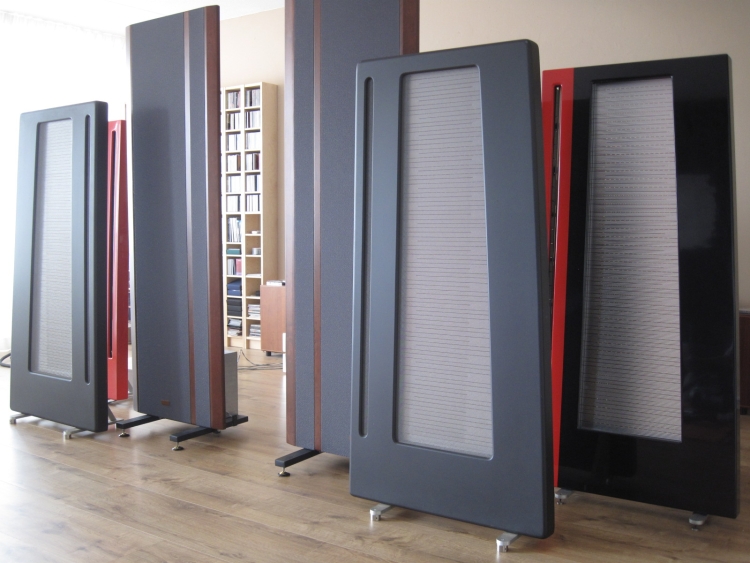
Speaker Comparisons:
Duetta Signature – New foils and new crossover
Duetta Signature – Original (two sets)
Magnepan MG 3.6R
This is the first installment of a multi-part assessment of the amazing Apogee Duetta Signature loudspeaker.
Now, take a deep breath, and dive in!
The refurbished Duetta Signatures under review here are the very speakers that started my Apogee Listening Sessions. Prior to hearing these, I was thinking that they would, at the very best, be similar to my Magnepans, but with added reliability problems. Oh how wrong I was…
Please Note
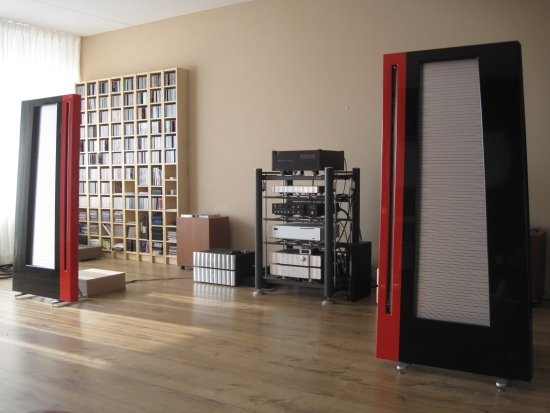
The red and black Duetta Sigs contain the older KLM2 type ribbons and use non-standard crossovers with deviating values.
Disclaimer
Any loudspeaker is highly interactive with its environment, the room that it is placed in. In all but the most perfect rooms, you are listening to a mixture of direct speaker sound and your room, reacting to the speakers. My room is far from perfect and even though I have heard a large number of speakers in it, my experiences need not be typical of results obtained in other rooms. At the very least though, the results as mentioned as part of comparisons with other speakers, should provide something of a starting point. Ultimately though there is just no substitute for listening to speakers in your own setup.
How they arrived in my system
JW, my closest friend and listening buddy has been bitten by the Apogee bug early on. Yet, the only Apogee model he has ever had were the small hybrid Centaurs. So, I teased him for years at end that he wouldn’t be a true Apogee-adept as long as he stuck with his hybrids. In the meantime, I did not want to try any full range Apogee model myself due to the horror stories on the forums about impossible loads and panel buzz.
I don’t quite remember when JW’s change of heart started to set in but at some stage I saw a perfect refurbished pair of Duetta Sigs for sale, and I notified him, saying that this was his moment: a perfect pair of full range, worry-free Apogees. But still he had doubts, so we arranged with the seller that we would first only come for a listen. We brought along Jeff Rowland amplification and had a listening session at the owner’s home. The owner in question was Toine Dingemans (known as ThingMan on forums) who himself had a long history using various Apogees and there are plenty of colorful photos of his setups floating on the ‘net.
The Duetta Sigs under review were refurbished (new KLM2 ribbons) by Henk van der Hoeven, official Dutch restorer. Additionally, Toine himself has made new crossovers, based on the values of the original, but omitting the treble energy switch and associated circuitry, as well as some of the capacitors, effectively fixing the treble on a unique “extra high” setting, which would later prove to be rather too much of a good thing.
Toine’s own amplification at the time of our visit consisted of a passive preamp (I forget the brand), Prefer and vdH cabling and an Usher poweramp, with an Olive music server as source, because his Marantz CD player was away for repairs. First we listened to his own setup. All it took was 1 minute for us to realize that 1. these speakers really do have sublime bass and 2. in spite of some hardness in the midrange and some coarseness in the treble, one of us was likely going to buy these speakers, if not JW, then I would want them myself. For in spite of their roughness, it was clear that these speakers do have sufficient treble openness. They did not sound dark like the pairs of Divas that we heard, or boxy like the Centaur Majors. Instead, there was natural, free-flowing sound with incredible bass power.
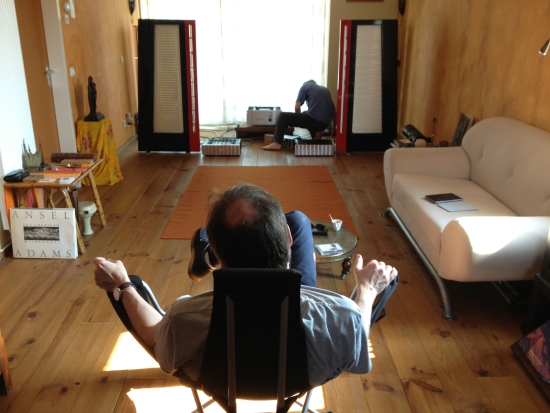
Above: Setup at Toine’s place, with JW in the listening chair and Toine connecting his Olive to the Jeff Rowland Synergy 2i that we brought along, together with the model sixes
We were curious to find out how the Duettas would perform with the Jeff Rowlands, so we switched from Toines own amplification to our brought-along Jeff Rowland Synergy 2i pre and model six poweramps, connected with Transparent Reference XL interconnects but still with Toine’s vdH speaker cables, as these were hard-soldered to the crossovers. The difference wasn’t subtle. All but gone was the hardness in the midrange, treble lost most of its grain and gained air and bass became even tighter. Also, soundstage layering and front-to-back imaging was now greatly improved, as was low-level detailing and overall smoothness. We were pretty impressed, and by now I was 100% certain that even if he did not say anything, JW was definitely going to buy them.
So, JW paid Toine, and we loaded the speakers in his car. We agreed that although JW is the owner, we would first set them up in my system, for an extensive comparison to my own Magnepan MG3.6R’s.
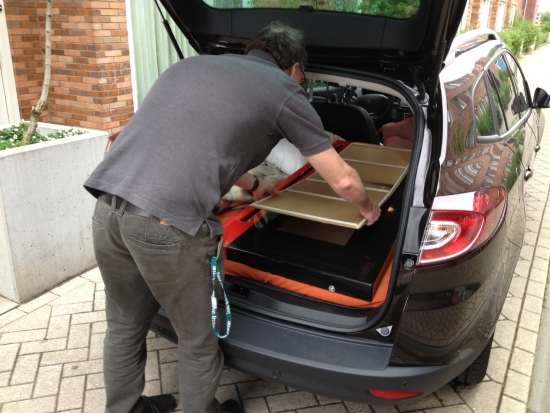
Above: JW loading the speakers in his car, using a protective sheet of thin MDF outfitted with soft draught strips, to prevent scratching.
Refurbished Apogee Duetta Signature compared to Magnepan MG3.6R
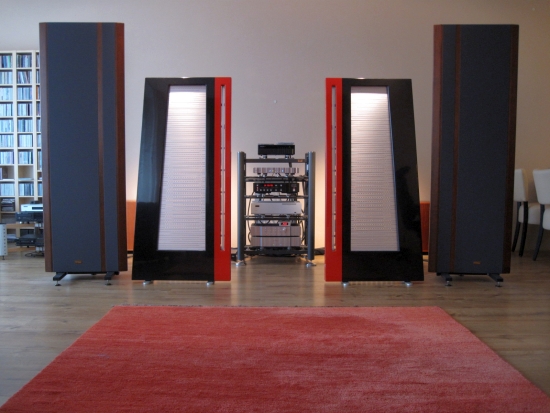
First Listening in my own setup
The Duetta Sigs sounded pretty impressive at Toine’s, but once set up in my own listening room, the sound was even more captivating. Even set up right in front of the Magnepans (that were at first still in their old positions) the Duettas already performed very well on various aspects and only seemed to lack ultimate focus, imaging and soundstage layering. But in this compromised position we already heard more air and a lot more refinement than in Toine’s environment. This is probably mostly due to my components and cabling but likely also a function of the larger area. Set up at first did not seem that critical but in hindsight that was only because I already knew the best positions for the Magnepans and simply put the Apogees in the same spot and worked from there. We would later find that we had already found the best spot for them on that very first evening, which is around 30cm more forward from the Magnepans, with the tweeter ribbons in almost the exact same location and with zero toe-in. Opinions differ on the latter, but I have to agree with the majority that no toe-in sounds most coherent and gives the best balance between direct focused energy and room-filling sound. If desired, some toe in will work toward getting a more focused, direct-coupled sound, but it will also exaggerate bad recordings and would sooner make for listening fatigue.
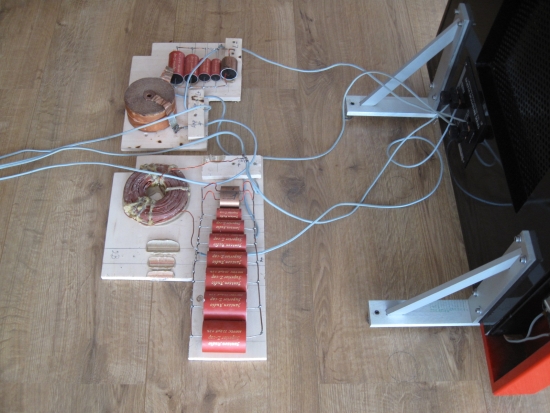
Above: Crossovers as we got them from Toine: low and high on separate boards. I would later make a nice closed MDF box for them, which unfortunately negatively affected the sound.
It is probably good to note at this stage that these refurbished models, with their new crossovers, sound quite different from the original models, but I’ll get into that in detail further below. For now I will only say that the refurbished models sound more upbeat and dynamic, and more “live” than the first pair of original Duetta Signatures, which sound somewhat filtered/rose-tinted.
Tilting proved very important: having one speaker “off” by only a millimeter can throw the balance off dramatically, but this is easily adjusted by glancing from the side across both speakers while turning the spikes.

Are companies still doing Apogee Duetta signature repair on the east coast of usa
See this page for the Apogee Acoustics Endorsed Installers: https://www.hifi-advice.com/blog/specials-graz-endorsed-installers/
Dear Christiaan,
thank you for an exceptionally informative review / article on your journey with Apogee Duetta Signature.
One question, just to make sure I understand correctly:
The infamous risk of some “buzz” from the woofer foils on the Apogee Duetta Signature (and other full range Apogees) seem to be present at – high volume levels – *no matter* if it is the refurbished ones with newer woofer foils, or the original speakers with the original woofer foils. Is that understood right?
(In the text it said. “However, I quickly found that JW’s refurbished Duetta Sigs behaved exactly the same way, and also it was mainly the right hand speaker. I later found that even my Divas do buzz somewhat but only when pushed even harder. So I must conclude that with Apogees some buzz is apparently unavoidable. “)
Again, it is really great to have such detailed 1.st hand experience on both original and refurbished Apogee DS from your article.
(Short on tne background: I made a DIY version of the Apogee Duetta back in 1987. (All that budget allowed being a student at that time!) It survived the years, by some stroke of luck and although living a quiet life for prolonged periods – still play well until this day. Recently however I’ve acqiuired a set of the “originals” – Apogee DS (and a large Krell power amp to drive them from about the same time). Although I really liked my home cooked DIY Duetta version… getting the “real thing” (of course) is a serious step up and has, in short, simply re-ignited this crazy HiFi hobby. Truly a lot of fun, and what a joý these speakers are!
Thanks in advance!
Peter
How cool that you made your own magnetostatic speaker! Kudos!
The Apogee buzz applies to the full-range models, not the hybrids. Or, at least, not in my experience. The potential for buzz is offset by Apogee speakers’ immense bass power, and their relatively large foil travel may well be a factor in this. The thing with the buzz is that, when the speakers are in great shape, it is usually inaudible unless you play certain music styles loudly, and actively search for it. Typically, if it is there, the buzz will be evident when playing loud transients followed by silence. In that case, you will hear the transient, a bass stab or drum whack, for example, followed shortly by a fading buzz than sounds like a muffled rattle. My theory is that the buzz is made (more) audible when the foil is allowed to resonate by itself, and it is masked, reduced, mitigated, or maybe even eliminated when there are other sounds reproduced by the foil.
Interestingly, the state of the foam is not a great indicator for whether or not a speaker will have buzz. A friend has Full-range Apogees that, when excited above a certain volume level, buzz at a certain frequency. He has been unable to eradicate this even after refurbishing with new bass foils twice. However, when I listen in his system, I never hear it, unless he uses certain recordings and points it out. I understand one can get fixated on these things, but it is a relative matter.
In any case, this is just a risk that comes with these otherwise quite amazing speakers. However, my refurbished Divas never buzzed, and a friend’s original Duetta Sigs with foam that is totally gone (smudges and sort of melts when touched) have also never buzzed, unless played unreasonably loudly.