
Listening – Disc Transport
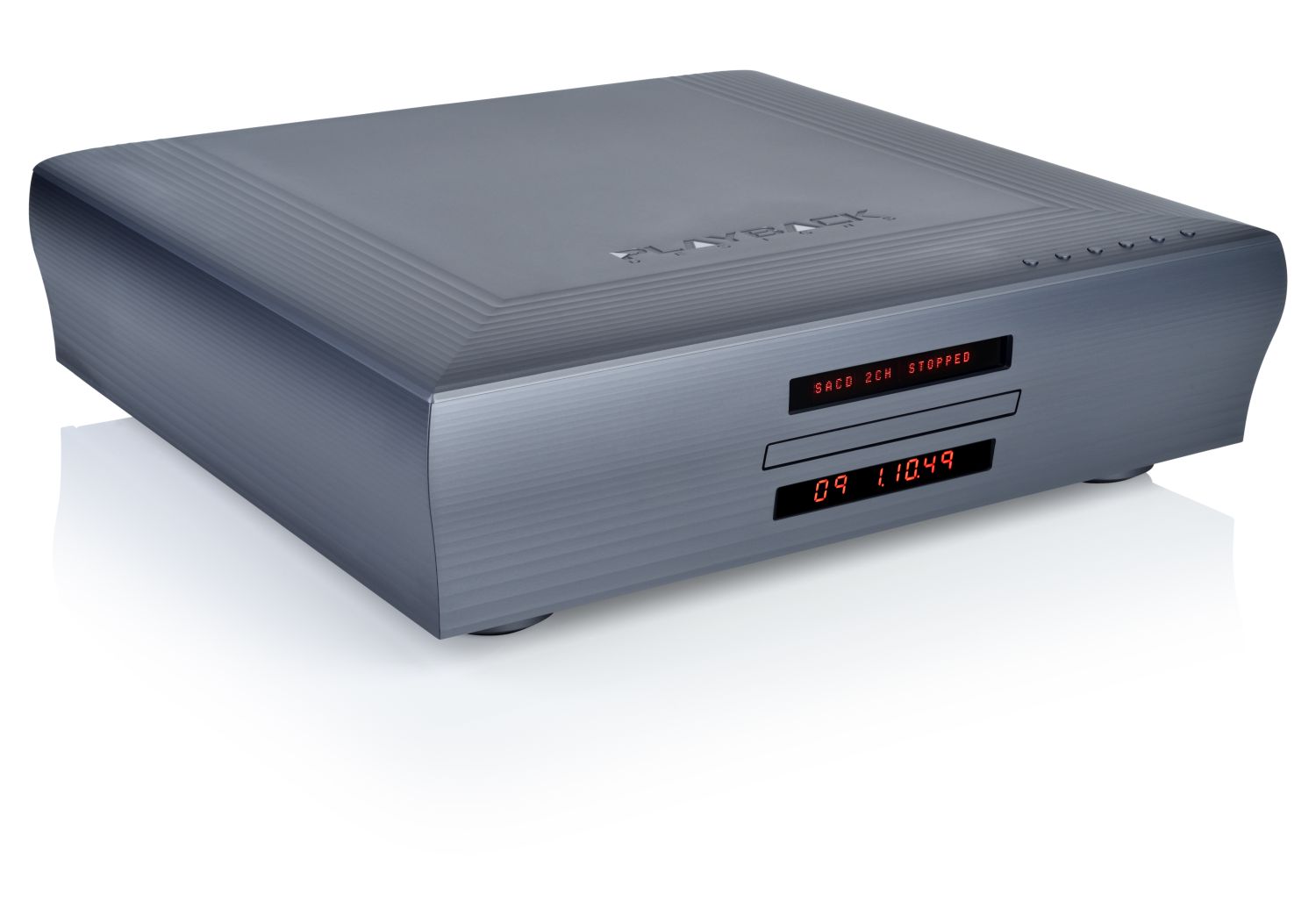
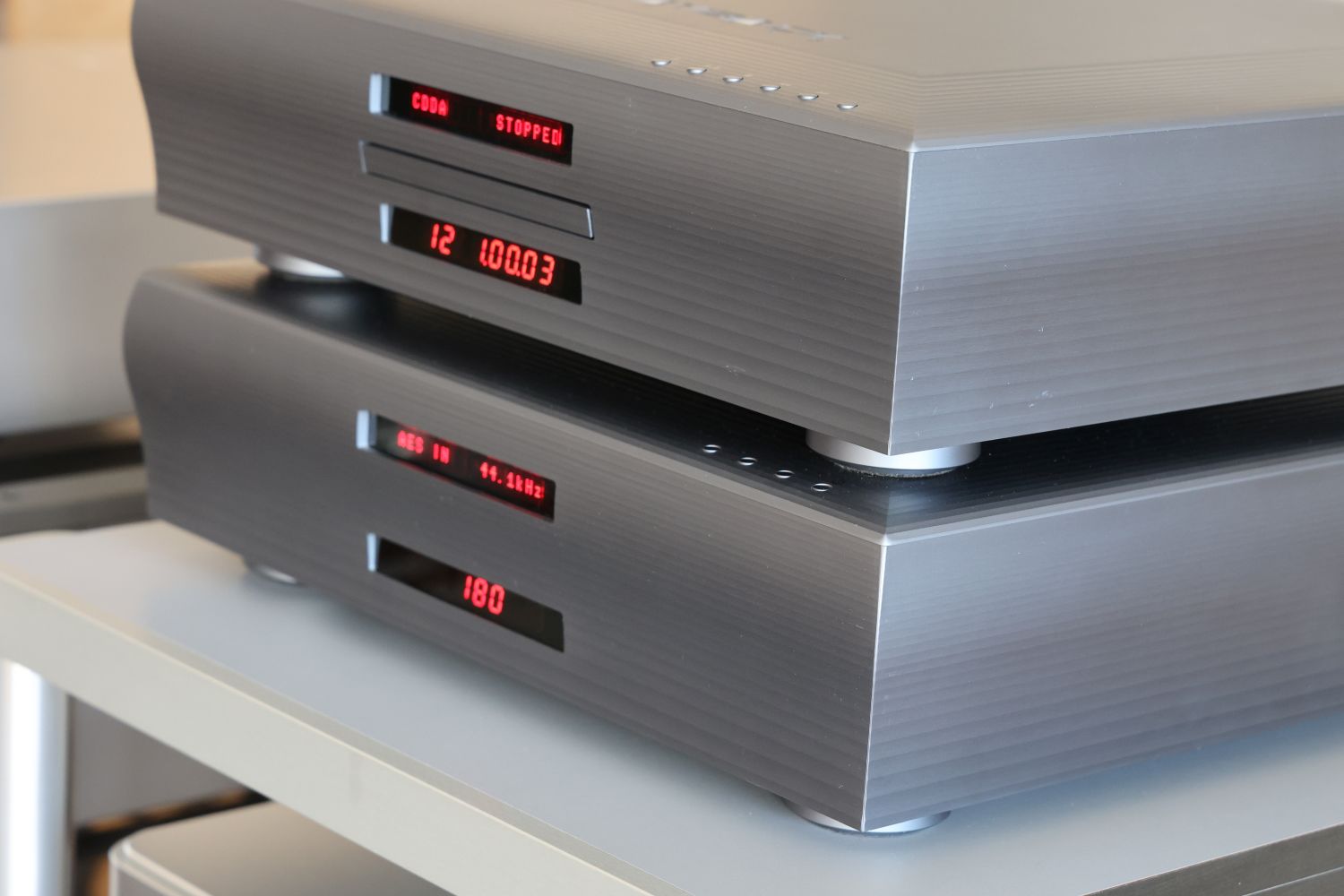
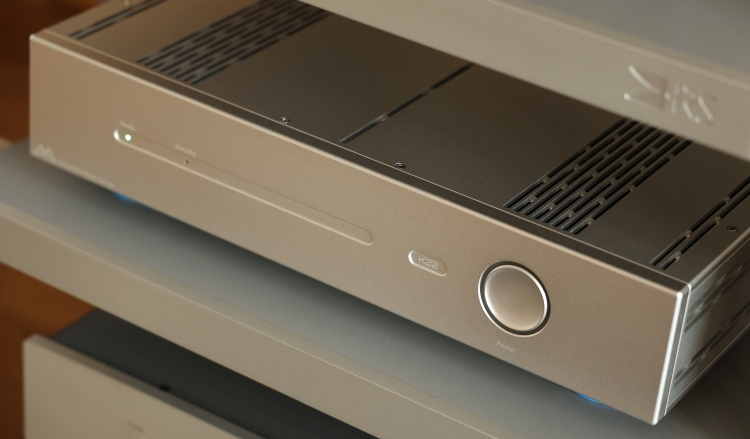
Although all three servers sounded great with the MPD-8, the big surprise came when I played a range of Red Book (44/16) CDs with the MPT-8’s internal disc transport via AES/EBU to the MPD-8.
The MPT-8’s disc transport has a delivery that deviates from that of the three servers. It has a tight, crisp, sure-footed, direct, and controlled, yet hugely punchy, upbeat, expressive, and energetic nature.
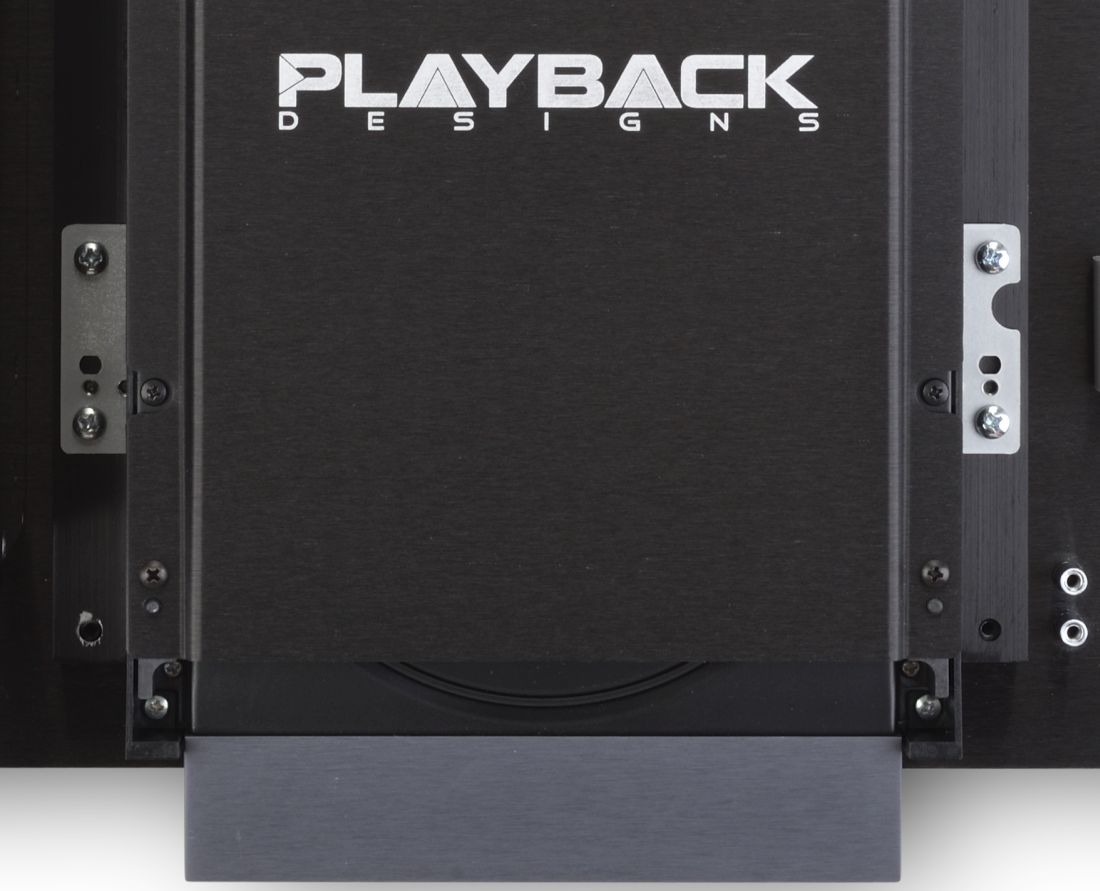
To some ears, perhaps the MPT-8’s disc transport might be felt to be a little on the matter-of-fact side, but to my ears, it is straightforward in being truthful to the source. Although it does not inject the sound with additional lushness or romance in the way that a classic CDM-1 or CDM-4-based CD transport would, its timbral density and tonal saturation keep it far from being cool or clinical.
To my ears, the MPT-8’s optical transport produced the best sound so far, outperforming the servers in terms of tension, jump factor, liveliness, and expression. Notably, the transport’s sonic prowess is evident not just with its stablemate but with any DAC.
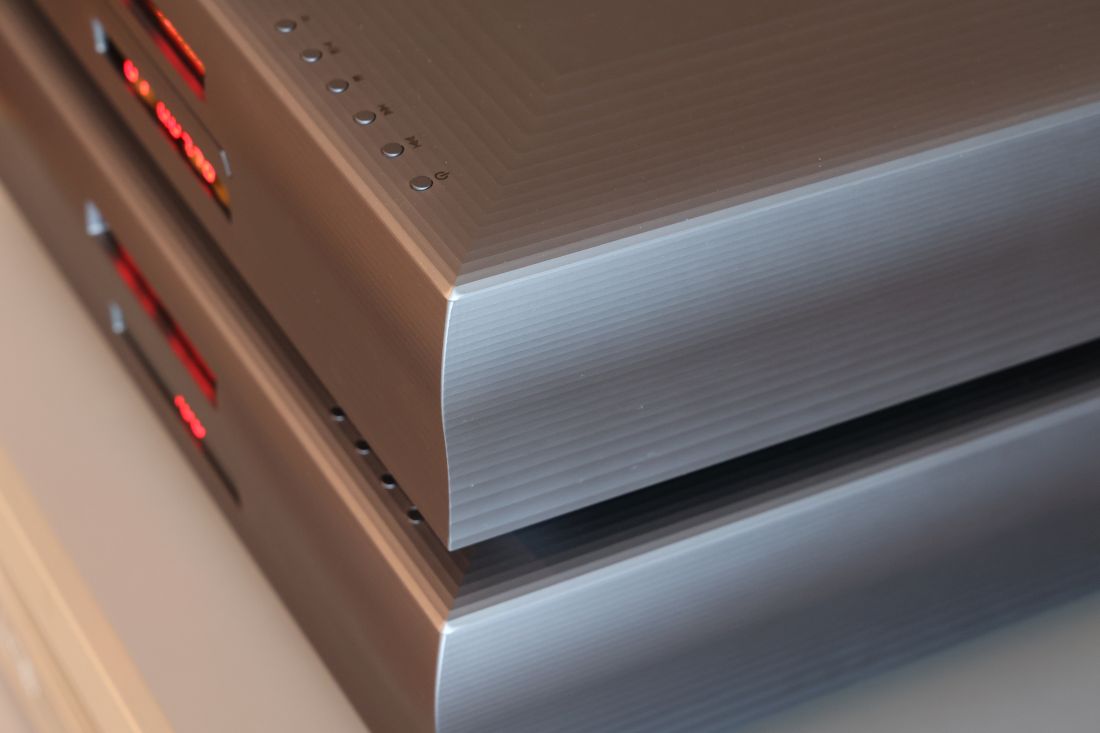
When combining the MPT-8 with the MPD-8 DAC, the combo has an additional trick up their collective sleeves: PLINK! Connected via the standard optical fiber cable, the sound is gentler, smoother, and more fluid. With this connection, the MPT-8 + MPD-8 combo now provides some of the most desirable qualities of the aforementioned classic Swing-Arm or belt-driven CD transports.
The MPT-8 is also an SACD player. I found that it plays these discs very much in line with its Red Book performance, illustrating precisely what is expected from the format, which is higher resolution, increased delicacy and fluidity, and an altogether more continuous feel. In my experience thus far, DSD playback can often be little more light-footed than PCM, and the MPT-8 behaves similarly. However, it is one of the most robust and incisive-sounding SACD players I have heard.
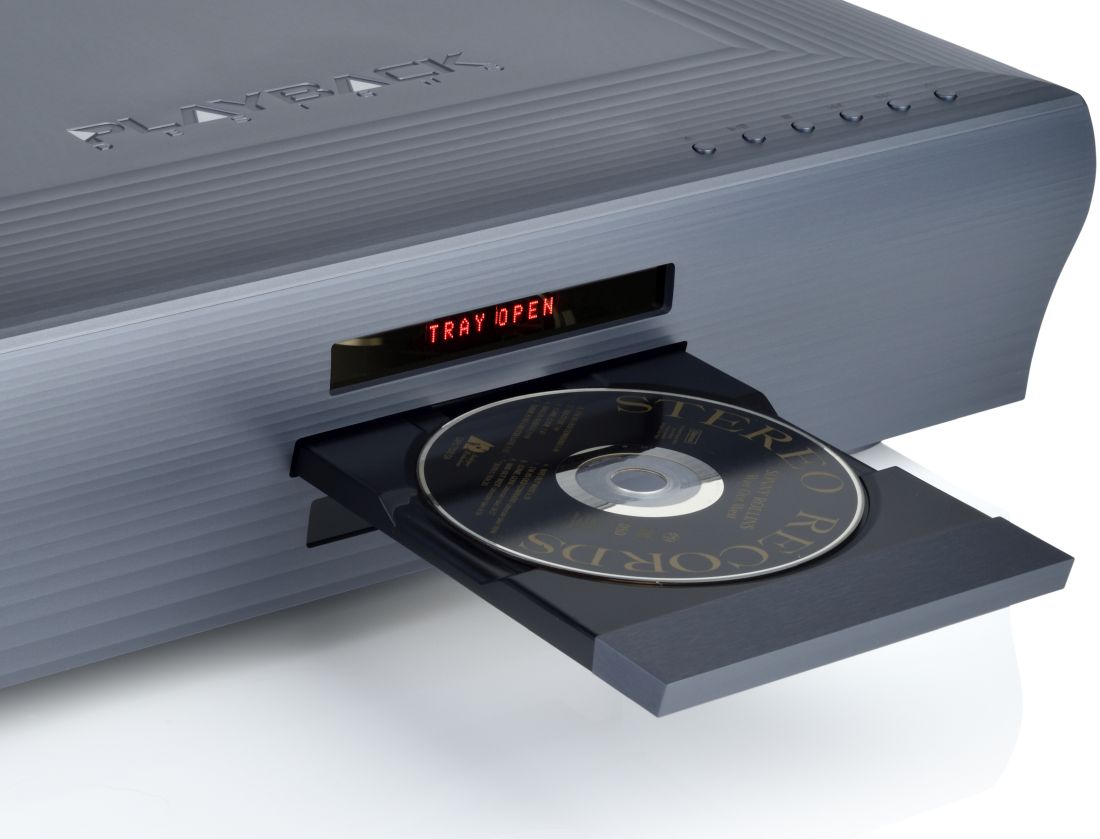
With the MPT-8 connected via AES/EBU instead of PLINK, it sounds a little fuller in the bass and, therefore, slightly earthier, although it now carries more of a PCM signature. In other words, it becomes less DSD-esque. Conversely, via PLINK, the sound is more light-footed but just as nimble, airier, and more fluid. In other words, PLINK enhances the DSD-typical qualities.
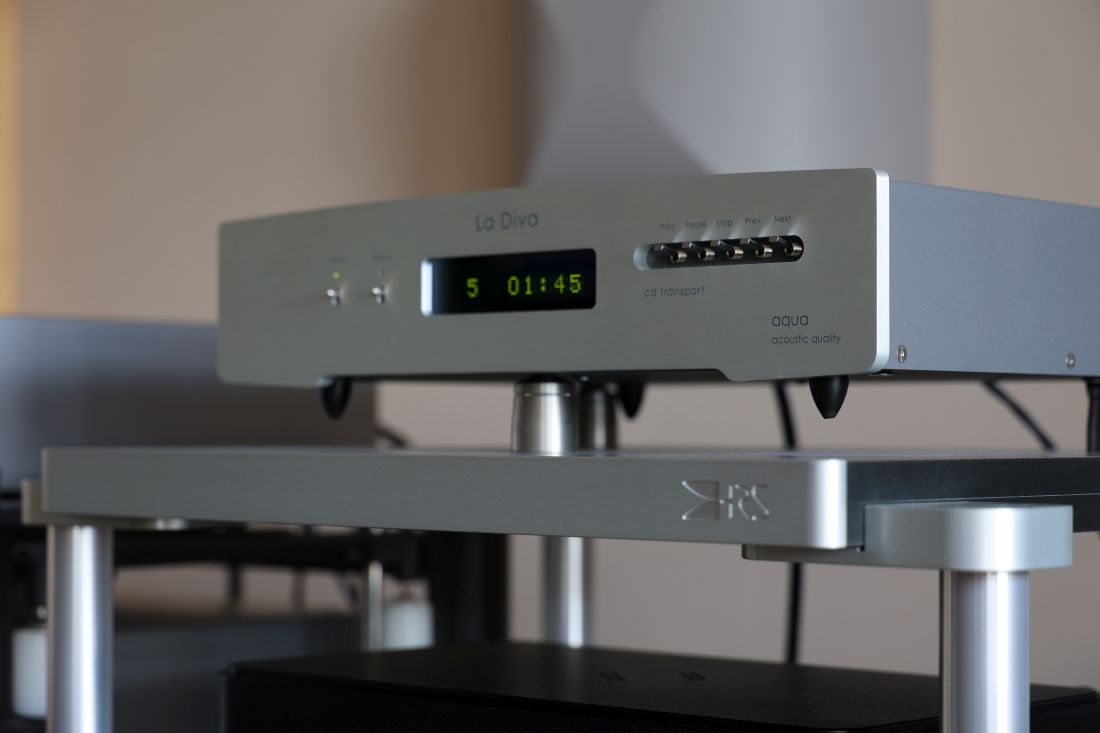
When a CD transport enters the arena, I must compare it to my reference at its price point: the Aqua La Diva M2. The Diva M2 has a huge heart and is my favorite player under 10.000 Euros. Its main fortes include fluidity, delicacy, refinement, air, and flow. Connected via a Mogami 3080 Neglex AES/EBU cable, the La Diva M2 sounds seductively smooth, lush, and deliciously delicate. However, there is no denying the MPT-8’s transport has spoilt me with its vitality and expression. In comparison, the Aqua is a little rounder than strictly neutral and lacks a measure of control and impact in the low and mid-bass. Otherwise, though, the Aqua keeps up remarkably well, providing similar measures of resolution, transparency, and, importantly, musicality.
While I greatly admire what the La Diva M2 achieves at its comparatively modest price point, this is also a reminder of what is possible in still higher tiers. The MPT-8 may cost more than three times as much, but it beautifully underlines the performance level that Playback Designs achieved with this product.
Listening – Streaming
As mentioned, the MPD-8 DAC’s USB and AES/EBU inputs produce excellent results with all three servers, with performance that can come close to the MPT-8 Dream Transport playing the physical CD. However, Roon still always brings its own character to the mix. This is audible with all servers, streamers, and DACs I heard; the MPD-8 is no exception.
This is where the MPT-8 Dream Transport and the PLINK connection come in!
When streaming with Roon to the MPT-8 connected to the MPD-8 via AES/EBU, there is an unmistakable improvement in spontaneity, agility, and expression compared to a direct connection to the DAC. These are precisely the areas where Roon is typically lacking compared to UPnP. When switching to PLINK between the MPT-8 and MPD-8, there is another jump in fluidity, delicacy, and naturalness. Playing this way, the three servers still maintain their individual character, and the Roon signature may still not be 100% gone, but every server sounded significantly and meaningfully purer and more expressive than when connected directly to the MPD-8 via USB. Speaking of which, the MPT-8’s USB input also consistently produces an even crisper and more expressive rendition than the MPD-8 DAC’s USB input, again bringing the sound quality more in line with Roon streaming and physical CD playback.
To rule out any external influences, I switched the Oladra from Roon to UPnP/MPD to compare its AES/EBU connection to the server streaming directly to the MPT-8. Entirely in line with earlier comparisons as part of the MPD-8 DAC review, the Oladra sounds slightly different using its AES/EBU outputs. Still, the overall feel is very similar, with both methods providing the server’s signature smooth yet transparent delivery. With the MPT-8, however, the two connection methods sound more similar than when the server is used directly with a DAC. Ultimately, the AES/EBU connection is a little rounder and riper, while the network stream sounds slightly tighter and crisper. Both renditions are technically superb and emotionally charged, although the Oladra with AES/EBU remains perhaps just a little more seductive, whereas the streaming connection offers a little more precision and control. Ultimately, with an interface that is this good, I would argue that it becomes a matter of taste or perhaps merely of convenience. Whatever format or connection method you choose, the MPT-8 always delivers sonic bliss. Or at least, this is the case with the Oladra. Would it be the same with the relatively much more modest Grimm MU1?
Next: more comparisons and Conclusion

Hi Christiaan,
thank you, great review as usual.
One question:
Only considering streaming from Qobuz, after this review which set-up (upstream to the DAC) provides the best performance when using MPD-8 as DAC?
Thank you
Matt
You mean which server? I will leave that to the reader to decide as they all have their unique characters, which I described in the MPD-8 review. The beauty of Qobuz is that you can also stream directly, without a server, directly from an app. This also sounds really good.
Hi Christiaan, I appreciate your review. I had a MPS-8 + Stream X2 and used it for some months with MPD-8, connected by P-Link. The sound was really impressive, better to all my previous digital set up. Listening to CD or SACD proved that PLAYBACK DESIGNS has realized a fantastic player at quite an expensive price but not stratospheric. Then I use TAIKO Extreme + MPD-8 with USB and the sound from Qobuz or server is much more open, more realistic in soundstage and dynamics increased to an unpredicted level of realness. I much recommend to use MPT-8 or MPS-8 with better feet than the original that use felt. Remove the 3 felts, use top rank cones + base and the sound will improve greatly.
Best
Hi PHP,
thanks for your info that Taiko Extreme outperforms MPS-8 + Stream X2.
I think you will not get a comment by Christiaan about Taiko since he works for this company.
ATB
Indeed, I cannot get into deeper comparisons between the Extreme and other servers, as that will pose a conflict of interest. This is why I rarely use the Extreme Server in my reviews.
Great review! I own an MPD-8 and previously owned a La Diva Mk. 2 CD transport but got rid of it because, while I found soundstage depth and layering to be excellent the height and width of the stage were of a significantly smaller scale than my previous (and rather boring Musical Fidelity transport). I’m curious what you noticed in comparing the soundstage (particularly the height and width) of the La Diva to the that MPT-8?
I think what you may be referring to as a high and wide stage is what I usually call an “aura” or “bubble”, a consistent feeling of a room-filling sound. This is not necessarily the same as a component accurately relaying the stereo- and phase information in the recording. To me, the Aqua La Diva M2 is every bit as wide, deep, and room-filling as the best players I heard, but only when this information is in the recording. I don’t recall finding the La Diva M2 to sound smaller than the PD MPT-8, although the latter clearly had more body and stature, providing a bolder and more impactful sound. However, I did find the original La Diva to have quite narrow imaging with less projection outside of the speakers, and with an overall less spacious feeling than most other players. On the other hand, it was also tighter and more accurate than most, and that usually has an inverse effect on the perception of space. Lastly, the way we experience soundstage also ties in quite heavily with the room acoustics, listening position, and speaker placement, making this, unfortunately, perhaps also a relative matter.
Hi Christiaan, Thanks for your reply! I don’t know if I am referring to the “aura” effect as you define it (because I’m not sure of that includes off-axis listening or not) but merely to the boundaries of the soundstage as one experiences them in a sitting in the sweet spot. The properties I’m talking about I think are the kind you mentioned there when describing there the original La Diva. You had also described the Tambaqui a while back in similar terms as producing a more “focussed” soundstage (horizontally) that sat more between the speakers rather than extending beyond them. In those terms, what I experienced was about the same from the mk 2. Indeed there are many variables at play including room acoustics, as you said. Seems you don’t have the same impression of the mk. 2. (that of a more “focussed” stage) after trying it in numerous system configurations. In my case I’ve had multiple transports in my system and the mk. 2 stood out as being on the side of the narrower and shorter soundstage.
Hi Ajay, Ok, interesting! Maybe I was generalizing. But indeed, I experience the La Diva M2 as much more spacious and free-flowing than the orginal La Diva, which does indeed image more or less similarly as the Tambaqui. In any case, the MPT-8 ranks at the top of my list.
Thanks, Christiaan! We all generalize about the characteristics of individual components even knowing that that is a tricky proposition because of system and room dependency factors. But I think some people have a sounder (even if not absolutely conclusive) basis for their generalizations than others. In your case you at least often get to try out components in many different configurations of systems which allows you to notice patterns which I can t so easily (because I have a much more limited array of equipment at my disposal). Interesting what you found with the mk. 2. Makes me cautious with respect to the MPT-8, though (given the soundstage width and height were not much different than with the mk. 2 in your tests). I suspect something else in my system is probably constraining the sound-staging in this regard.
Hi Ajay, thanks for the trust. Following what you said about the MF, I know that certain transports can sound extra-spacious, or perhaps even larger than life. Some of the classic CDM-1-based players come to mind, but invariably, these are also much less concrete and precise, and I do not consider these classic players reference-grade. But ultimately, as much as we want it to be an exact science, there is always a personal component to audio. We may perceive things differently, or just prefer different renditions. BTW, the MPT-8’s behavior can be influenced by the digital interconnect system, and it sounds significantly more liquid (as well as most free-flowing and subjectively more spacious) when using PLINK. Personal preferences aside, when you have an MPD-8, I would still think the MPT-8 is the ideal partner, and I would recommend trying to get a home audition so you can decide for yourself. If you do, I will be interested in hearing your thoughts!
Thanks, Christiaan! I will keep you posted on that. BTW, apparently the Muaical Fidelity transport utilizes the Sharp GH6C005B optical pickup mechanism — seemingly something relatively uncommon in the audiophile world. Still, it synergism’s well in my system — perhaps more because it compensates for other system limitations than because it’s such a great player. Have to agree that the La Diva mk 2 was more resolving, imaged better, etc.
Hi Christiaan, I have a Nagra HD DAC and am wondering if any other SACD players use this plink. The Playback Design MPT-8 is a bit above my budget. Please let me know.
Hi Maurits, not that I am aware of.
Hi Christiaan,
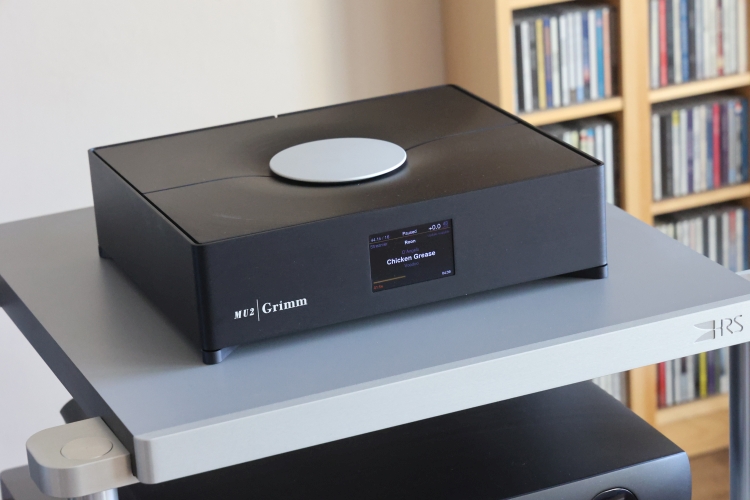
As I make my shortlist of considerations for introducing a CD transport to my system, one significant drawback of the Aqua La Diva M2 in my case would be that my Tambaqui’s single AES input is already consumed by my MU1, so in this setup I’d have to switch my AES cable between my MU1 and the Aqua all the time which wouldn’t be good.
It sounds like the MPT with Stream-X2 might be a good alternative that solves this problem with only the need for 1 AES output to my Tambaqui regardless of whether I’m streaming or playing CDs.
My tastes tend towards precision with a neutral, fast, crisp, airy and layered presentation, while being simultaneously delicate and energetic. I don’t consider this profile to be analytical if done right.
With the MPT-8, how much would I be compromising using AES into my Tambaqui instead of Plink with a Playback DAC?
And, given my tastes, would Playback’s Stream X2 be an upgrade over the MU1?
Lastly, have you been able to compare any of the Esoteric transports at this level? With this approach I’d have the choice to use the onboard DAC or my Tambaqui.
Decisions….
Hi Christiaan, one clarification related to my question, my MU1 has no storage and so only use it to stream using Roon. With an MPT-8 I’d be using Stream-X to do the same but with UPnP and Tidal, and I’m wondering if this would be equal or better to my current setup with the MU1. If so the MPT-8 may be the best option for me.
Hi Nigel, the MPT with Stream-X2 is indeed an excellent alternative. Even with AES/EBU instead of PLINK, I still think this combo is superb: just as neutral, crisp, and precise, but grander, more majestic, and more organic than the MU1 with Tambaqui.
As for Esoteric, I cannot go into detail about equipment I have not reviewed in my own system and on HFA, but I have used and heard several Teac and Esoteric transports, both classic and current. They tend to have a very robust, earthy, well-controlled, slightly dark delivery. YMMV, but I personally prefer the MU1, Aqua, and Playback Designs for their blend of technical excellence with delicacy and flow.
MTP8+Stream X2 is better than MU1. MTP8+Stream X with optical link is miles better.
Thank you for clarifying this – I wasn’t certain from your review if you had only tested the MPT-8 with the different servers streaming to it, or if you had compared the MPT-8 directly streaming from the network with no server in front of it.
Hi Nigel, that response was not from me, but from Philippe of PHP Audio:-) Nevertheless, I can confirm that the MPT-8 with Stream-X2 sounds superb with any source. It ranks at the top in the streaming endpoint and CD Transport sections of the HFA Awards page for a good reason;-)
Thanks Christiaan! I’ve placed an order for a mint condition MPT-8, which supposedly only has a couple of months use on it according to the dealer. After selling my MU1 the net cost will even be lower than the Aqua M2, but with better CD performance and better streaming performance than my MU1, all in one box.
Thanks again!
Hi Nigel, Congrats! Having heard all these units, I would say you made the correct choice. Be curious to get your reaction here. When does the MPT arrive to you?
Thank you! The MPT should arrive in two weeks. I’m not sure if the unit is fully broken in, as the prior owner used it only for two months (supposedly according to the dealer), before deciding it wasn’t a match with their system. Sounded like they were after a warmer and lusher and relaxed presentation (not my thing).
Should be interesting as I was happy with the MU1 already, and was really just after a CD transport, after realizing just how much noise comes in over the stream that isn’t solvable with the most capable audio gear for networks. Thought it was due to power quality fluctuations at first (after attempting to solve the issues for years with all manners of audiophile acrobatics), and it was to a degree. But I took my system entirely off-grid, powering my PS Audio Power Plant 20 with a Goal Zero rechargeable power source. After still experiencing fluctuations in quality (albeit with a notable improvement in quality and consistency), I dug out a 30 year old Arcam CD player and was blown away by how it made me realize just how much noise I was getting over my network stream, 90% of the time at least. Maybe my issue is unique to my house, who knows.
Either way, I’m looking forward to having both streaming and CD capabilities in one box, with consistently high performance.
My Preowned MPT-8 arrived and with my Tambaqui/Makua and playing CDs with AES (Valhalla 2) it’s the best sound I’ve had in my system (coming from an MU1 and other servers). More comprehensively filled out tonally, more control, precision, and without a sense things are constantly shifting (which I get with all streaming servers despite my Network Acoustics gear). A goldilocks balance of technical and musical performance.
My unit has only 100 hours of use so a ways to go. Haven’t tried streaming yet as the remote is needed to change the input and it’s coming with my MPD-8AI.
A note on the recommendation in the user manual to use WD40 to clean the chassis: despite this seeming utterly wrong to use on a HiFi product, the results were brilliant. I failed initially to wipe some fingerprints away with a moist cloth and was worried I had discoloured the chassis. But when I tried the WD40 it worked wonders, easily applying a perfectly consistent and smooth finish and removing all traces of fingerprints. The manual should caution that the lustre did change a bit using the WD40, becoming a slightly more deeper and more saturated tone – but, the look to me is very obviously improved! It looks even more luxurious now. I’d suggest just doing this, for aesthetics alone. Phew – that could have gone very wrong!
Looking forward to more break in and the MPD-8AI when it arrives!
Hey Nigel, Great update! Sounds amazing. I own both an MPD-8 and a Tambaqui. I believe when that MPD-8AI arrives you’re going to make a much bigger shift forward than the one you have just experienced. Wider, deeper soundstage, much more natural tonality, much more musicality. When does your MPD arrive?
Hi Ajay, the MPD-8AI arrives Thursday. But like my MPT-8 it only has 100 hours of run time as it was the same prior owner. On Friday I’m headed out on a short trip, so I doubt I’ll have much time with the MPD-8 until next week. At least I’ll have it running while I’m gone!
I tried a Network Acoustics Muon 2 AES between the MPT-8 and the Tambaqui, and it is seriously better than the Nordost Valhalla 2 I was using. Now I feel as though the Valhalla 2 wasn’t quite letting the full potential of the MPT-8 through, as good as it was. Now it’s crisper, lighter, more airy, and more spacious. With the Valhalla 2 it had spookily dense center vocals that made them seem extra planted and centered but overall I prefer the Muon 2. Honestly not sure I “need” the MPD-8AI at this point (arrives tomorrow), but I expect that could change after I hear it. Normally when I acquire new gear, I don’t love it at first and I spend a lot of time tweaking, and up front I know it may end up getting sold (I buy used for this reason). Not so with the MPT-8! I expect this will live in my system for a very long time.There are no specific elements that stand out – it’s more the full package of many elements that make it so satisfying. Take with a grain of salt though as I have hardly any experience going beyond the Tambaqui / MU1 level of gear. I’m sure CH Precision, Rockna, and in particular EMM Labs are also all great – just went with PBD as Christiaan’s descriptions of PBD aligned with my tastes, and I had a good opportunity on a lightly used stack. That said I’d love to see Christiaan review the equivalent products from Rockna and EMM to compare! Hint hint…