
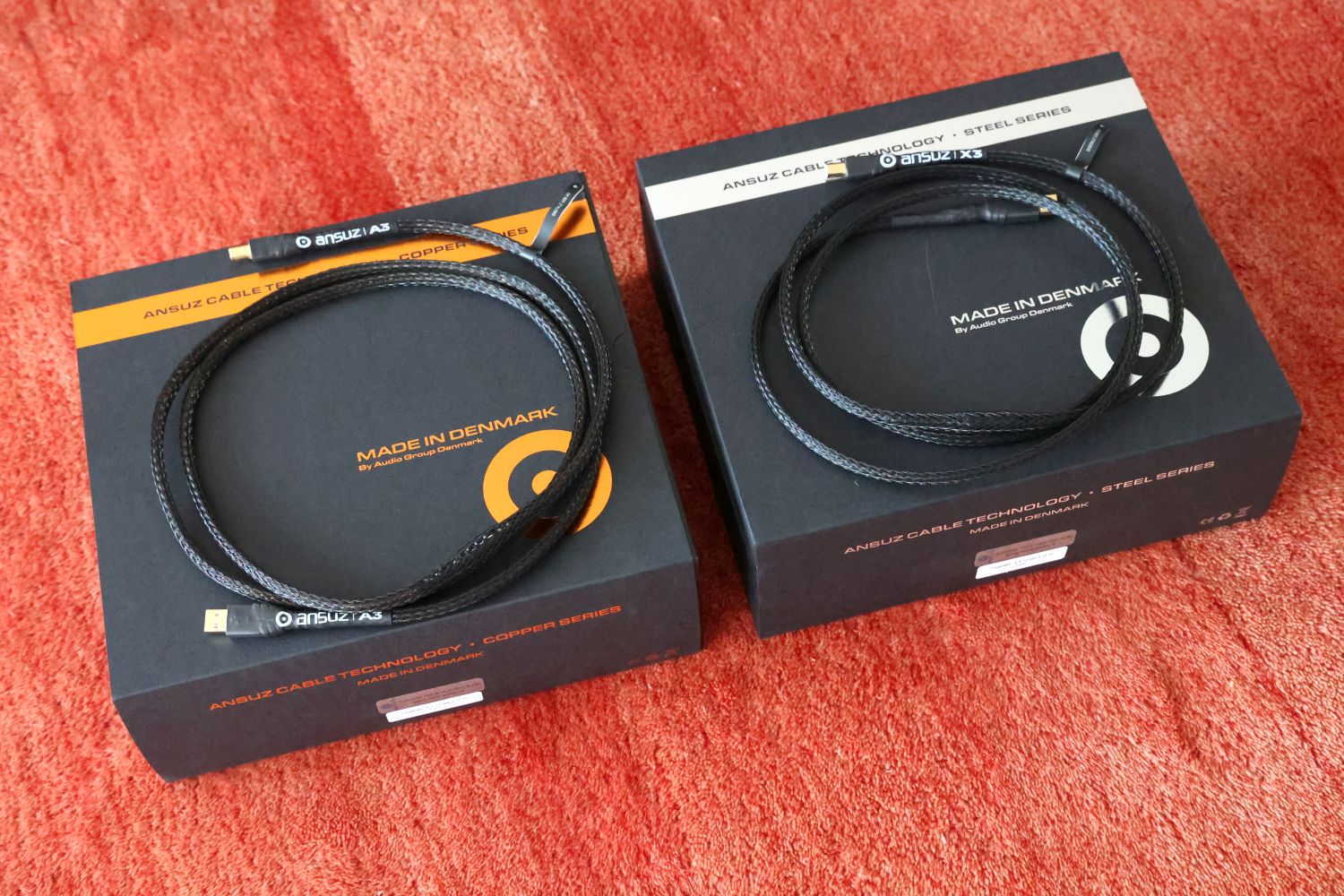
Review samples supplied by Ohm Audio
Retail prices in the Netherlands, including 21% VAT:
X3 USB 2,0m: 480 Euro
A3 USB 2,0m: 800 Euro
Foreword
In the Ansuz lineup, the X represents Ansuz’s entry-level product line. Counterintuitively, the A corresponds to the next level up. So, A is more premium than X.
Before looking this up and understanding the cables’ respective tiers and price points, I assumed that X was positioned above A, and I went into my initial listening comparison with that in mind. After hearing the A3, I was pleasantly surprised by its crisp and lively sound. But after hearing the X3 next, I was puzzled and wondered how this cable could be higher up on the hierarchy, as it performed on a lower level than the A3. Of course, I had it totally backwards. And as soon as I realized that, the puzzle pieces fell right into place.
I’m mentioning this mishap because it inadvertently served as a one-man blind test. As reassuring as it is to know I can rely on my ears, this also allowed me to assess the differences between the two models entirely objectively.
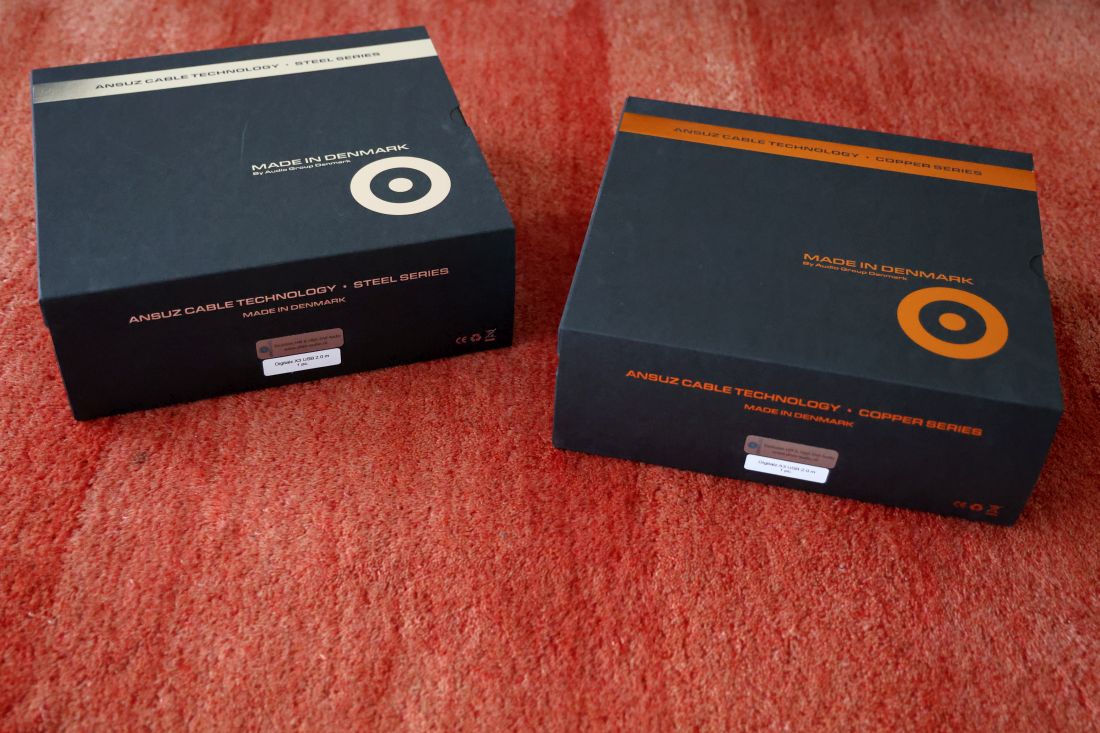
X3 and A3
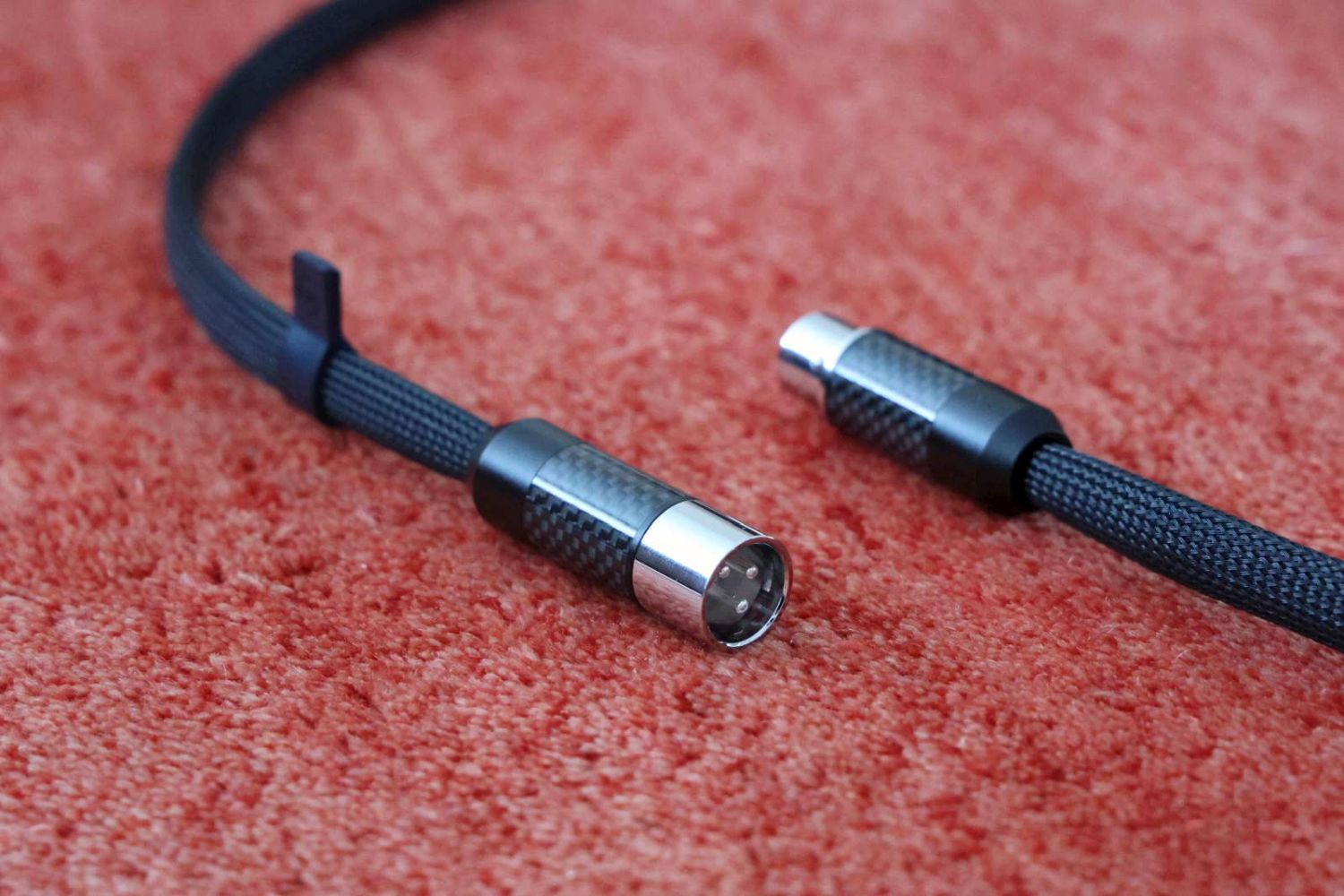
The X3 and A3 cables share multiple identical properties. For instance, both have silver-plated copper conductors, and both are terminated with gold-plated connectors. Both cables contain a range of special proprietary Ansuz techniques.
A special technique used for both cables is ‘Passive End Coil Technology’. At one end of the cable, a passive Tesla Coil is wound around the conductors to prevent noise from reaching the audio components. The passive Tesla Coil is mounted just in front of the connector, and when it encounters a noise spike, a counter spike is generated and added to the signal to cancel the noise. This process is conceptually similar to how noise-canceling headphones work. The result is a lower noise floor and a cleaner signal.
The difference between the X3 and A3 lies in the types and numbers of techniques used. In short, A3 has twice the number of Passive End Coils and Passive Cable Tesla Coils as the X3, and an additional Passive Tesla Coil.
X3
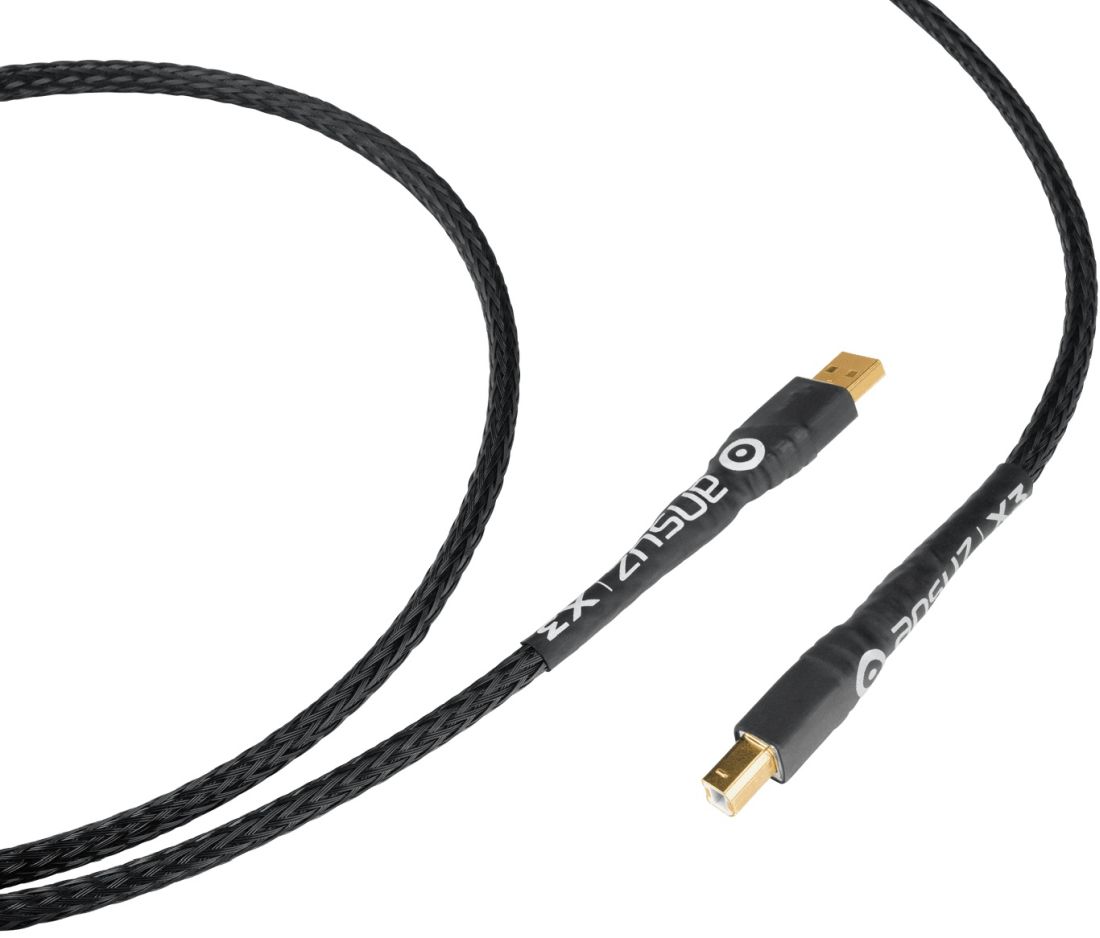
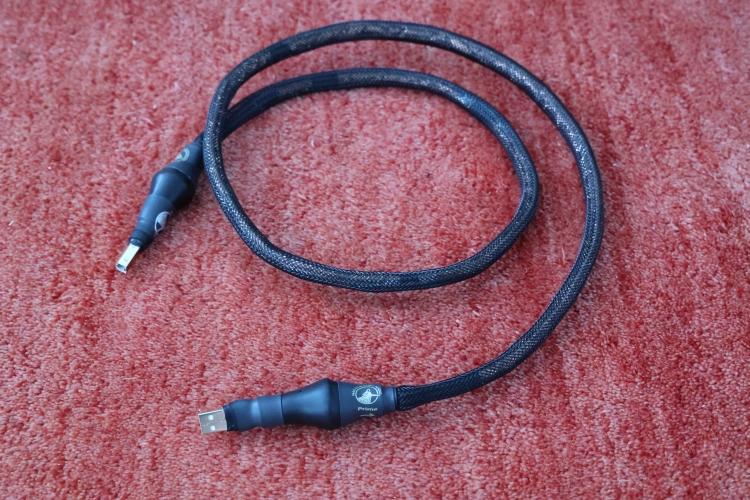
The X3 is Ansuz’s entry-level USB cable. At 480 Euros, the X3 can be considered very affordable, especially in the Ansuz catalog. The Ansuz Digitalz X3 USB has silver-plated copper conductors and is terminated with gold-plated connectors. This cable is extremely supple, just as bendy as a standard USB cable, but sonically it is very different.
Ansuz Passive End Coils: 1 x 70.4 cm
Ansuz Passive Cable Tesla Coils: 1 x 48.8 cm
Ansuz Active Cable Tesla Coils: 0
Ansuz Passive Tesla Coils: 0
Ansuz Powerbox Connection: N/A
Shielding: 4 x Tin Foil tinned Copper Mesh
Conductors: 4 x 0.3 mm2 Shielded Silver plated Copper
Insulation: HDPE
A3
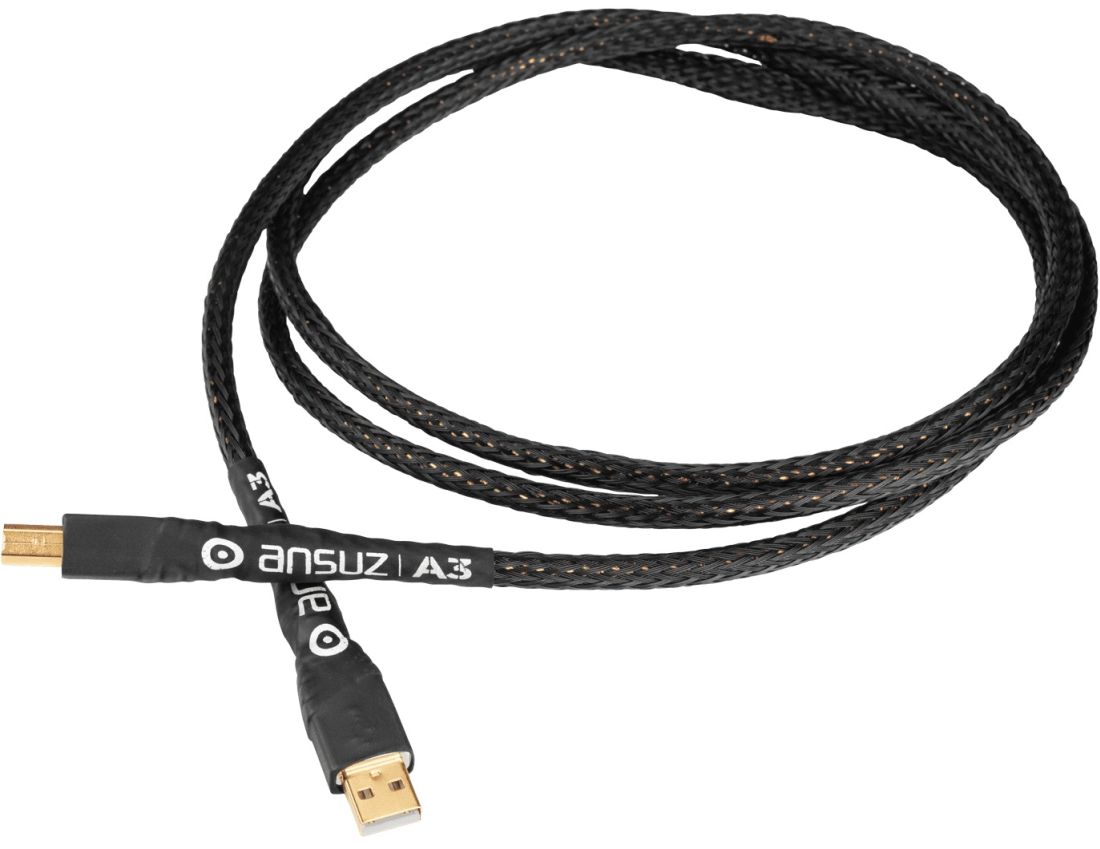
The A3 is positioned one tier above the X3. At 800 Euros, the A3 is considerably more expensive, but honestly, in a world where USB cables often start at much higher prices, I still consider it reasonably priced.
The A3 USB cable has dual Passive End Coils and Passive Cable Tesla Coils, whereas the X3 USB cable has one of each. Additionally, the A3 USB cable has a 148cm-long, wound Tesla Coil built into it. The A3 is a little stiffer than the extremely supple X3, but in absolute terms and compared to the average USB cable, it’s still very pliable.
Ansuz Passive End Coils: 2 x 70.4 cm
Ansuz Passive Cable Tesla Coils: 2 x 48.8 cm
Ansuz Active Cable Tesla Coils: 0
Ansuz Passive Tesla Coils: 1 x 148 cm
Ansuz Powerbox Connection: N/A
Shielding: 4 x Tin Foil tinned Copper Mesh
Conductors: 4 x 0.3 mm2 Shielded Silver plated Copper
Insulation: HDPE
Review Context
The X3 and A3 USB cables were listened to in the main system, which consists of the CH Precision C1.2 DAC, CH Precision L1 preamplifier, and CH Precision A1.5 power amp, using the Antipodes Oladra Music Server. All interlinks are Driade Flow Link Reference 808, and the speaker cables are Driade Flow Reference 808. All components are powered by the PS Audio P20 PowerPlant. Speakers used are the Apogee Duetta Signature (recently refurbished with the latest Graz foils).
Foreword
As regular readers will know, I have often noted profound differences between USB and other digital connections. Typically, direct USB-to-USB connections have a precise, controlled, and somewhat mechanical nature. This has led to a personal preference for AES/EBU cables. Interestingly, in most cases when a server has outputs such as AES/EBU or S/PDIF, these are derived from an internal USB port. So, why do there still seem to be structural differences?
Antipodes has found a way to mitigate the differences by fitting their servers’ USB ports with the same Reclocker circuit as used for the digital output section. As part of the G4 incarnation, the Oladra server has been updated, and I confirmed that USB now sounds much closer to the server’s AES/EBU or other Digital Outputs. This kind of uniformity is a blessing for a reviewer assessing cables, but it reignites the question of which cable is ideal: USB or traditional digital.
All I can say is that this remains a relative matter. The quality of a USB connection depends not only on the transmitting side but also on the USB receiver in the DAC, the synergy with the rest of the system, and personal preferences.
In any case, even with a reclocked USB output, I find that the USB cable still matters, and there are still significant differences from cable to cable, which brings us to the Ansuz A3 and X3 USB cables.
Next: Listening and Conclusion

Hi Cristian,
I needed a new longer USB cable. Sold my Curious Cable very fast over Marktplaats. Based on your review I bought the A3.
Very good in colour and detail indeed. THX for pointing out the direction. (connects Lumin U2 to Accuphase DC1000 DAC)
BR Gerard
Glad you found my review helpful!