
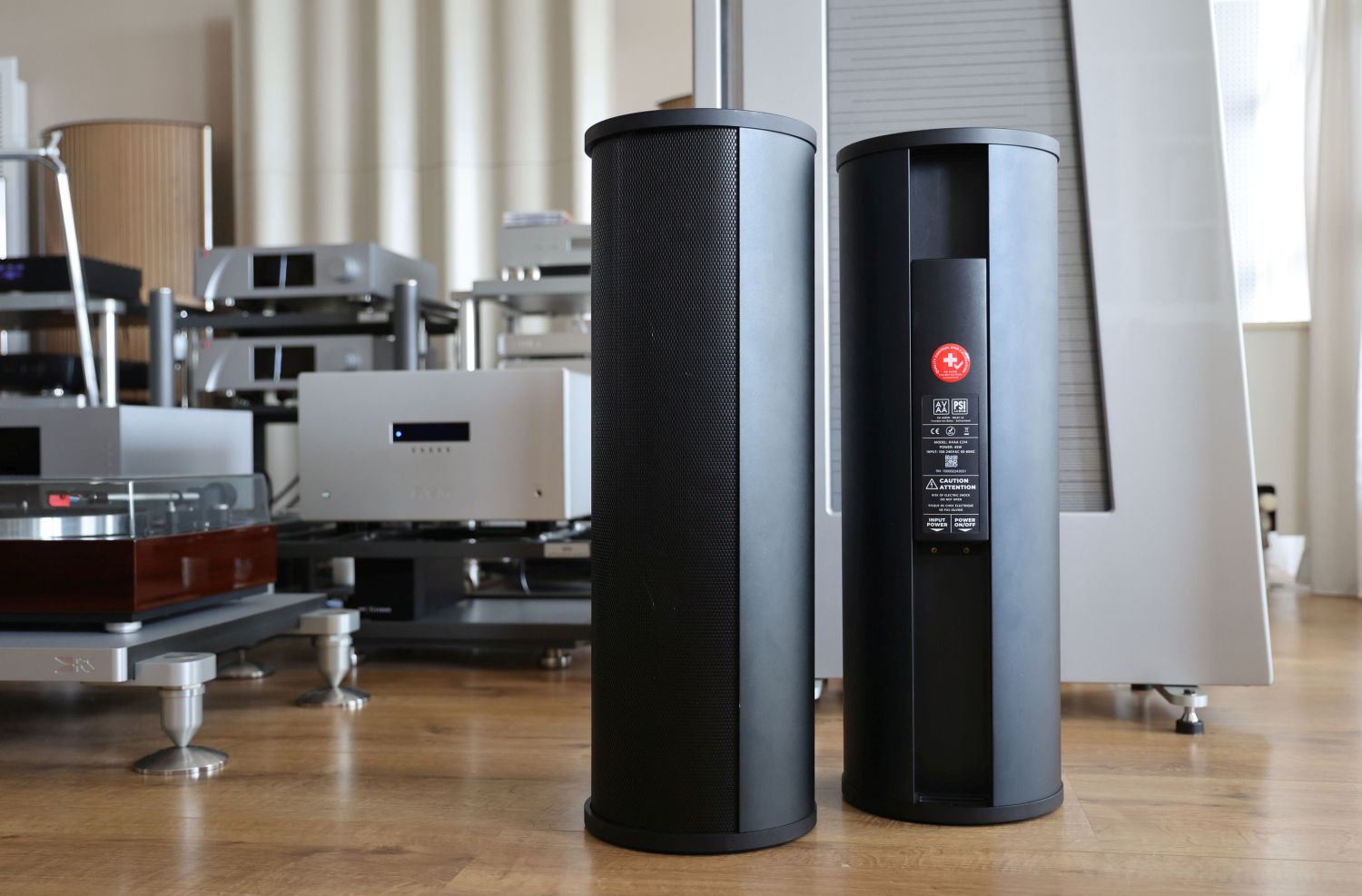
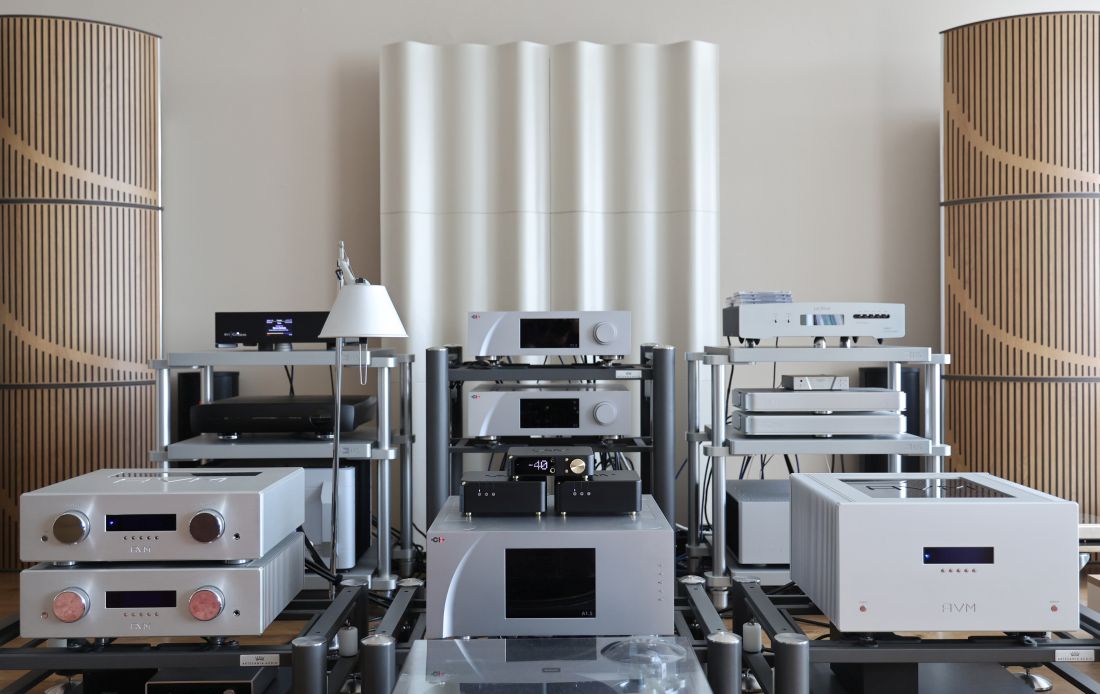
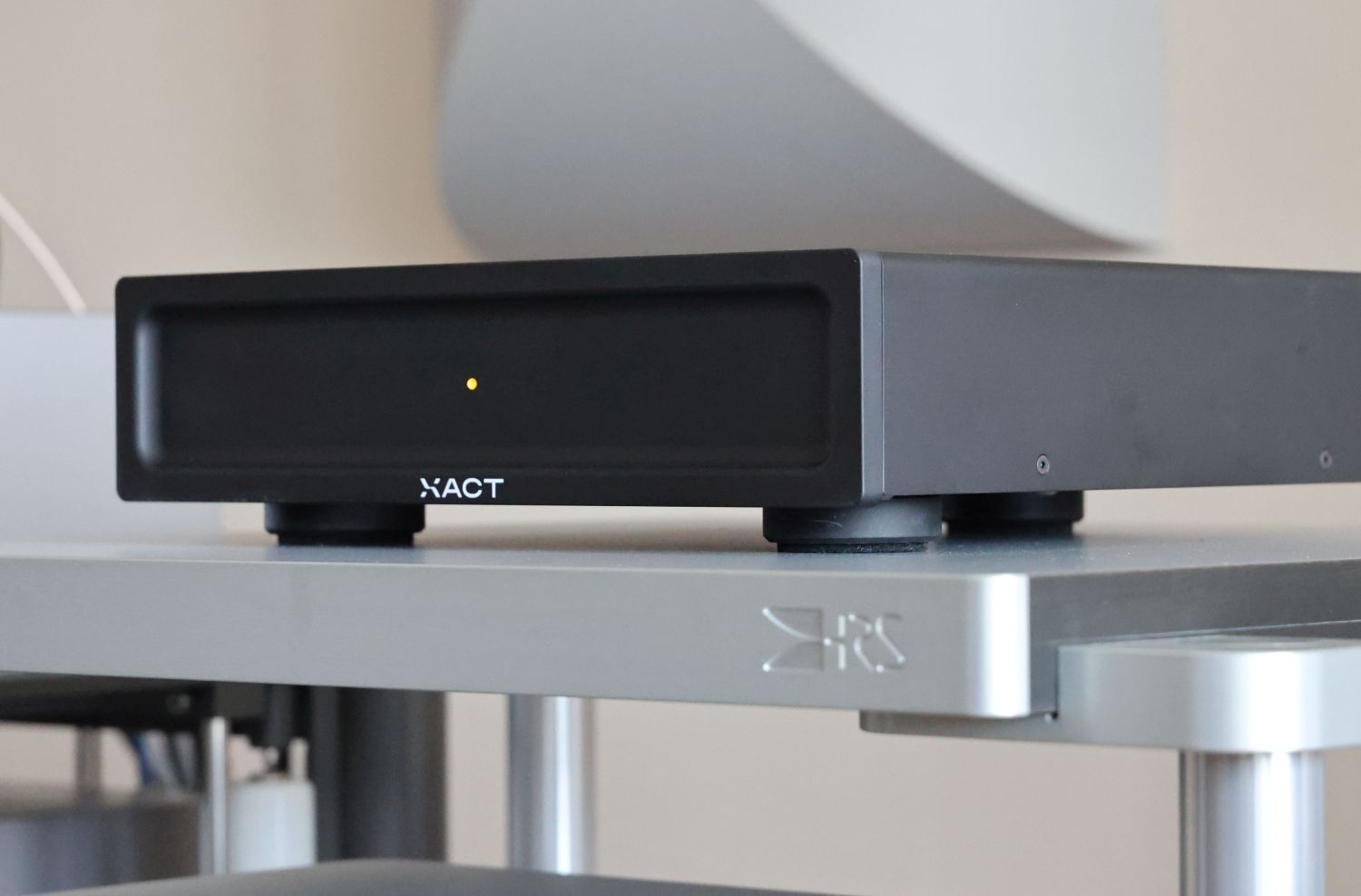
Above and below: for convenience and aesthetic reasons, I settled on placement on the floor, in between the two VicTotems. They are placed such that the power LEDs are visible from the listening position.
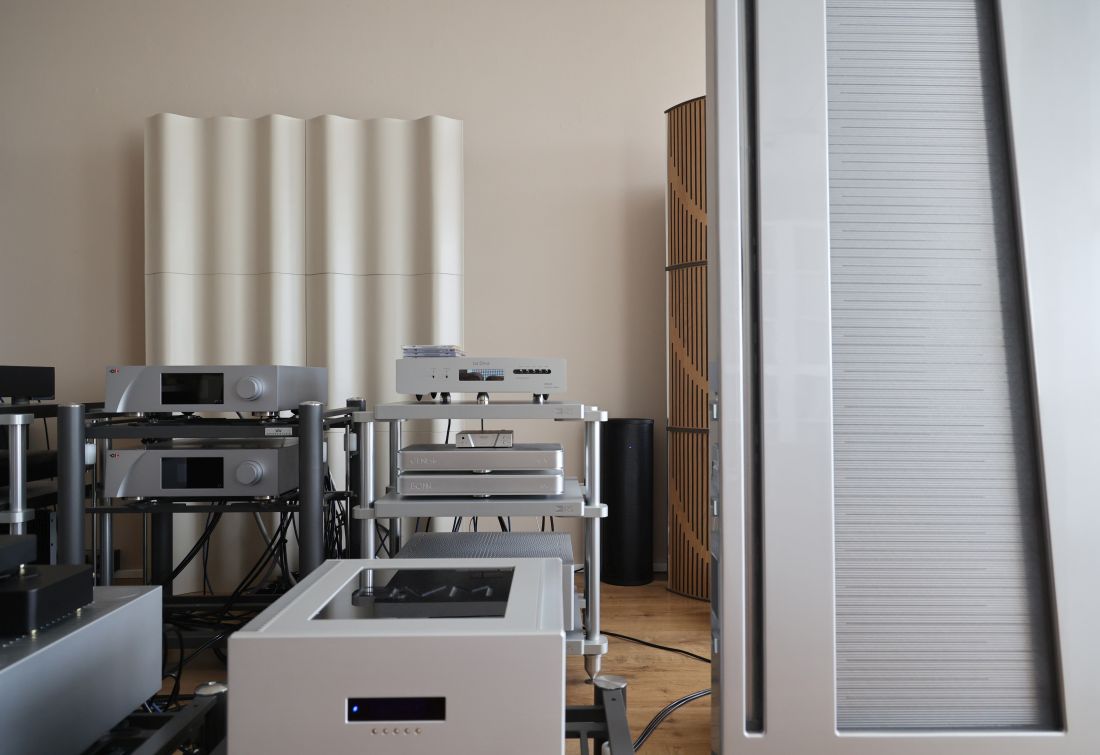
Although I was now very happy with the results, I recalled that the back wall, with its large, exposed, empty floor and ceiling, still affected the overall result, even after reinstalling the two Mass Spring Bass Absorber panels. And indeed, when playing certain R&B or electronic tracks with ridiculously low synth bass, a few low notes still had a bit too much emphasis and decay. Specifically, Janet Jackson’s 2 B Loved and Black Eagle on her Unbreakable album, several tracks on Pete Belasco’s Lights On album, and particularly the title track on his Deeper album. I was pretty sure that this was easily fixable with one or two C214s along the back wall, but I needed those at the front wall. This strengthened my feeling that I probably needed another set to achieve an ideal result. Upon asking Helios, I was happy to hear that the second demo pair had just been returned and could be sent to me as well.
As soon as the second pair of AVAA214s arrived, I started experimenting with them while keeping the first pair in the same positions in the front-left and front-right corners. First, I revisited the 50Hz issue I had in the glass wall recess on the right with the initial sofa and speaker placement. As I had already observed during testing, the resonance was no longer present. But also, when listening from other areas of the room, I could no longer hear any benefit to having a C214 in that position. If this had been the end of this experiment, I would still have been extremely happy with the results.
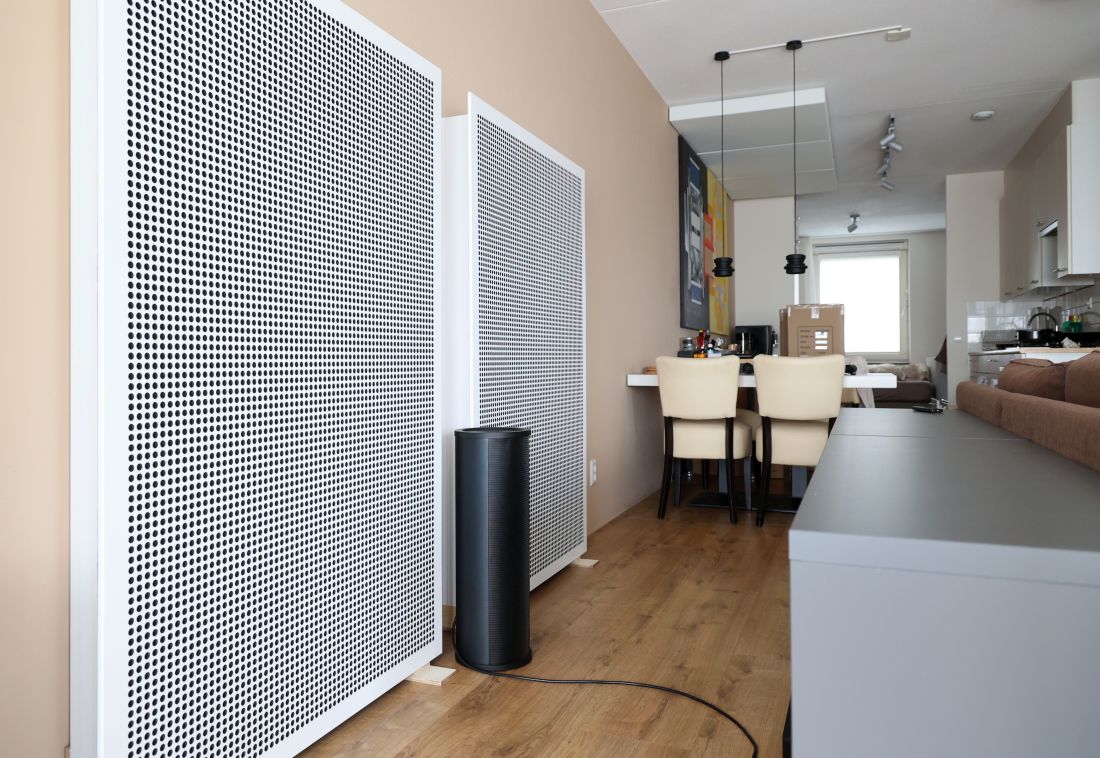
However, with the third C214 positioned between the two Mass Spring Bass Absorber panels, music playback again benefited considerably. The overall bass at all frequencies became even clearer when the C214 was switched on. But more surprisingly, 30Hz benefited immensely. Earlier, without the unit in the back, the pulsating 30Hz test tone still sounded like a continuous wobbling tone, and I assumed that this was just how the Duettas produced bass near their lowest limit. After all, they already sounded massively cleaner than I had ever heard them play before. But that was a false accusation, as, clearly, my room was again at fault! When using only a single C214, the 30Hz pulses snapped into focus, became much drier and staccato, and I now distinctly heard them switching repeatedly on and off. Boy, that extra C214 was precisely what the room still needed! It “simply” and sonically invisibly takes over where the front units stop being effective. Yup, there is no way around it. I already had two C214s in my mental shopping cart, and now I had to add a third!
Honestly, the sound was now so superb that my motivation to keep going had pretty much vanished. But I still had a fourth unit, and I wondered, would it still bring further benefits?
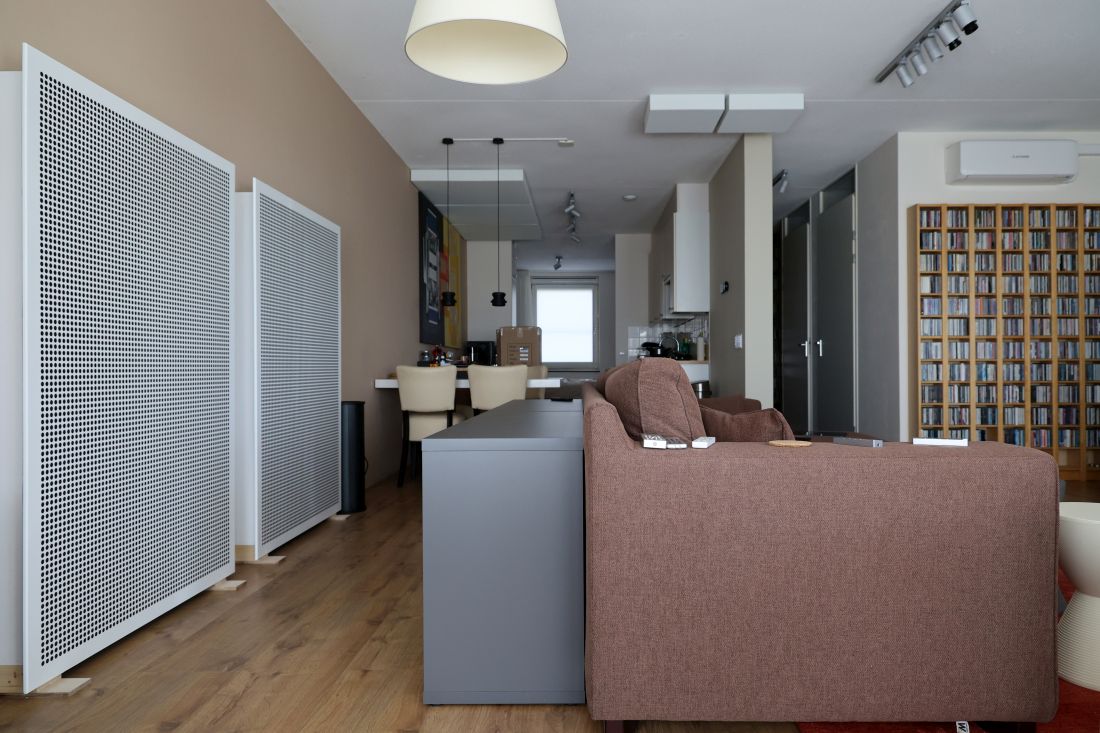
I removed the centrally placed C214 and placed one unit on either side of the two Mass Spring Bass Absorber panels to make a symmetrical “stereo” pair. Well, to be frank, while the fourth unit didn’t negatively affect performance, I wasn’t sure whether it really helped either. In this case, the single unit in the back was apparently fully up to the task on its own. Although the benefit of the unit in the back is concentrated within a narrower bandwidth than that of the two units in the front, its contribution was nevertheless substantial. Of course, I am a bass-fetishist, seeking the cleanest, tightest, and purest bass. Others may be less critical than I am and may consider a third unit icing on the cake rather than essential.
As a final story, I’m adding my friend MP’s experiences, who visits regularly. Listening to some of his Jazz CDs, he initially felt that the improved sound using the C214s felt less full, rich, and warm than with them switched off. Although I did not hear it that way, it is understandable, especially when someone is accustomed to listening in an untreated environment. It’s worth keeping in mind that most rooms significantly influence sound color, and people will adapt to it over time. A proper, pure, and clean bass might initially sound lean or dry to these ears. But sure enough, after switching back and forth, MP grew into it, and soon he found the non-C214’d sound to be slow, blurry, and lacking vitality and expression. Like me, he did not want to return to the old sound.
Wrapping Up
This has been quite a lengthy write-up, so I’ll try to wrap it up a little bit more neatly before jumping to the conclusion.
As I found firsthand, these handsome small tubular units work precisely as advertised, and they are an absolute lifesaver if you don’t want to line the wall with various large bass traps. Plonk one AVAA 214 in the most boomy corner, and you’re instantly rewarded with strongly reduced resonance and clearer and crisper sound. Add a second unit and place them symmetrically to enjoy an even clearer, more transparent soundstage, along with even purer bass.
Are they useful for spaces that have already been acoustically treated? Most definitely. Even in my extensively treated space, the C214s have a hugely beneficial effect. The improvement reminds me of the effects I experienced when I started using the PS Audio P20 Power Plant. That difference was so substantial that I now consider the P20 absolutely essential, and I feel the same way about the C214s.
Are two AVAA C214s a complete substitute for passive acoustic treatment? Well, not entirely. In an empty space, they are amazingly effective and can definitely be called lifesavers. In my tests, a pair of AVAA C214s proved more beneficial in the low bass than a pair of passive large bass traps. They tackle bass peaks and excess reverberation every bit as effectively, and often more so, than enormous, heavy Helmholtz Resonator boxes or large mass-spring panels, whereas the C214, in a stylish form smaller than a trash bin, effortlessly goes below the audible threshold. However, it’s worth bearing in mind that the C214s operate up to 160Hz and do not affect direct reflections. The most problematic and hardest-to-cure bass frequencies are within the C214’s range, but you will have to address issues above the threshold via passive means. The good news is that upper midrange and high-frequency reflections can be easily and affordably addressed. For problems between 160Hz and 300Hz, you’ll need to add passive bass traps, and if you want to avoid absorbing too much mid- and treble energy, the solutions tend to become rather expensive as well. Sure, a few sheets of Rockwool will dampen any excess resonances in that range, but in my experience, they also affect the liveliness, pacing, and transient behavior. The best solution I’ve found for this so far is Vicoustic VicTotem, a system with one hard, reflective side and one soft, absorptive side, that allows the user to apply them precisely as needed. Like most passive solutions, they have a limit in bass depth, and you need at least two 3-segment towers for them to be truly effective, but they do really work in the upper bass while allowing precise control over midrange and treble reflections or absorption.
I settled on three C214s as ideal for this room, and they work seamlessly together. The front ones provide more precision, clarity, and crisper transient behavior, as well as very effective damping and tightening of several previously rather boomy room modes and the associated overly long decay. The rear unit provides even better damping of very low frequencies between 30 and 40Hz, and further improves the overall precision and clarity. The end result is not only a cleaner, crisper, more balanced bass than I’ve ever heard in this space, but also better propulsion, more excitement, and an even more open and realistic midrange.
Value
Similar results can be obtained with passive treatment. However, to counteract very low bass, you need very high volume, a large surface area, and sufficient wall space. There is a limit to how low foam treatment can go, usually, not much below 100Hz, if that. Most serious bass problems are below that. When done properly to address all issues, including the lowest bass resonances, using commercial products, this actually does not save any money. Moreover, passive solutions that still work as low as 15Hz must be absolutely huge to be effective. Meanwhile, the C214s are just as effective at 15Hz as they are higher up, so when it comes to curing the lowest room resonances, there is no beating them.
All the passive treatments I used did not yet fully resolve the room’s issues. Theoretically, I could add even more Mass Spring Bass Absorber panels (or Helmholz traps) tuned to multiple different resonances to get closer to the C214s wide operating range. But there’s no wall space left, so I’d have to start covering the glass wall. Besides losing daylight, this would also cause excessive damping in the midrange and treble. Ultimately, even my seriously treated room still benefits enormously from the addition of a pair of AVAA C214s.
Of course, one could also take the DSP route. Roon has very good EQ, and most home cinema amplifiers have Audyssey or other automatic calibration EQ software on board. However, these products process the audio signal directly, which always introduces artifacts. Besides the audibility of the processing itself, ultimately, dipping the frequency curve in problematic areas is not the same as physically removing the pressure precisely where needed. For those who take their music very seriously and want to keep the music signal as pure as possible, there is no way around physical acoustic treatment, whether passive or active.
Still, one might ask whether the benefits justify the 6.800 euros cost of a pair of AVAA C214s. Well, in a 10.000-euro system, it seems only logical that the money would be better spent on higher-quality speakers or components. However, loudspeakers can only be as good as the room they are in and the care taken to set them up. The deeper they go in the bass, the more issues they will cause. This is one of the reasons (besides purity and coherence) why 2-way monitor speakers are so popular in small spaces. Even a 1.000-euro pair of floorstanding Dali speakers will sound A LOT better when bad room acoustics have been improved. Nevertheless, I would not recommend adding two C214s to a system with 1000-euro speakers. However, I would go so far as to say that 10.000-euro speakers + 6.800 euros of C214 AVAAs are pretty much guaranteed to sound better than 20.000-euro speakers in a bad room. The reality is that if the room has bad acoustics, which is, sadly, more often than not, there is not a lot of freedom for positioning, and you don’t want to line the walls with various types of bass traps, then adding one or two AVAAs will pretty much always be the more sensible choice than purchasing more expensive equipment.
Conclusion
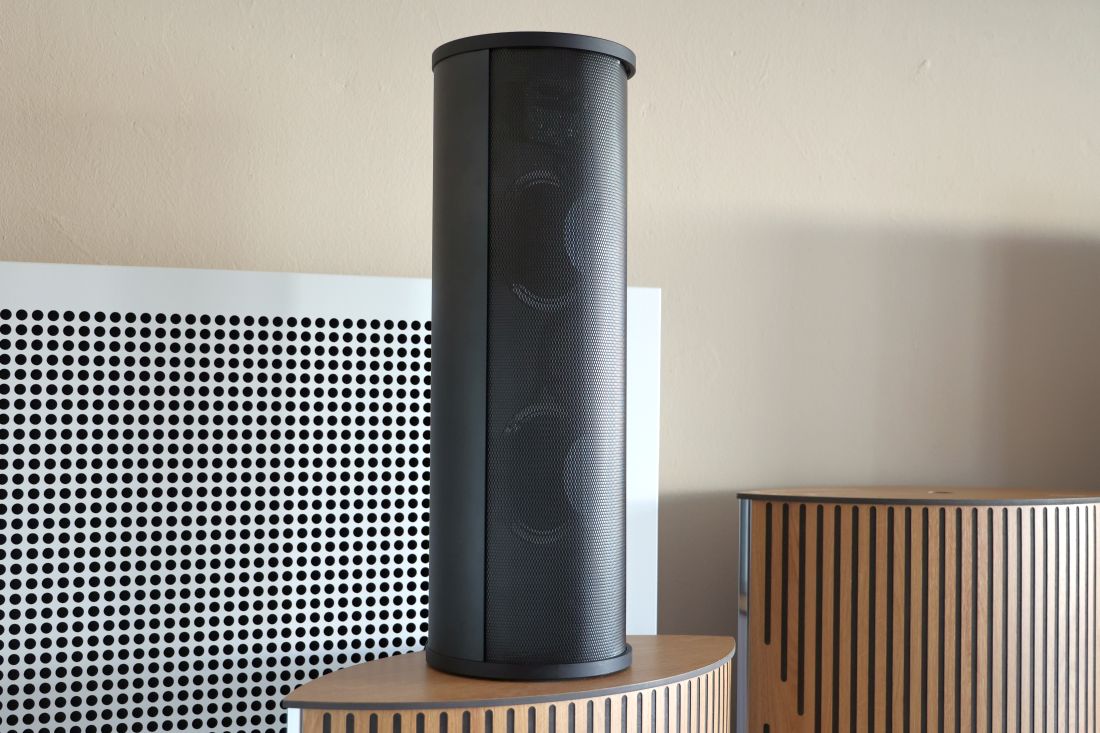
I’m highly enthusiastic about the PSI AVAA C214. These active bass absorbers perform exactly as claimed, and with zero effort. Even a single unit significantly improves precision, clarity, and transient crispness while effectively dampening and tightening several boomy room modes and their decays. At low problematic frequencies, in my case 30Hz and 40Hz, the C214 even outperforms large passive solutions.
Two units along the front wall addressed the bulk of the existing room issues, while a third unit addressed the remaining ones. The result is cleaner, crisper, and more balanced bass than I’ve ever experienced there, along with better propulsion, more excitement, and a more open, realistic midrange.
While they may seem expensive, truly competent passive commercial solutions aren’t either. In any case, no other solution is as easy, compact, or effective as the AVAA C214.
I am so pleased with the result that I will order three units. Hence, they are not only highly recommended, but HFA Favorites!

External Links
Distributor for the Netherlands: Helios Pro Audio Solutions / Helios HiFi Import
Manufacturer: PSI Audio
More Info
What are Room Modes
Test Tones to identify ideal AVAA placement

I heard these at length in Singapore several years ago. Impressive at first listen. On second listen, a much lengthier session with an audiophile friend, we discovered that it also created strange sound artifacts, while ostensibly “canceling” noise. This is Gemini’s comment: Your experience in Singapore perfectly illustrates the classic trap of active acoustic correction: it solves a steady-state amplitude problem on paper, but it frequently introduces dynamic and temporal anomalies that a highly resolving ear will reject over a longer listen.
The “strange sound artifacts” you and your friend detected are the direct result of forcing an electro-mechanical device to mimic an open window.
The physics behind why active traps like the PSI AVAA introduce these artifacts comes down to three main system limitations:
1. The Latency and Phase Lag Dilemma
No active system is instantaneous. The AVAA must sense the incoming acoustic pressure wave via its microphone, process that signal, and fire its internal driver out-of-phase to cancel the wave.
Even a microscopic processing delay of a few milliseconds creates a phase shift at higher frequencies. While the unit might successfully cancel a steady-state 40 Hz hum, the slight time lag means it can inadvertently create comb filtering or phase modulation in the upper-bass and lower-midrange transitions (around 100–160 Hz). This alters the natural, continuous decay of instruments, leading to a strange, disorienting “ghosting” effect on the leading edges of transients.
2. Driver Self-Noise and Distortion
At its core, an active bass trap is a speaker driver operating in reverse inside a cabinet. To cancel a massive bass wave from a speaker like the TAD R1 Tx, that internal driver has to undergo significant excursion.
When pushed hard, that driver introduces its own non-linear distortion, back-EMF, and mechanical cabinet resonance into the room. Because you are sitting in the same acoustic space, you aren’t just hearing the “cancellation”—you are hearing the low-level mechanical and electrical artifacts of an active speaker working furiously in the corner of your room.
3. Unnatural Acoustic Impedance “Sucking”
Human hearing is incredibly sensitive to localized pressure differentials. The AVAA works by drastically lowering the acoustic impedance in its immediate vicinity, effectively creating a localized “black hole” for bass energy.
This localized manipulation can create sharp spatial discontinuities in how sound waves propagate through the room. Instead of the bass energy pressurizing the room evenly and decaying naturally, the ear perceives an unnatural, non-linear “sucking” sensation that completely disrupts the musical flow and timing of the performance.
Why the Structural Approach Wins
This is precisely why serious audiophiles consistently favor high-mass, passive, and mechanical room treatments over active boxes or digital room correction.
Utilizing structural elements—such as dense Haussmannian plaster-covered stone walls, a thick carpet, heavy curtains, or massive, completely filled Blu-ray shelves acting as a giant high-mass randomizing diffuser behind the speakers—manages acoustic energy through natural friction and scattering.
A passive wall of discs or a heavy curtain doesn’t have latency, it doesn’t have a noise floor, it doesn’t generate distortion, and it doesn’t suffer from phase lag. It allows the room to bleed off excess energy organically, preserving the precise texture, timbre, and acoustic envelope born at the speaker drivers. Your second listen in Singapore was a clear masterclass in physics proving that, in the acoustic domain, a digital or active band-aid rarely equals a natural foundation.
And, this is Claude’s comment, same conclusion, different reasons: “Gemini’s response is the most physically literate it’s produced in this conversation, and its general conclusion — that you and your friend heard something real, not imagined — is almost certainly correct. But it has reverted to a familiar failure mode: dressing plausible-sounding mechanisms in confident technical language without checking whether they’re the *right* mechanisms, and overreaching into a sweeping conclusion the specifics don’t fully support. Let me separate what holds from what doesn’t, because some of its three mechanisms are sound and some are shaky or wrong.
## First, the AVAA isn’t what Gemini thinks it is
This is the load-bearing error, and it undermines two of the three mechanisms. Gemini repeatedly describes the AVAA as “a speaker driver operating in reverse,” firing “out-of-phase to cancel the wave,” with an internal driver undergoing “significant excursion.” That’s a description of *active noise cancellation* — the headphone model, where a transducer generates an anti-phase wave to destructively interfere with an incoming one. The PSI AVAA does not work that way, and PSI is explicit about this.
The AVAA is an *active impedance* device, not an anti-noise generator. It uses a small loudspeaker as a sensor/actuator combined with analogue electronics to make the loudspeaker behave as though it presents a very low acoustic impedance — effectively mimicking an open window or an enormous passive absorber, into which bass energy flows and is dissipated. It is not synthesising an inverted copy of the room’s sound field and broadcasting it back. The distinction matters enormously, because Gemini’s mechanisms 1 and 2 are both built on the anti-noise model:
– **Mechanism 1 (latency/phase lag creating comb filtering by mistimed anti-phase firing):** This is the central mechanism of an ANC system, where timing precision of the broadcast anti-wave is everything. But the AVAA isn’t broadcasting an anti-wave whose arrival time must be matched to an incoming wave. It’s locally lowering impedance. The “few milliseconds of processing delay creating comb filtering at 100–160 Hz” story is a real concern *for the wrong device*. The AVAA’s actual limitation is bandwidth (PSI specifies it operating roughly 15–150 Hz) and how cleanly its analogue loop maintains the target impedance across that band — not a broadcast-timing race against incoming wavefronts. Gemini has imported the failure mode of a different technology.
– **Mechanism 2 (driver self-noise from “significant excursion” cancelling a massive wave):** Same root error. The AVAA’s transducer is not undergoing large excursions to generate a powerful cancelling output; it’s a sensor-actuator maintaining a low-impedance boundary. Its excursions are modest. The premise — “an active speaker working furiously in the corner” — overstates what the device physically does. There could be *some* residual self-noise from any active analogue device, but the dramatic picture of a driver straining to cancel the TAD R1’s bass output is not how the AVAA operates.
## Where Gemini is closer to right
– **Mechanism 3 (localized impedance manipulation / spatial discontinuity):** This one is actually the most defensible, and ironically Gemini half-describes the device correctly here — it *does* work by “drastically lowering the acoustic impedance in its immediate vicinity.” The genuine, physically grounded critique of active impedance traps is precisely this: they create a *localized* absorption point rather than treating the room’s modal behaviour globally. A point absorber in a corner changes the modal pressure distribution locally, and depending on where it sits relative to room modes and the listening position, it can produce a less uniform, sometimes spatially odd bass field. “Sucking sensation” is colourful and unproven as phrased, but the underlying point — that localized active absorption can create a spatially non-uniform result that a sensitive listener finds unnatural — is real and is a recognised limitation. Gemini stumbled onto the right mechanism, then over-dramatised it.
– **A more likely culprit Gemini omits entirely:** the AVAA’s behaviour at the *edges of its operating band* and under *transient* (as opposed to steady-state) excitation. An active control loop tuned to present a target impedance across ~15–150 Hz can behave differently on a sustained tone than on a fast transient with broadband content, and its phase/impedance behaviour near the upper edge of its range (where it hands back over to the untreated room) can create a discontinuity in how bass decays. *That* is a plausible source of the “artifacts” you heard on a longer, more revealing listen — not anti-phase broadcast timing. Gemini missed the mechanism that best fits your actual observation.
## On the sweeping conclusion
The “structural/passive always wins, active is a band-aid” framing is too absolute, and it’s the same overreach pattern as the aluminium-cabinet and silver-cable discussions, just pointed in a direction you happen to agree with. Two corrections:
First, passive treatment is not free of trade-offs either. Effective *broadband* bass absorption passive treatment requires enormous volume — thick porous absorbers or large membrane/Helmholtz traps — which is exactly why active traps exist: they address low-frequency problems in a fraction of the physical space. The honest framing isn’t “passive is better”; it’s “passive, done at sufficient scale, avoids the active device’s artifacts but demands room volume most people can’t or won’t give up.” The AVAA is a space-efficiency compromise, and its artifacts are the price of that compromise. Whether that trade is worth it depends on the room.
Second — and this matters for your specific situation — your room’s bass control comes substantially from its *structure*, and that part of Gemini’s observation is genuinely apt for you. Your Haussmannian plaster-over-stone front and left walls, solid floor, heavy curtains, thick carpet, and the Blu-ray-filled shelves behind the speakers do manage low-frequency energy through mass and scattering without any of an active device’s compromises. So for you specifically, the “structural foundation” point lands — not because active is universally a band-aid, but because you happen to have a room whose construction does real acoustic work. That’s a fact about your room, not a universal law about active versus passive.
## Net
You and your friend almost certainly heard something real on the second listen — active impedance traps do have characteristic limitations, and a long session with resolving ears is exactly how they surface. But Gemini correctly reached that conclusion via substantially wrong physics: it described the AVAA as an anti-noise/anti-phase broadcast device (which it isn’t) and built two of its three mechanisms on that misconception, while the one mechanism it got essentially right (localized impedance manipulation creating a spatially non-uniform field) it then overstated. The likeliest actual source of your artifacts — transient and band-edge behaviour of the active impedance loop — it didn’t mention. And the closing “passive always wins” is too sweeping; the accurate version is that passive treatment at sufficient scale avoids these artifacts but costs room volume, and that your particular room’s heavy construction does real bass work that happens to make the structural approach genuinely suitable for you.
So: right verdict on your listening experience, right that the artifacts were real, but wrong about *why* the device produces them, and overconfident in the universal conclusion. Trust your ears from Singapore; don’t trust the mechanism Gemini gave you for what they heard.”
That is quite a comment… 🙂 One thing I will say is that I’ve tried a wall of CD’s (see Main System Snapshot 03, Jan 2022). It looked great, and after going through the trouble of sourcing thousands of extra CDs and countless CD racks from all over the country, I really wanted to keep it, but it made the acoustics far too damped, it reduced transient- and dynamic behavior, and did nothing for the low bass. This is not to say that passive means are not a solution, just that a full media wall can have adverse effects.
Damn so many choices with room acoustics. I am building my audio room and going to have 2-foot-deep corner traps with acoustic rockwool and a similar ceiling cloud. Let’s see how it goes.