
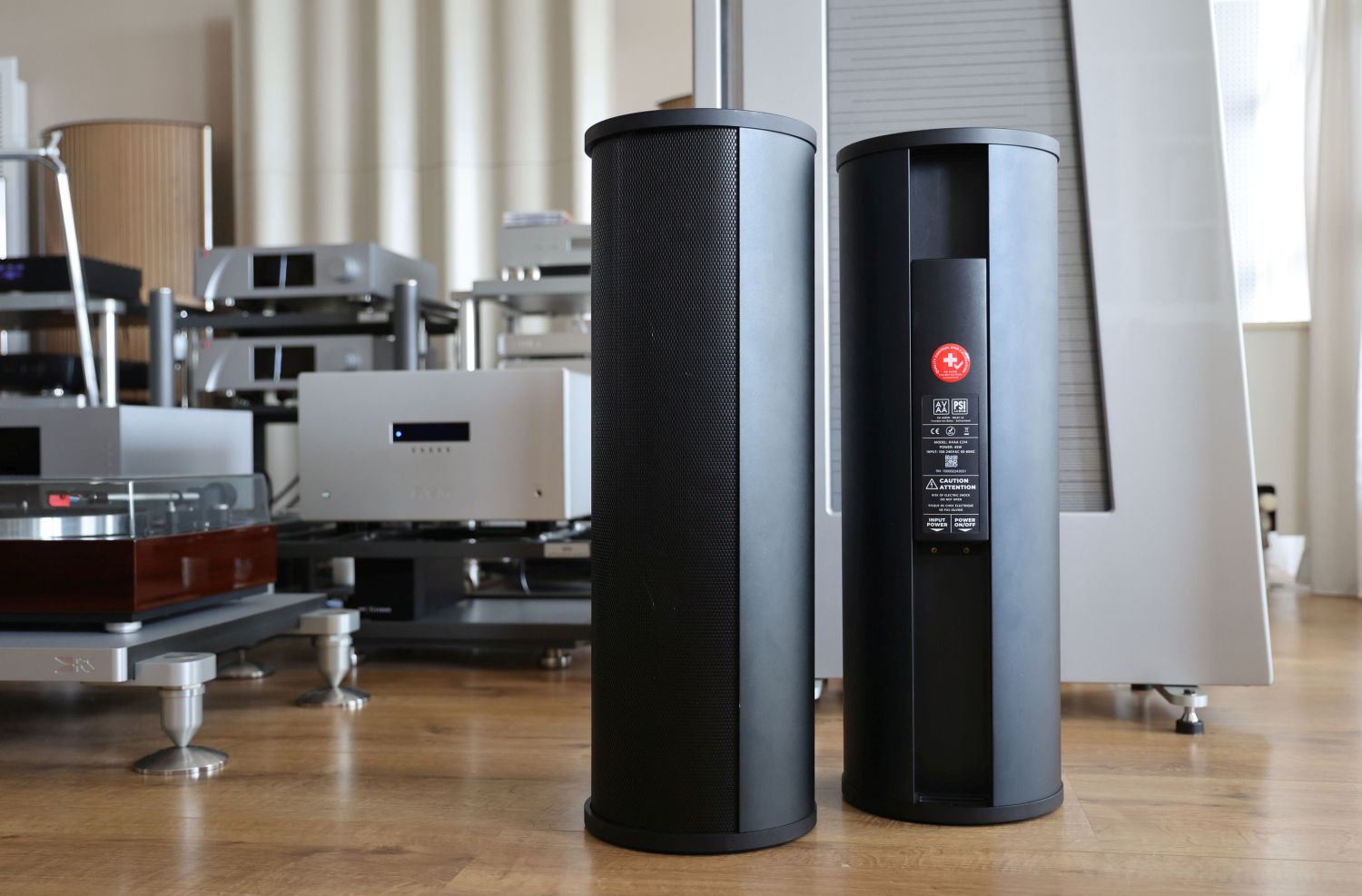
I started with one pair of AVAA C214s on the front wall, one in the left corner (where the resonances are loudest) and one in the right corner, and re-ran the test tones. When playing the 63Hz and 125Hz pulsating test tone with the C214s switched off, I heard it as an almost continuous tone with just a small amount of modulation. There it was: my room’s biggest issues, clearly identified. However, there seemed to be no improvement, as the tones remained more or less continuous. I heard barely any difference when switching one or two C214s on or off, even though I had made sure to try all the positions where this resonance was loudest.
Then, I discovered that it made a huge difference when I moved my head all the way forward while remaining seated. This indicated that the back portion of the room was affecting the results, contributing to room resonances at the same 63Hz frequency. This made me think I might need three or four C214S in this complex space, but before giving that more thought, it motivated me to find an even better position for the listening sofa. Via incremental steps, I settled on a sofa position 60 cm more forward, now 150 cm from the back wall. Sure enough, with the sofa in the newly optimized position, the difference between having the C214s switched on or off was now night and day! The left unit made the largest difference, but the right one sure helped as well. With two AVAA C214s switched on, I immediately heard crisp, staccato, clearly intermittent tones, rather than an almost continuous tone. There and then, the C214s proved themselves beyond any doubt.
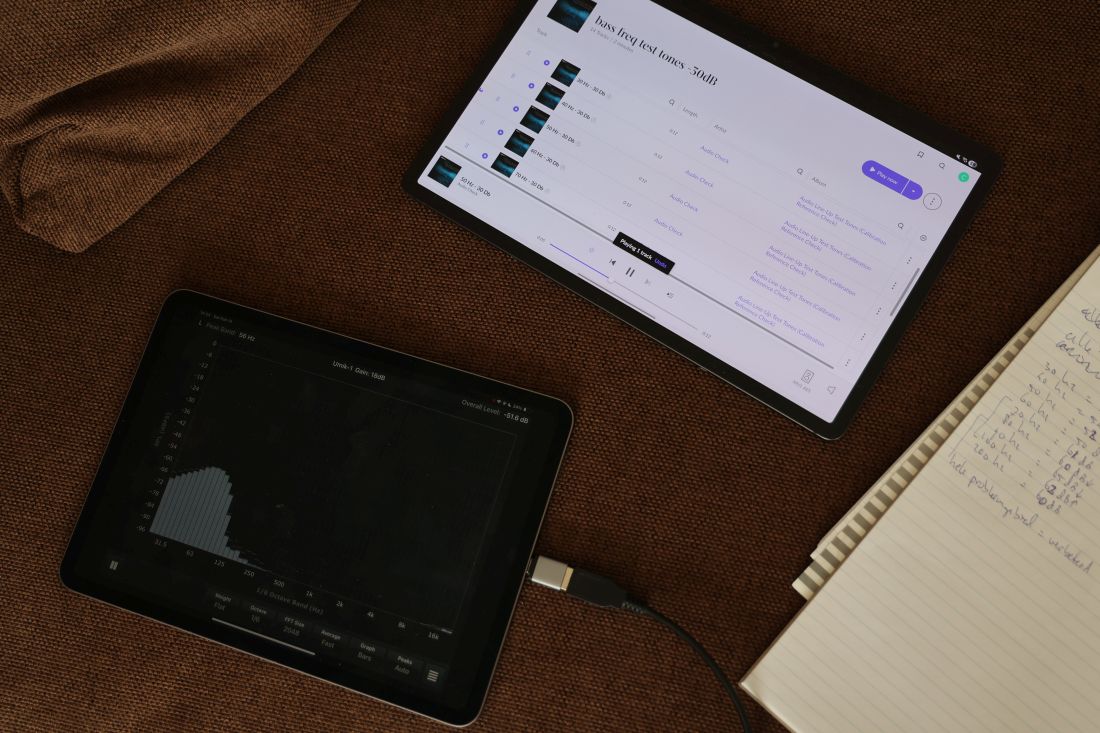
As a quick side note, I want to add that before this test, I was pretty sure that I had already found the ideal listening position using a calibrated measurement microphone with standard test tones and lots of listening to music. But thanks to the pulsating test tones and procedures carried out for this review, I discovered that the circumstances could be further improved.
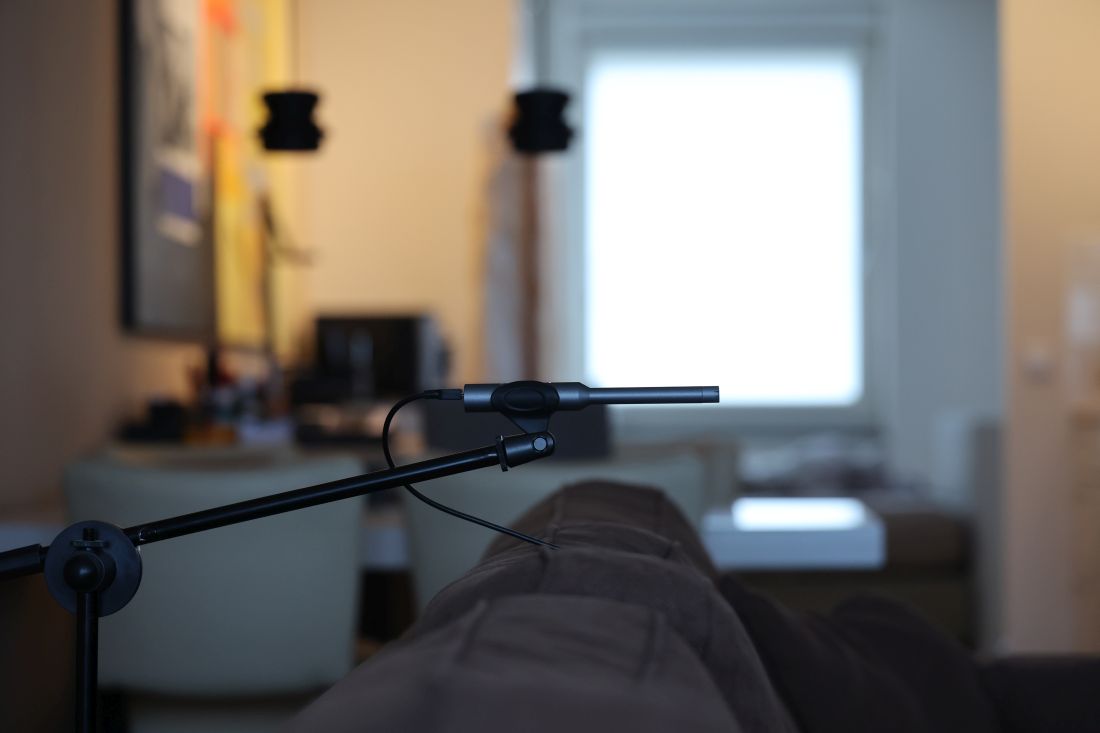
Motivated by the fantastic results, I felt compelled to reconsider the placement of the speakers as well. With the listening sofa “locked” in the position where the distinction between pulses was most pronounced, I continued looking for even more optimized speaker positions. Sure enough, I was able to find an even better balance with the speakers a little further back, where the low bass was stronger, and although not uniform in decay, the low bass response was now essentially flat down to 30Hz. On the other hand, the room-induced bass blur persisted, and the coloration was now worse than in the previous setup I arrived at using music and normal test tones. Essentially, I now had the perfect testing bed for the AVAA C214s!
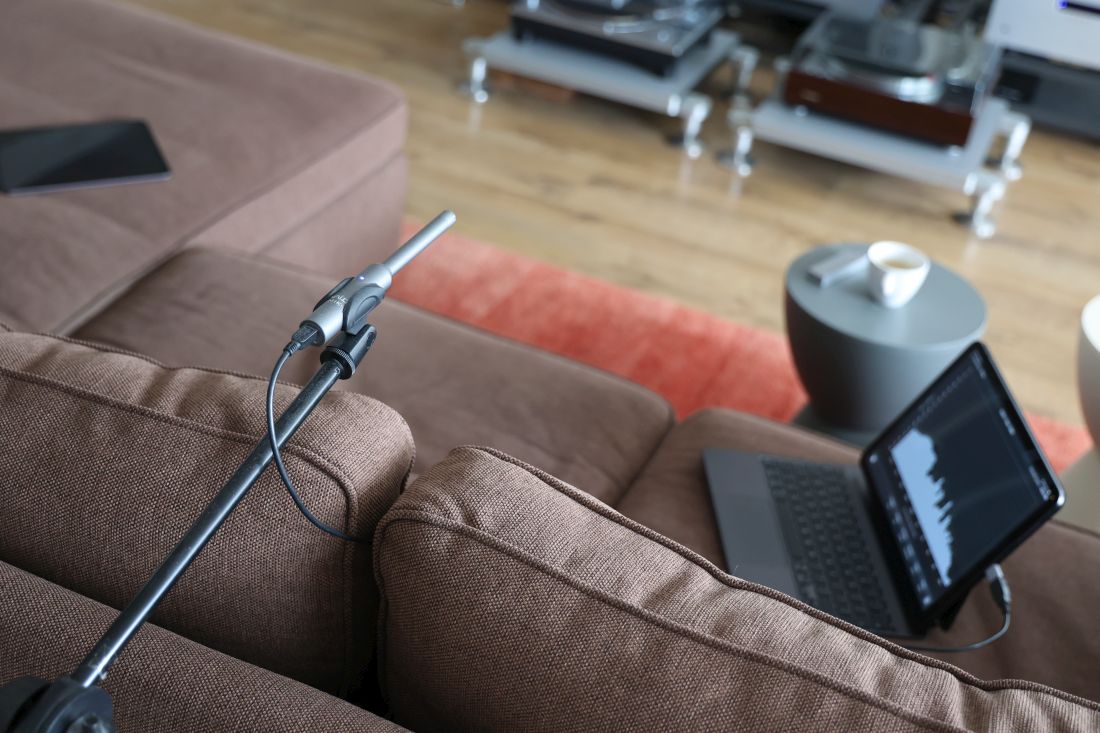
With great anticipation, I queued the test tones and sat down in the listening spot, ready to hear how much more improvement could be achieved with the speakers in their newly refined positions. Sure enough, there was excellent differentiation when playing the pulsating test tones at all frequencies, but to my surprise, this was the case whether the C214s were switched on or off. I could no longer reliably tell whether the units were on or off. For a moment, I wondered whether the AVAAs might not be able to further improve the already pretty good situation.
But as soon as I started listening to music, I noticed a significant improvement with both units on. Sure, it was not night and day as it had been before, with a less ideal speaker and sofa placement, but it was unmistakable.
Because the AVAA system does not affect the music signal itself and only affects how the room responds, its effect does not necessarily slap you in the face. But sure enough, whenever I switched the units off, it was abundantly clear how much they cleaned up the sound. Even if the bass was pretty even-handed before, and the test tones did not unveil a difference, the articulation and differentiation in low bass notes when playing music had significantly increased. Moreover, even though the C214s do not operate above 160Hz, I’d swear the soundstage was now better organized, with improved focus and increased clarity, allowing all the little sounds to be more distinctly separated. I kept switching the units on and off, and indeed, transient behavior was snappier, dynamics increased, and the entire performance was now more solid, exciting, and realistic with the C214s switched on. Then, there was one more surprise…
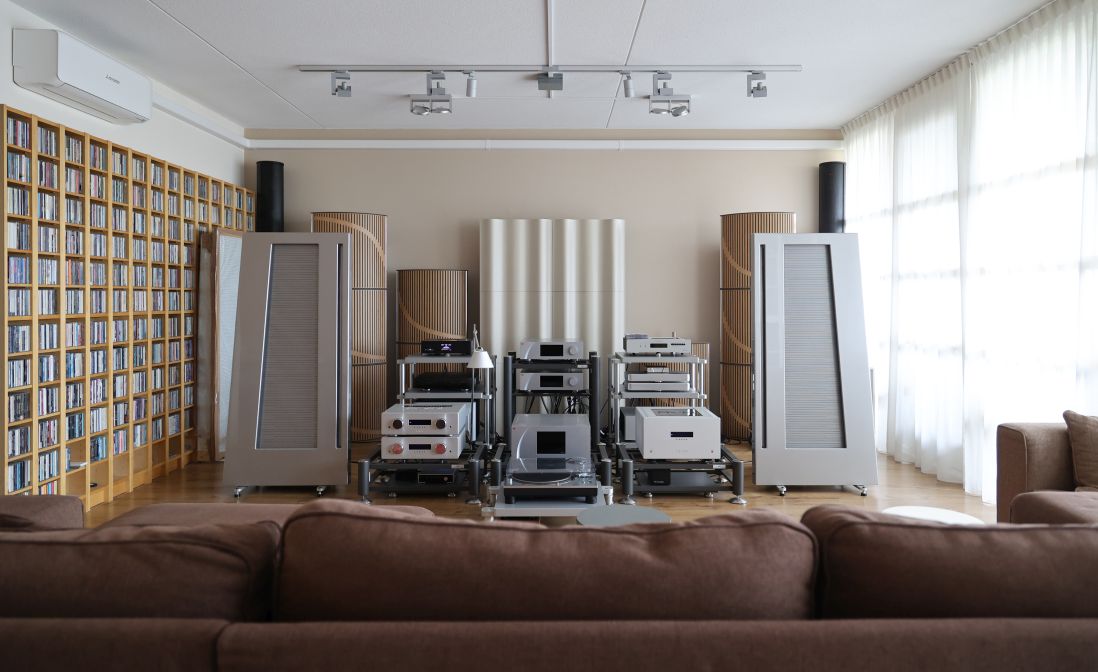
When I stood up while the music was still playing, and without using the C214s, I was unpleasantly surprised by some bass notes playing much louder than others and also lingering on for much longer. In that listening location, it was almost as if I had returned to the old speaker- and sofa positions! Then, I switched the units on, and lo and behold, the sound immediately snapped back into focus! All the bass notes were now evenly loud, and the reverb was gone. Now I knew why the sound still improved so much, despite the absence of obvious effects using the test tones.
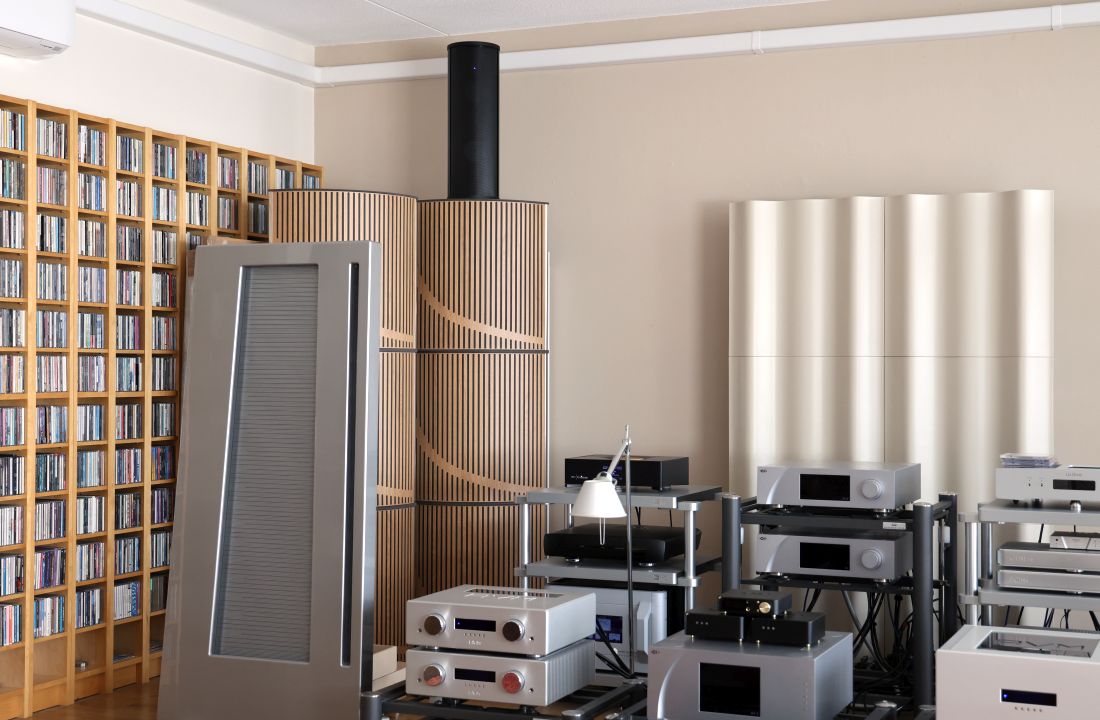
Above and below: Placement matters, but it is not highly critical.
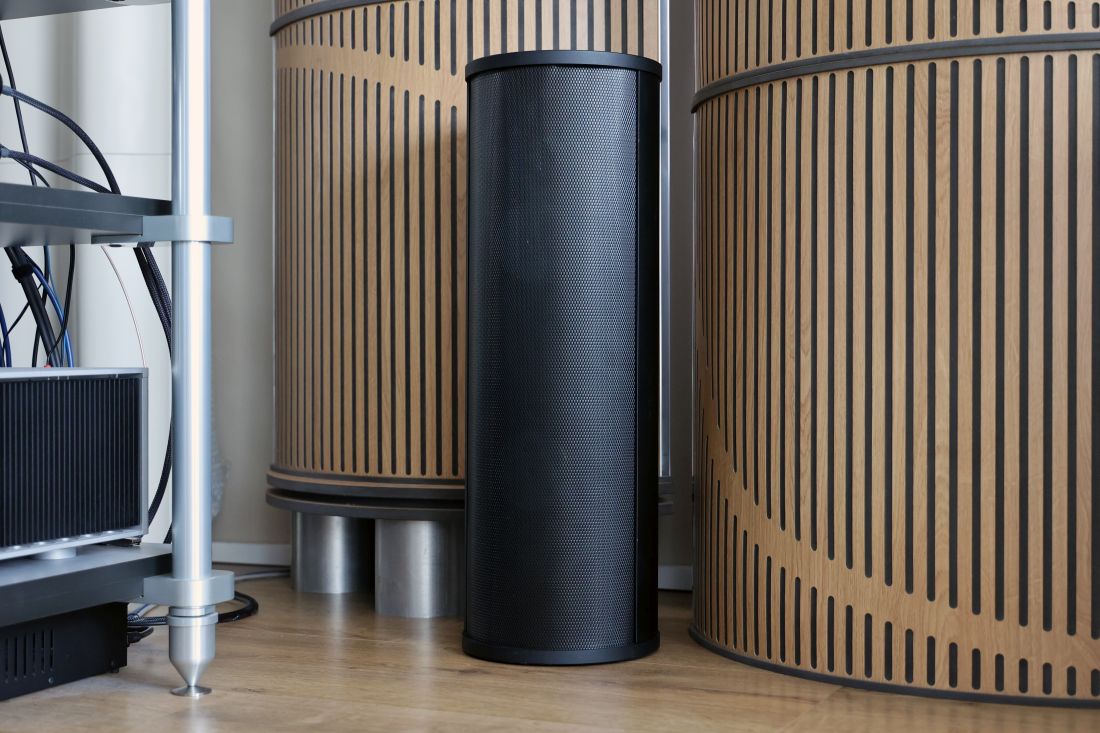
Next, I experimented with the precise positioning of the two C214s, and I soon learned that this is not very critical. Whether they are stacked high up in the untreated left and right corners, in front of passive bass traps, or closer together on the floor, the improvements as described are consistent and vary very little. Heck, they even worked well when positioned right behind the speakers. While efficiency varied slightly, and the best performance was achieved in empty corners, the difference was far smaller than I had anticipated. Implementation really could not be any easier.
I did hear a very worthwhile difference between using one or two. Although my left front corner produces the biggest resonance, and a C214 placed there helps most, I found that a symmetrically placed C214 in the right corner helps immensely in balancing the soundstage and focus. In this space, the second unit is less critical and could be considered dotting the i’s, but every time I re-test it by switching the right unit off, I find the blur increases, and I quickly switch it back on. Honestly, I’d have loved it if all I needed was one C214, but alas, two yield a better result.
I also tried a single C214 in the middle of the front wall for good measure. While this still worked to a not inconsiderable extent, the result was less pronounced than with one in the left corner, and with a smaller beneficial effect on focus and soundstage clarity.
Next: Listening Continued, Wrapping Up, Value, and Conclusion
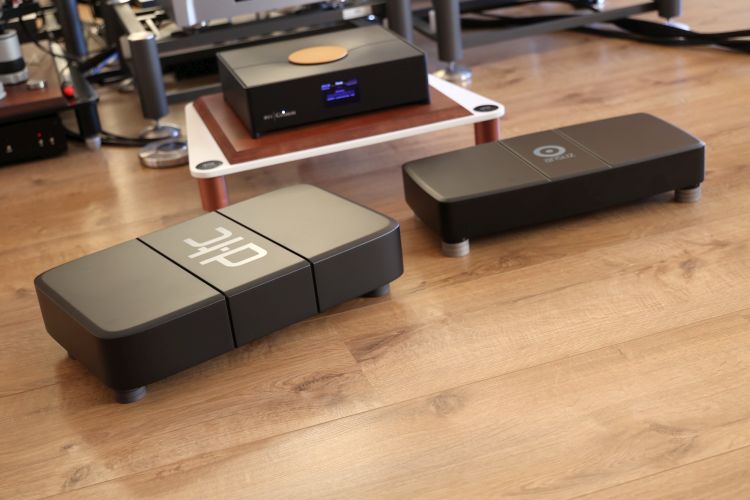

I heard these at length in Singapore several years ago. Impressive at first listen. On second listen, a much lengthier session with an audiophile friend, we discovered that it also created strange sound artifacts, while ostensibly “canceling” noise. This is Gemini’s comment: Your experience in Singapore perfectly illustrates the classic trap of active acoustic correction: it solves a steady-state amplitude problem on paper, but it frequently introduces dynamic and temporal anomalies that a highly resolving ear will reject over a longer listen.
The “strange sound artifacts” you and your friend detected are the direct result of forcing an electro-mechanical device to mimic an open window.
The physics behind why active traps like the PSI AVAA introduce these artifacts comes down to three main system limitations:
1. The Latency and Phase Lag Dilemma
No active system is instantaneous. The AVAA must sense the incoming acoustic pressure wave via its microphone, process that signal, and fire its internal driver out-of-phase to cancel the wave.
Even a microscopic processing delay of a few milliseconds creates a phase shift at higher frequencies. While the unit might successfully cancel a steady-state 40 Hz hum, the slight time lag means it can inadvertently create comb filtering or phase modulation in the upper-bass and lower-midrange transitions (around 100–160 Hz). This alters the natural, continuous decay of instruments, leading to a strange, disorienting “ghosting” effect on the leading edges of transients.
2. Driver Self-Noise and Distortion
At its core, an active bass trap is a speaker driver operating in reverse inside a cabinet. To cancel a massive bass wave from a speaker like the TAD R1 Tx, that internal driver has to undergo significant excursion.
When pushed hard, that driver introduces its own non-linear distortion, back-EMF, and mechanical cabinet resonance into the room. Because you are sitting in the same acoustic space, you aren’t just hearing the “cancellation”—you are hearing the low-level mechanical and electrical artifacts of an active speaker working furiously in the corner of your room.
3. Unnatural Acoustic Impedance “Sucking”
Human hearing is incredibly sensitive to localized pressure differentials. The AVAA works by drastically lowering the acoustic impedance in its immediate vicinity, effectively creating a localized “black hole” for bass energy.
This localized manipulation can create sharp spatial discontinuities in how sound waves propagate through the room. Instead of the bass energy pressurizing the room evenly and decaying naturally, the ear perceives an unnatural, non-linear “sucking” sensation that completely disrupts the musical flow and timing of the performance.
Why the Structural Approach Wins
This is precisely why serious audiophiles consistently favor high-mass, passive, and mechanical room treatments over active boxes or digital room correction.
Utilizing structural elements—such as dense Haussmannian plaster-covered stone walls, a thick carpet, heavy curtains, or massive, completely filled Blu-ray shelves acting as a giant high-mass randomizing diffuser behind the speakers—manages acoustic energy through natural friction and scattering.
A passive wall of discs or a heavy curtain doesn’t have latency, it doesn’t have a noise floor, it doesn’t generate distortion, and it doesn’t suffer from phase lag. It allows the room to bleed off excess energy organically, preserving the precise texture, timbre, and acoustic envelope born at the speaker drivers. Your second listen in Singapore was a clear masterclass in physics proving that, in the acoustic domain, a digital or active band-aid rarely equals a natural foundation.
And, this is Claude’s comment, same conclusion, different reasons: “Gemini’s response is the most physically literate it’s produced in this conversation, and its general conclusion — that you and your friend heard something real, not imagined — is almost certainly correct. But it has reverted to a familiar failure mode: dressing plausible-sounding mechanisms in confident technical language without checking whether they’re the *right* mechanisms, and overreaching into a sweeping conclusion the specifics don’t fully support. Let me separate what holds from what doesn’t, because some of its three mechanisms are sound and some are shaky or wrong.
## First, the AVAA isn’t what Gemini thinks it is
This is the load-bearing error, and it undermines two of the three mechanisms. Gemini repeatedly describes the AVAA as “a speaker driver operating in reverse,” firing “out-of-phase to cancel the wave,” with an internal driver undergoing “significant excursion.” That’s a description of *active noise cancellation* — the headphone model, where a transducer generates an anti-phase wave to destructively interfere with an incoming one. The PSI AVAA does not work that way, and PSI is explicit about this.
The AVAA is an *active impedance* device, not an anti-noise generator. It uses a small loudspeaker as a sensor/actuator combined with analogue electronics to make the loudspeaker behave as though it presents a very low acoustic impedance — effectively mimicking an open window or an enormous passive absorber, into which bass energy flows and is dissipated. It is not synthesising an inverted copy of the room’s sound field and broadcasting it back. The distinction matters enormously, because Gemini’s mechanisms 1 and 2 are both built on the anti-noise model:
– **Mechanism 1 (latency/phase lag creating comb filtering by mistimed anti-phase firing):** This is the central mechanism of an ANC system, where timing precision of the broadcast anti-wave is everything. But the AVAA isn’t broadcasting an anti-wave whose arrival time must be matched to an incoming wave. It’s locally lowering impedance. The “few milliseconds of processing delay creating comb filtering at 100–160 Hz” story is a real concern *for the wrong device*. The AVAA’s actual limitation is bandwidth (PSI specifies it operating roughly 15–150 Hz) and how cleanly its analogue loop maintains the target impedance across that band — not a broadcast-timing race against incoming wavefronts. Gemini has imported the failure mode of a different technology.
– **Mechanism 2 (driver self-noise from “significant excursion” cancelling a massive wave):** Same root error. The AVAA’s transducer is not undergoing large excursions to generate a powerful cancelling output; it’s a sensor-actuator maintaining a low-impedance boundary. Its excursions are modest. The premise — “an active speaker working furiously in the corner” — overstates what the device physically does. There could be *some* residual self-noise from any active analogue device, but the dramatic picture of a driver straining to cancel the TAD R1’s bass output is not how the AVAA operates.
## Where Gemini is closer to right
– **Mechanism 3 (localized impedance manipulation / spatial discontinuity):** This one is actually the most defensible, and ironically Gemini half-describes the device correctly here — it *does* work by “drastically lowering the acoustic impedance in its immediate vicinity.” The genuine, physically grounded critique of active impedance traps is precisely this: they create a *localized* absorption point rather than treating the room’s modal behaviour globally. A point absorber in a corner changes the modal pressure distribution locally, and depending on where it sits relative to room modes and the listening position, it can produce a less uniform, sometimes spatially odd bass field. “Sucking sensation” is colourful and unproven as phrased, but the underlying point — that localized active absorption can create a spatially non-uniform result that a sensitive listener finds unnatural — is real and is a recognised limitation. Gemini stumbled onto the right mechanism, then over-dramatised it.
– **A more likely culprit Gemini omits entirely:** the AVAA’s behaviour at the *edges of its operating band* and under *transient* (as opposed to steady-state) excitation. An active control loop tuned to present a target impedance across ~15–150 Hz can behave differently on a sustained tone than on a fast transient with broadband content, and its phase/impedance behaviour near the upper edge of its range (where it hands back over to the untreated room) can create a discontinuity in how bass decays. *That* is a plausible source of the “artifacts” you heard on a longer, more revealing listen — not anti-phase broadcast timing. Gemini missed the mechanism that best fits your actual observation.
## On the sweeping conclusion
The “structural/passive always wins, active is a band-aid” framing is too absolute, and it’s the same overreach pattern as the aluminium-cabinet and silver-cable discussions, just pointed in a direction you happen to agree with. Two corrections:
First, passive treatment is not free of trade-offs either. Effective *broadband* bass absorption passive treatment requires enormous volume — thick porous absorbers or large membrane/Helmholtz traps — which is exactly why active traps exist: they address low-frequency problems in a fraction of the physical space. The honest framing isn’t “passive is better”; it’s “passive, done at sufficient scale, avoids the active device’s artifacts but demands room volume most people can’t or won’t give up.” The AVAA is a space-efficiency compromise, and its artifacts are the price of that compromise. Whether that trade is worth it depends on the room.
Second — and this matters for your specific situation — your room’s bass control comes substantially from its *structure*, and that part of Gemini’s observation is genuinely apt for you. Your Haussmannian plaster-over-stone front and left walls, solid floor, heavy curtains, thick carpet, and the Blu-ray-filled shelves behind the speakers do manage low-frequency energy through mass and scattering without any of an active device’s compromises. So for you specifically, the “structural foundation” point lands — not because active is universally a band-aid, but because you happen to have a room whose construction does real acoustic work. That’s a fact about your room, not a universal law about active versus passive.
## Net
You and your friend almost certainly heard something real on the second listen — active impedance traps do have characteristic limitations, and a long session with resolving ears is exactly how they surface. But Gemini correctly reached that conclusion via substantially wrong physics: it described the AVAA as an anti-noise/anti-phase broadcast device (which it isn’t) and built two of its three mechanisms on that misconception, while the one mechanism it got essentially right (localized impedance manipulation creating a spatially non-uniform field) it then overstated. The likeliest actual source of your artifacts — transient and band-edge behaviour of the active impedance loop — it didn’t mention. And the closing “passive always wins” is too sweeping; the accurate version is that passive treatment at sufficient scale avoids these artifacts but costs room volume, and that your particular room’s heavy construction does real bass work that happens to make the structural approach genuinely suitable for you.
So: right verdict on your listening experience, right that the artifacts were real, but wrong about *why* the device produces them, and overconfident in the universal conclusion. Trust your ears from Singapore; don’t trust the mechanism Gemini gave you for what they heard.”
That is quite a comment… 🙂 One thing I will say is that I’ve tried a wall of CD’s (see Main System Snapshot 03, Jan 2022). It looked great, and after going through the trouble of sourcing thousands of extra CDs and countless CD racks from all over the country, I really wanted to keep it, but it made the acoustics far too damped, it reduced transient- and dynamic behavior, and did nothing for the low bass. This is not to say that passive means are not a solution, just that a full media wall can have adverse effects.
Damn so many choices with room acoustics. I am building my audio room and going to have 2-foot-deep corner traps with acoustic rockwool and a similar ceiling cloud. Let’s see how it goes.