Review sample provided by Grimm Audio
Retail price including VAT: €23.999 per pair
PA1 description
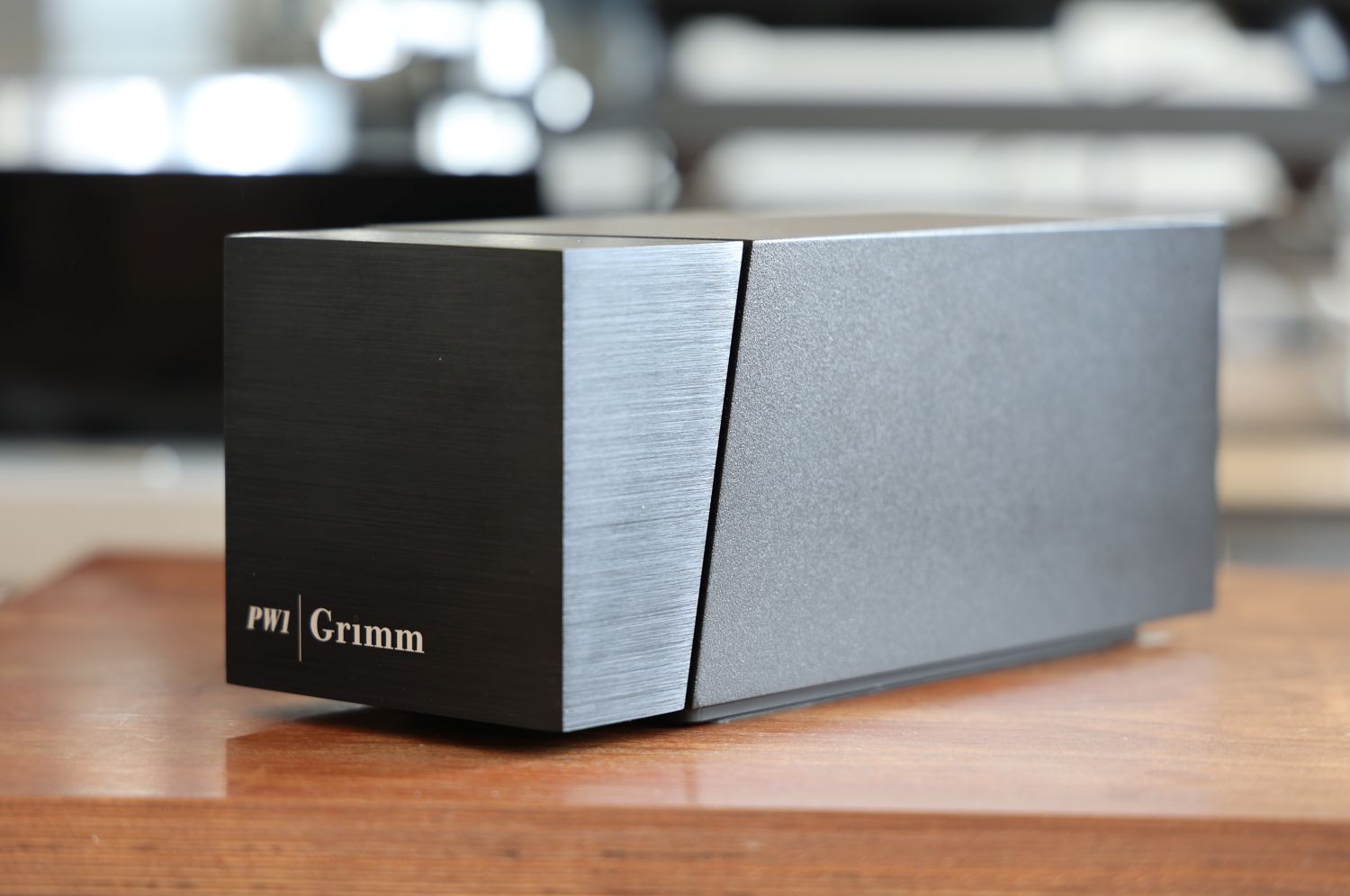
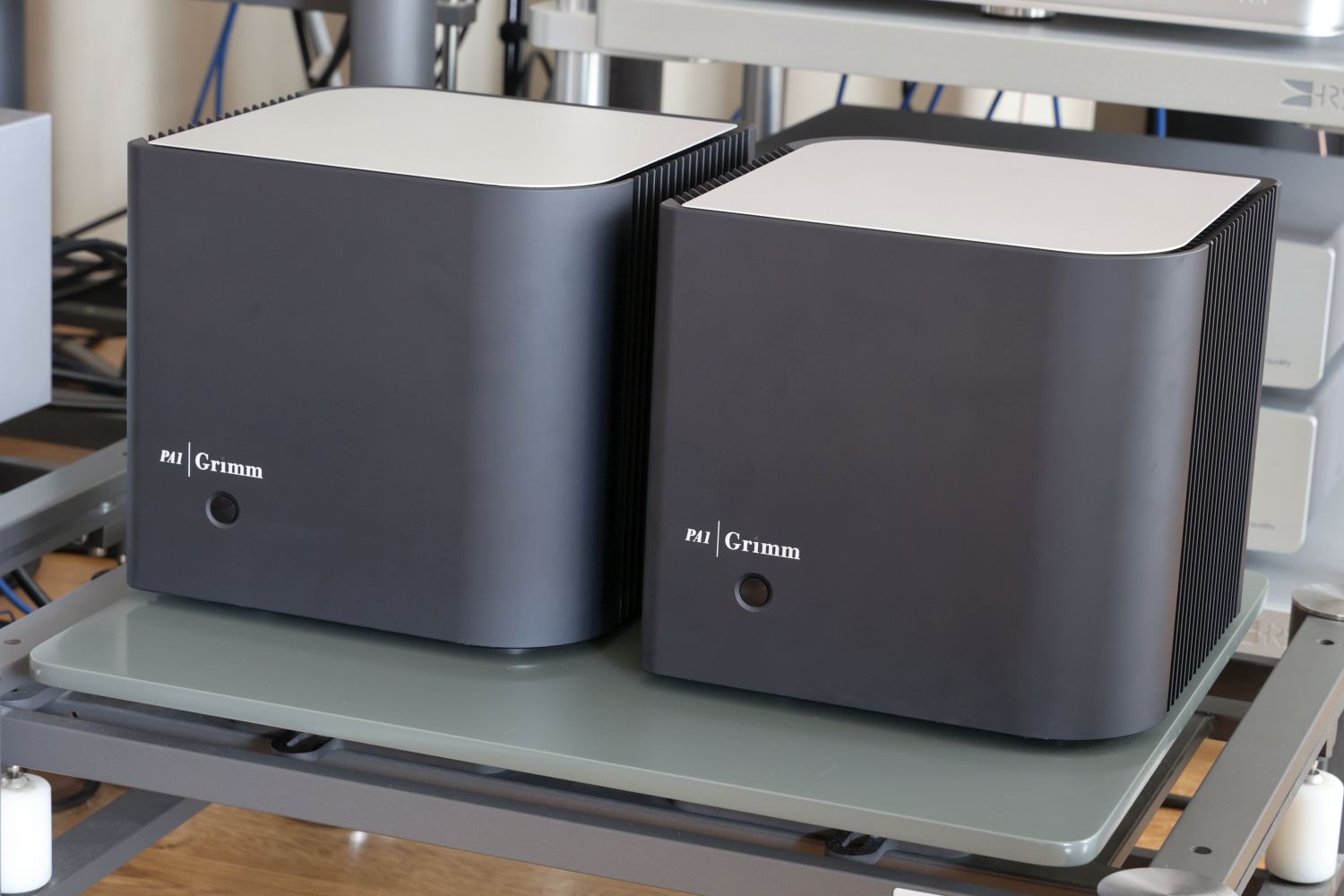
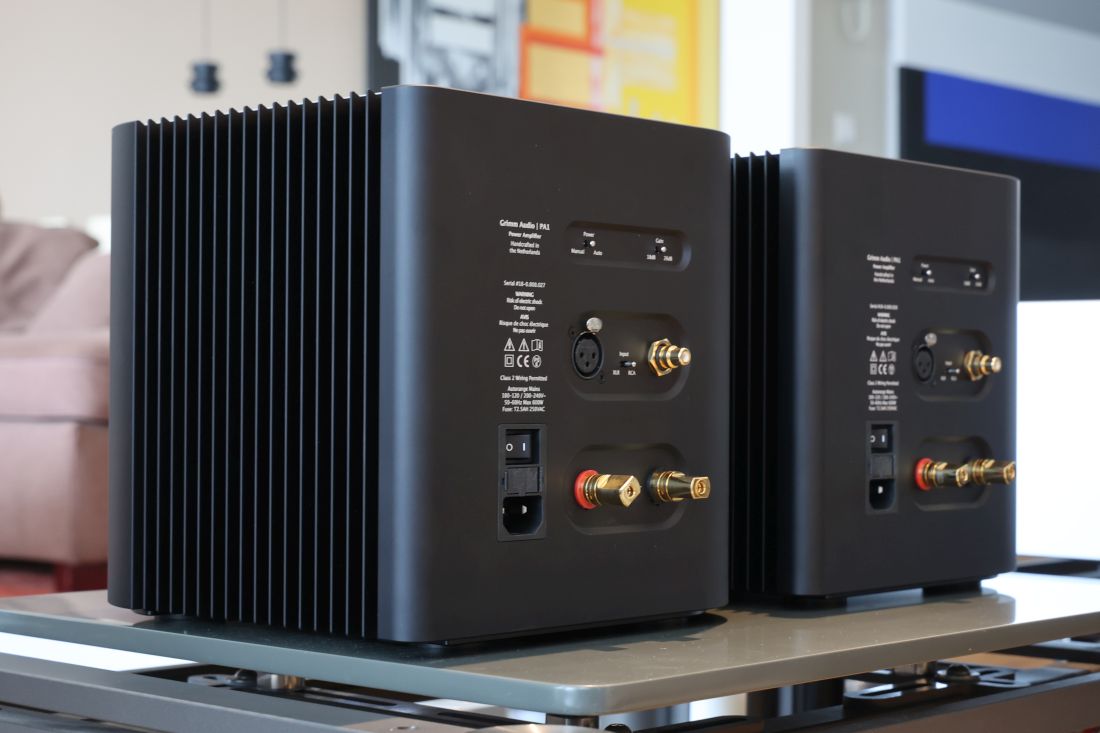
Designed by Michiel Uylings, who also designed the MU1 and PW1, the PA1 features a seemingly simple yet intriguing design that marries a classic square shape to modern asymmetrical curves, resulting in a highly elegant appearance. The cooling fins are perfectly integrated, flush with the sides and top panel, with no screws or perforations in sight. With its small 25 cm x 25 cm footprint, two of these beauties will fit side by side on most shelves.
The PA1 mono-block power amplifier minimizes dynamic signal distortion that many overlook, but that greatly affects sound quality. The Grimm engineers took an ingenious amplifier concept to the next level through a meticulously optimized design that takes full advantage of modern technologies. The amplifier delivers what may seem like a modest 100 watts into 8 Ohms, but it doubles to 200 Watts into 4 Ohms, indicating a very low-impedance output and high stability.
Technical Details
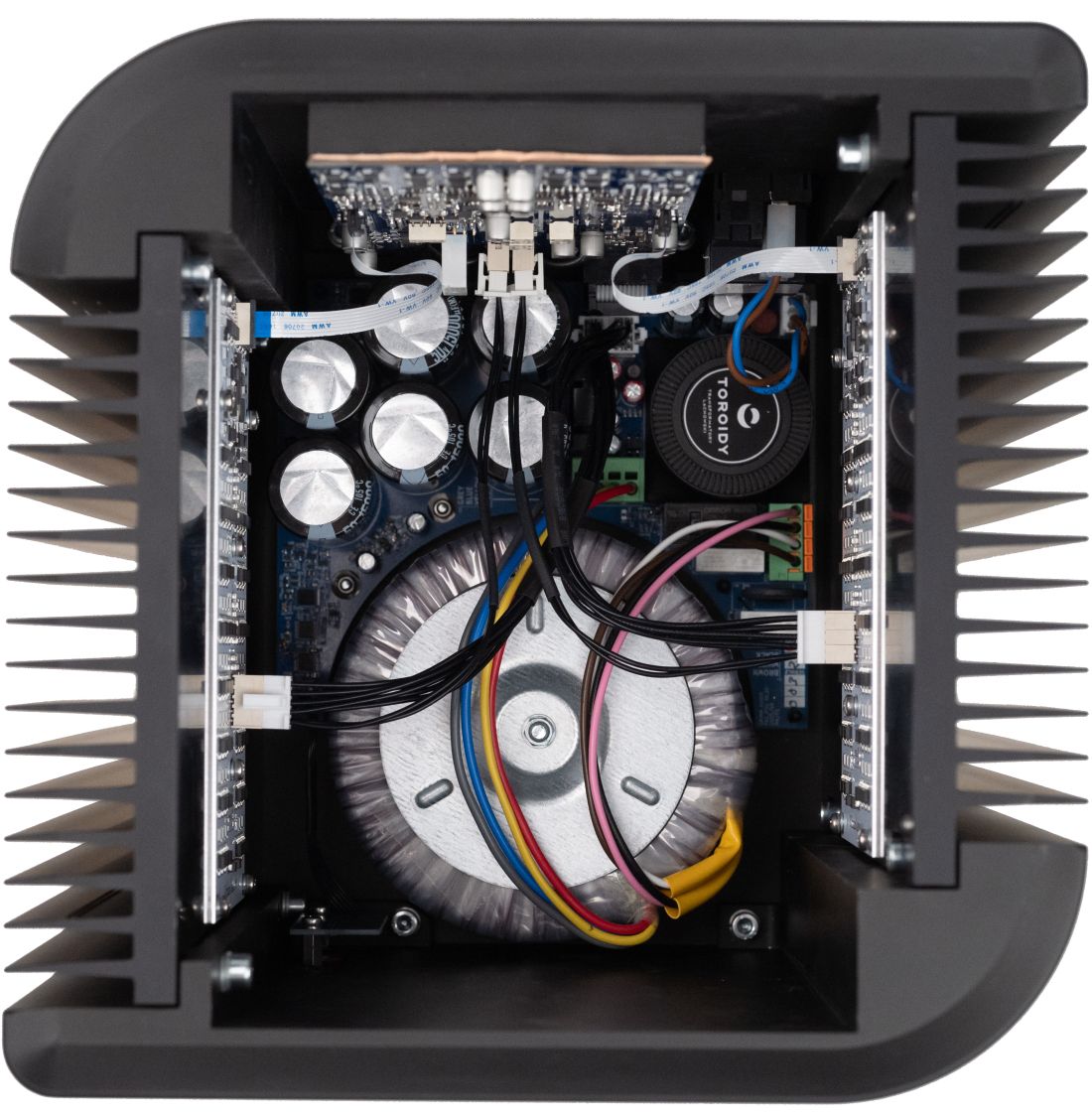
One of the most striking design choices in the PA1 is its output power stage. It is a traditional ‘Class AB’ design, but with a unique twist. The output stage is a fully symmetrical circuit, with no fewer than 96(!) small, fast power transistors to achieve very high bandwidth. This technique became possible with modern aluminum printed circuit board technology, which provides extremely tight thermal coupling among all the power transistors. A special output driver circuit, mounted on the same aluminum printed circuit board, sets the quiescent current point (Bias) of the output-stage transistors.
This circuit is derived from an original design by the late Henk ten Pierick, dating back to 1985. His concept provides an extremely well-defined power-output-stage setting point, through which the impedance remains constant across the full crossover region, resulting in the lowest possible distortion of dynamic signals. The tight thermal coupling of the output-stage transistors with the driver stage ensures this ideal setting point is maintained even when large (low-frequency) currents are delivered to the loudspeaker. The PA1 name refers to Henk’s genius; the “Pierick Amp”.
The importance of an extremely stable crossover region in the transfer curve can hardly be overstated, since music signals naturally contain large amounts of low-frequency content. This low-frequency content modulates the output transistors’ temperature, causing an offset from the amplifier’s optimal bias via thermal runaway. Standard 1 kHz waveform THD measurements do not capture the resulting distortion because this signal’s simple and predictable nature has an even-handed effect on the transistors. However, even small changes in an amplifier’s crossover-distortion footprint are audible and degrade true fidelity. The tight thermal coupling of all output devices in the PA1, combined with their clever driving circuit design, prevents such problems fundamentally ‘by design’.
Another often-overlooked type of distortion is phase modulation, which occurs when the circuit’s speed varies with the audio signal’s amplitude. Like crossover distortion, phase modulation produces a distortion profile that varies across the different frequency components of the music signal. For instance, the (usually large) low-frequency components of a bass instrument can cause time smearing in the higher-frequency components of instruments and voices. In the power stage and other signal stages of the PA1, dedicated design techniques, including feedforward corrections, keep this type of distortion extremely low.
With this highly optimized and fast amplifier circuitry, an appropriate amount of global feedback is applied. Grimm developed a second-order feedback loop for the PA1, which further reduces the last remnants of distortion. The very careful and unique design of this feedback circuitry – again preventing phase modulation and thermal errors in this part – further strengthens the fidelity of the amplifier.
In addition, the input signal path is designed without series coupling capacitors, preventing any audio degradation of the incoming signal. A meticulously optimized multilayer PCB layout preserves input signal integrity. The input signal routing to the circuitry is kept as short as possible, as is the critical output-signal wiring. To prevent output-signal degradation, PA1’s clever protection circuitry is designed to work without relay contacts in the output signal.
A large Amplimo toroidal power supply transformer ensures minimal capacitive coupling from the mains rails while providing ample current. The transformer current is buffered by a massive 90.000uF supply decoupling capacitance. In addition, the power supply to the driver and feedback circuitry is stabilized locally, ensuring stable operation independent of the output current drawn by the loudspeaker.
Specifications
- Power: 100 W in 8 Ω, 200 W in 4 Ω
- SNR: 96 dB (1 W, 8 Ω)
- THD: <0.0001 %
- Damping Factor: >800 re 8 Ω
- Frequency response: 0.1 Hz – 300 kHz
- Weight: 15 kg
- Dimensions: w x d x h: 250 x 250 x 240 mm

First impressions at the Vienna High End Show
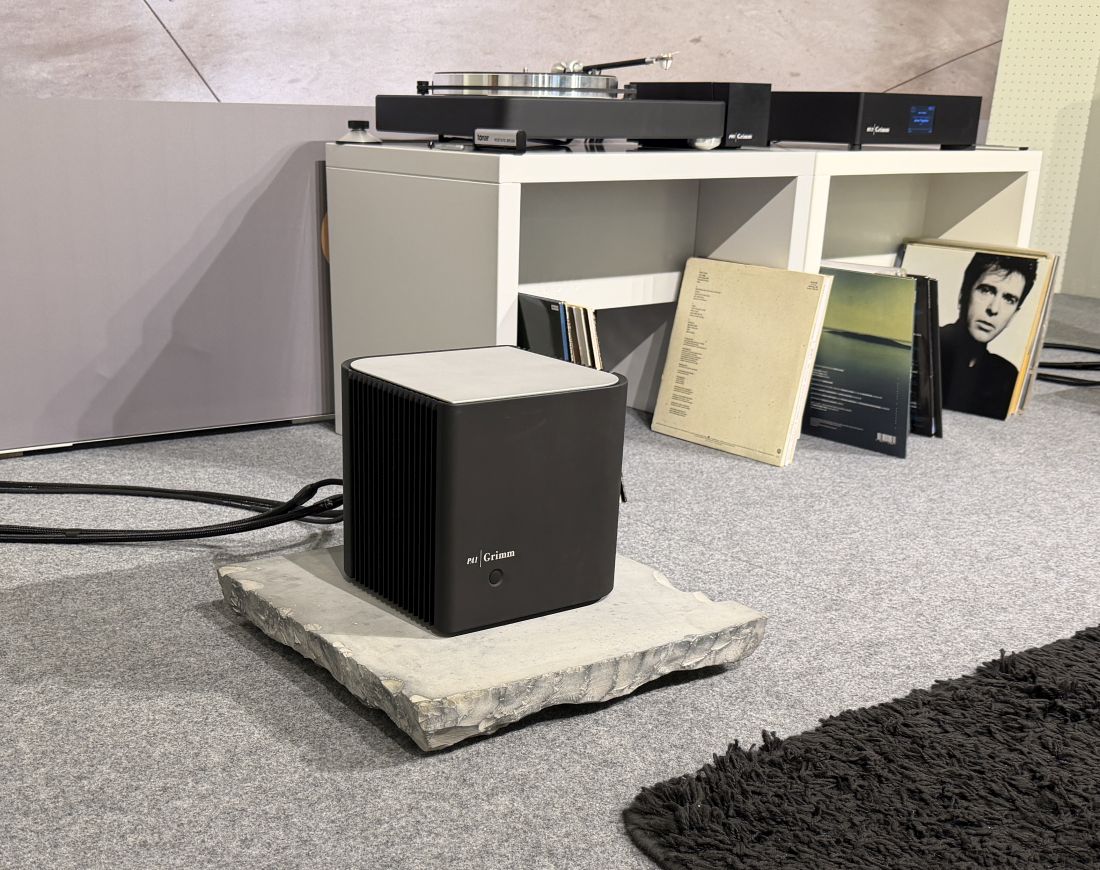
I first heard the PA1’s at the High End Show in Vienna earlier this year, where they were driving brand-new passive Grimm Audio speakers. These speakers had such full and rich bass that it made me look behind the banner for a subwoofer. The system as a whole sounded remarkably musical and engaging, but because I hadn’t heard these speakers before, I couldn’t isolate the power amplifiers’ performance.
Review Context
I listened to the Thiele TT01 in the main system, comprising the CH Precision C1.2 DAC, L1 preamplifier, and A1.5 power amplifier. Digital sources include the Grimm MU1 and Antipodes Oladra music servers, and the Aqua La Diva M2 CD Transport. Speakers are the Apogee Duetta Signature (recently refurbished and fitted with new foils). All interlinks are Driade Flow Link Reference 808, and the speaker cables are Driade Flow Reference 808. All components (including review components) are powered by the PS Audio P20 PowerPlant.

Listening
According to Grimm, the PA1 offers both the musicality of the best tube-based designs and the rock-solid performance of the best solid-state designs. When I think of a typical tube sound, I imagine a lush, harmonically rich midrange and a voluptuous bass that feels more easygoing than tight and controlled. I recognize the typical transistor downsides, but when choosing a transistor amplifier, I’d want it to excel at the typical transistor strengths, even if it also incorporates typical tube strengths. One shouldn’t come at the expense of the other. In reality, however, that is often the case.
The PA1 “Under the hood” whitepaper describes “an absolutely pristine audio playback with an extreme authority in the bass, true-to-life mids, and clean transient highs, with crisp speed and clarity”, which does not read like a typical “lush and relaxed” tube sound.
All in all, I wasn’t sure what kind of sound signature to expect, other than generally good performance. After all, Grimm has been on a home run since the MU1 Music Server and PW1 Phono Stage, which I both purchased after their review.
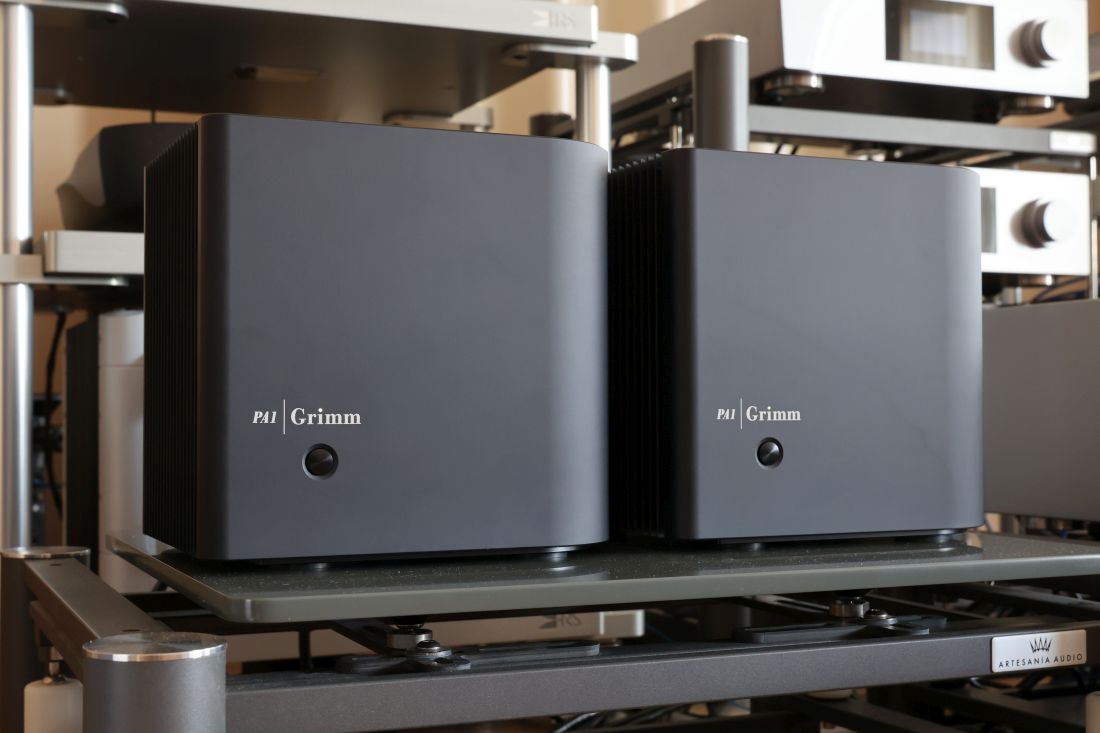
Two PA1s fit perfectly on a single 53.5 cm-wide Artesania Audio Krion KSH2 shelf
The pair I received was practically new, and Eelco forewarned me about the considerable impact of running in. When Grimm says something like that, you can be sure it’s true, because they don’t subscribe to the audiophile-tweakery school of thought and prefer to rely on measured or undeniably perceived performance.
Nevertheless, from the moment I connected them, the amplifiers sounded superb—or rather, they barely sounded at all, which is about the highest compliment I can give a power amplifier. That‘s why I use the CH Precision A1.5: for its neutrality and complete lack of editorializing or added character. Coming from the A1.5 and listening to the PA1 pair unboxed mere hours earlier, the difference was astoundingly small. This is an absolute rarity. In fact, it only occurred twice in the past 7 years.
The first time was with the spectacular Halcro Eclipse, which reigns supreme at not sounding like a transistor amplifier at all, but with a starting price of 47.900 euros, cost is a significant factor. The second time this happened was with the 36.390 euro WestminsterLab Rei monos. These amplifiers were leaner in the bass and less harmonically saturated than the A1.5, and they were certainly less tube-like, but otherwise shared the remarkable absence of additive character. And that brings me to the Grimm PA1s, a pair of unassuming small amplifiers… that actually tick many of the same boxes as the Halcro, WestminsterLab, and CH.
This early in the review, the PA1s performed so effortlessly neutrally and naturally that I worried I’d have little to write about. The PA1s and A1.5 really only differed in bass fullness and transient attack, where the A1.5 sounded more impressive, at least with the user-adjustable setting for the balance between local and global feedback set to 20% (meaning 20% global feedback and 80% local feedback), which I normally use. In fact, it occurred to me that the PA1s sounded a lot like the A1.5 with its feedback set to 0% (only local feedback).
But as mentioned, this was only the first day of the review.
Next: Listening Continued and Conclusion