
Review Context
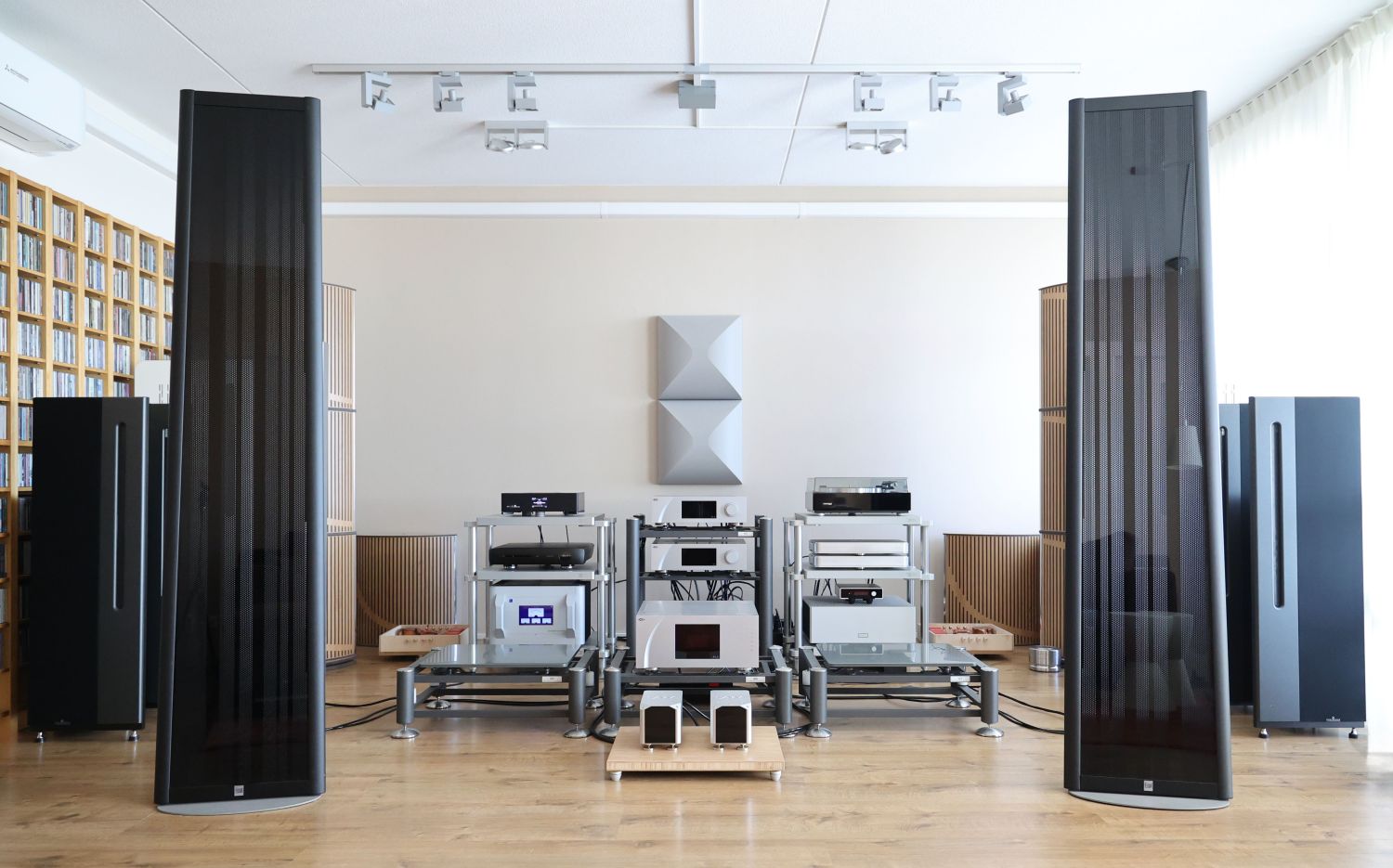
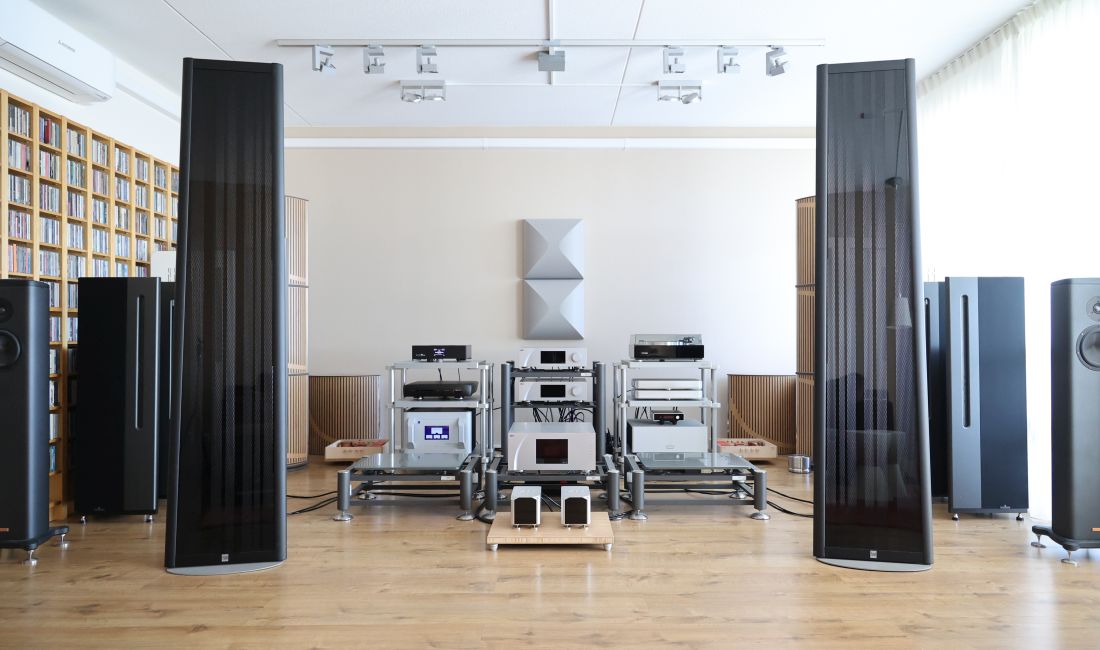
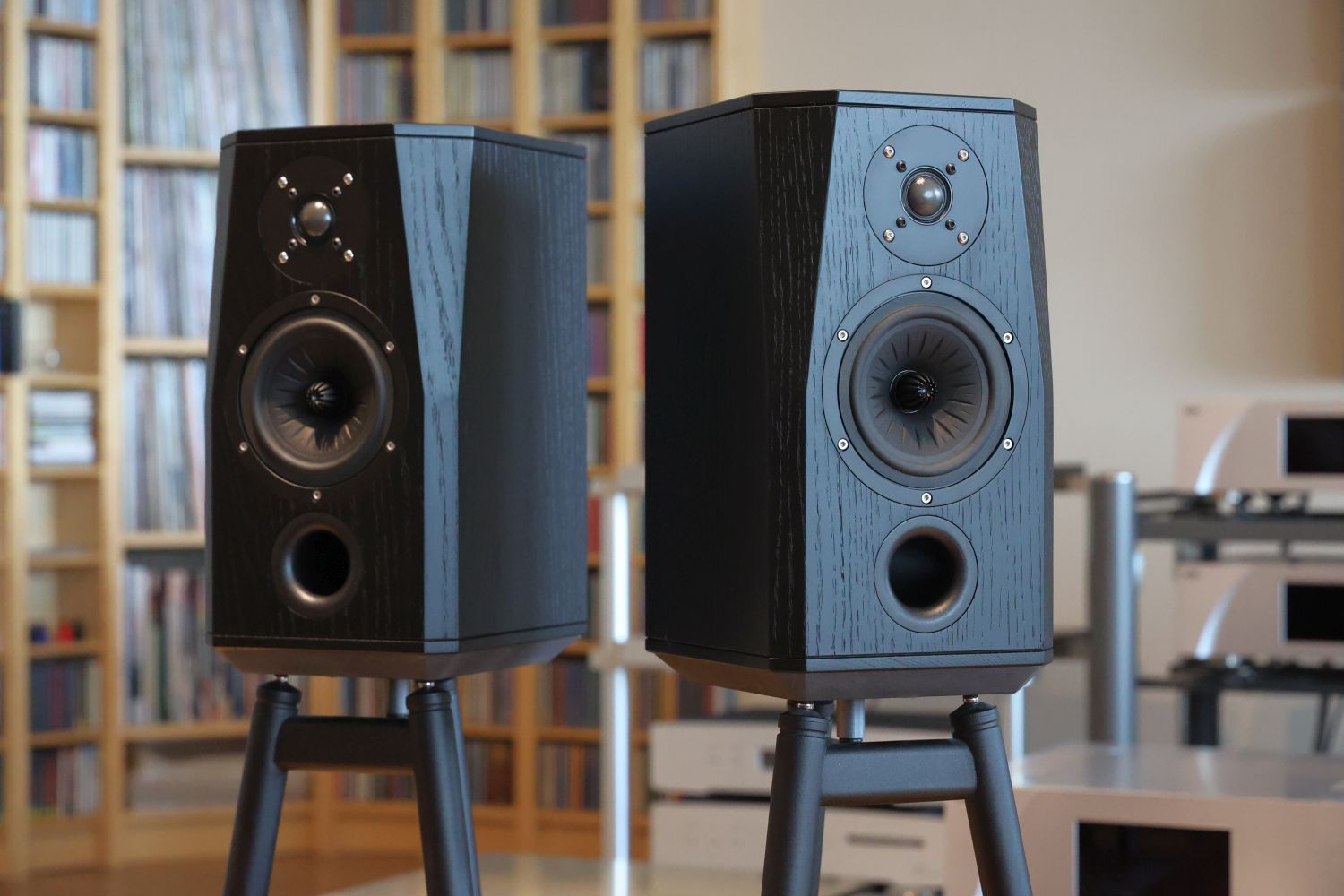
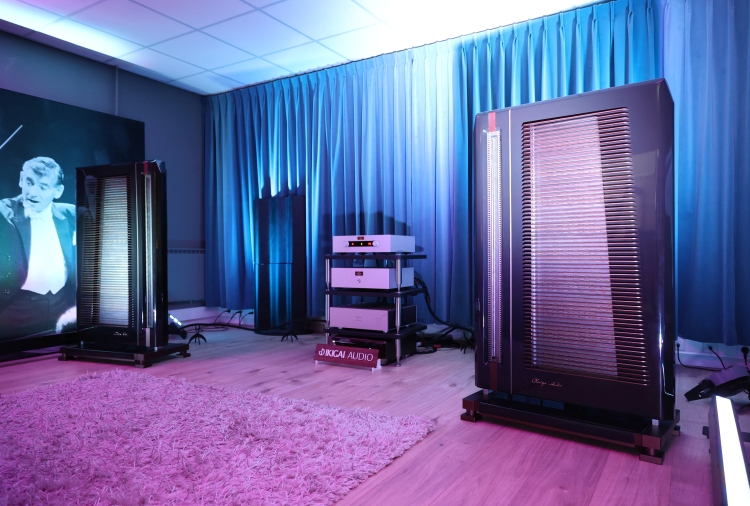
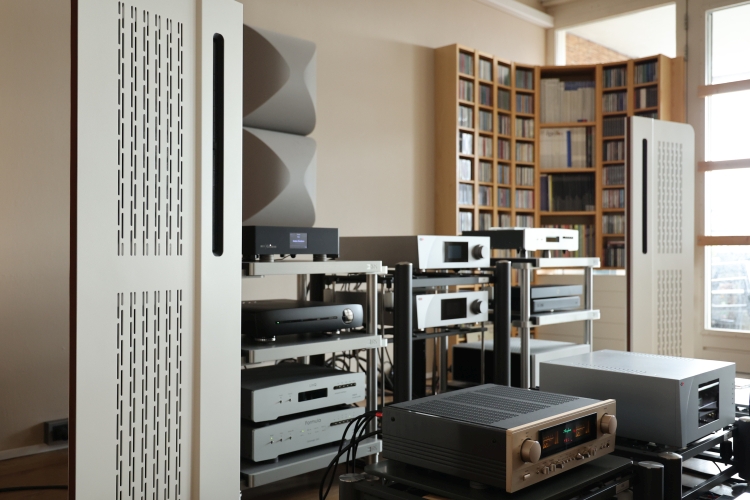
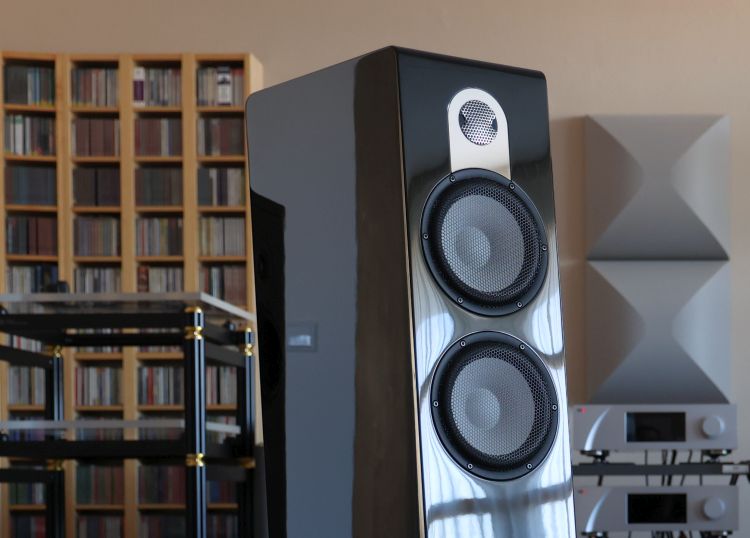
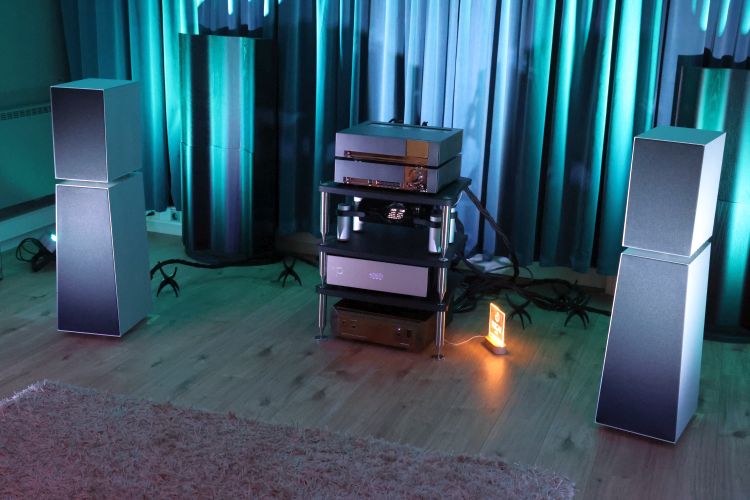
The Final Model 15+ speakers were listened to in the main system, which consists of the CH Precision C1.2 DAC, CH Precision L1 preamplifier, and CH Precision A1.5 power amp. Digital sources are the Antipodes Oladra and Grimm MU1 music servers. All interlinks are Driade Flow Link Reference 808, and the speaker cables are Driade Flow Reference 808. All components, including the Finals, are powered by the PS Audio P20 PowerPlant. Speakers available for comparison include the Magico S1 MkII, Apogee Centaur, Apogee Duetta Signature (recently fitted with new foils), Diptyque DP 140 MkII, and Martin Logan ElectroMotion ESL.
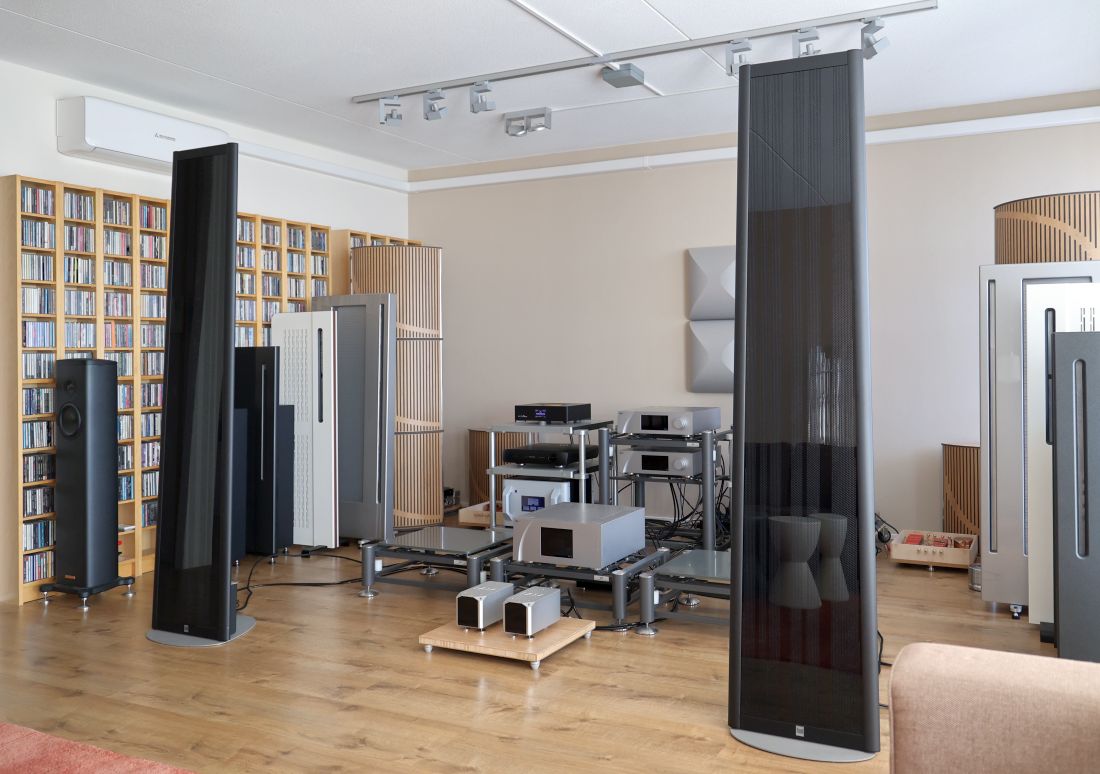
The Finals were assessed not only with all the other loudspeakers in the room, but also with the other speakers moved to the adjacent room. Unfortunately, I forgot to take pictures of that setup.
Listening
Having a long history with various planar speakers, I had certain expectations, but the Final 15+ still surprised me in a few areas. If you’ve never experienced magnetostatic or electrostatic loudspeakers, you’re in for a real treat. Say goodbye to coloration, boxiness, and boominess, as the Final Model 15+ electrostats sound clean, refined, and highly resolving, with a refreshing lack of any aspects associated with traditional speaker cabinets. So far, this is common to speakers of this kind. However, listen further, and it becomes clear that the Finals possess certain unique features. For starters, they are not just very neutral, but their timbre is also remarkably natural. I do not hear the synthetic sheen or “plasticky” character that is so evident with some other electrostatic speakers, nor do they exhibit any hardness, sharpness, or edginess, as some listeners experience with metal domes, ceramic drivers, or aluminum ribbon speakers. Even more unique for an electrostatic speaker is that the Finals have very wide treble dispersion and excellent focus, not just in the center but throughout the listening area, thanks to their segmented foil sections and narrow tweeters. Further, the 15+ are tall enough to maintain full treble output even if you stand up and walk around.
The midrange also deserves special mention for being superbly well integrated and possessing a vocal reproduction and overall naturalness reminiscent of the best BBC monitors, particularly the Graham Audio LS5/9 and LS5/9f. Quad electrostatics were also famous for this quality, but I feel that the Finals, due to their more natural timbre, have an even more convincingly realistic midband.
In terms of soundstaging, the Finals are straight-up unique in the world of electrostatics. I must admit that I was a little worried when I was informed that these speakers have, effectively, multiple crossover points. I need not have worried, as I cannot detect any phase issues, and the speakers sound as though they contain only a single driver. Honestly, I have never heard an electrostatic speaker with such a deep and well-layered soundstage.
Martin Logans, by contrast, project sound more toward the listener, which can be entertaining or invasive, depending on the listener’s preferences. Meanwhile, soundstage layering behind the speakers is not their strong suit. The Finals have excellent focus and imaging and are neither forward nor aggressive. The Finals are more ethereal than visceral, and, in a way, they pose a bit of a contradiction: they are not as crisp and explicit as the similarly priced Martin Logans ESL 11A, or the Apogee Centaurs and refurbished Apogee Duettas, yet they are in no way lacking resolution. The Final Model 15+ sure are open, transparent, and detailed, but in a polished, highly refined, and gentlemanly manner. With their excellent imaging and introspective character, the Model 15+ politely refrains from being offensive and invites the listener to let go of everyday worries and relax into the music.
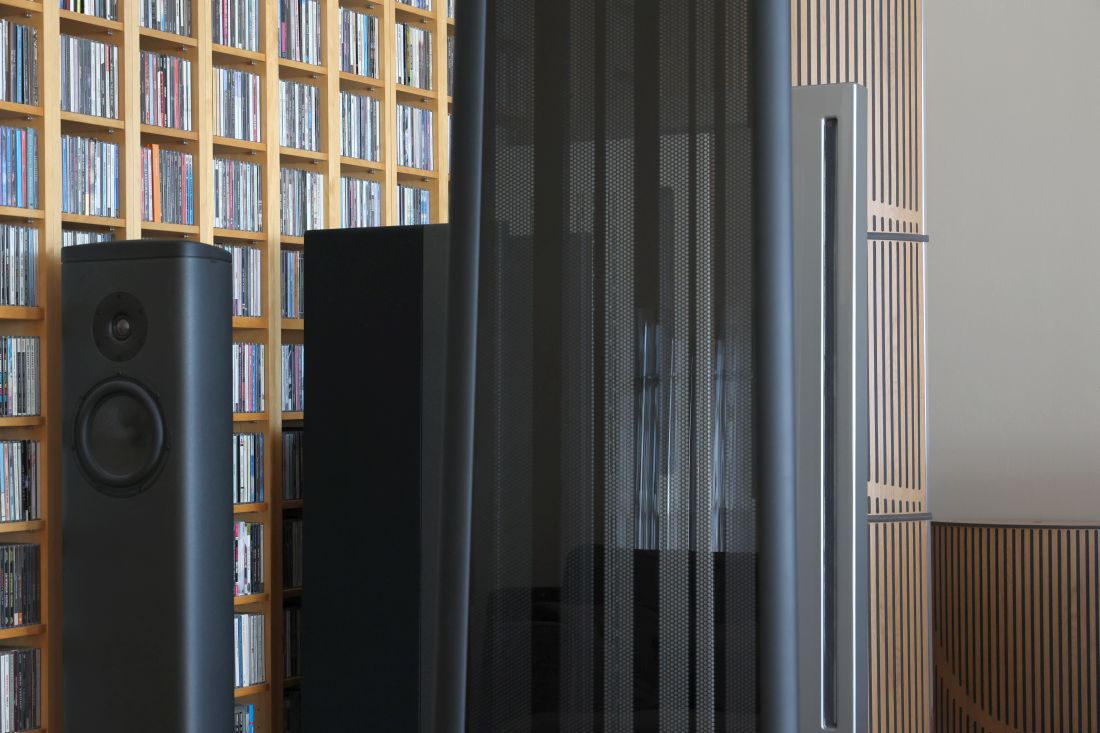
The Model 15+’s treble is delicate, fluid, and airy. The speakers are designed to have a linear frequency response, but they can appear a little dark compared to the brighter, more spritely Apogee Centaurs, Duettas, and Diptyque DP 140 MkIIs. Although it can be argued that the Apogee Centaurs and the Diptyques both have higher-than-average treble output, I feel that, separate from treble level, both speakers also sound more expressive and direct, which I personally find more exciting.
In a direct comparison with the Martin Logan ElectroMotion ESLs, and focusing only on the upper treble, the two speakers’ behavior is actually not very different: both are open, transparent, delicate, and airy. However, to some ears, Martin Logans can be a little spicy in the upper midrange/lower treble, and this is certainly not the case with the Finals. Indeed, these speakers diverge considerably in the midrange, where the ElectroMotions exhibit a mix of leanness at the lower end of the foil’s midrange response and a distinct wooden-box effect with a considerable reduction in articulation and precision where the dynamic woofer takes over for the lower midrange and bass. Granted, the small Logans do have prodigious bass, but their boxy character is distinctly different from the cleanness of the upper end of the frequency range. Naturally, the ElectroMotion ESL is only the entry-level Martin Logan electrostatic, and higher-end Logans have considerably better bass. Indeed, the crossover from the foil to the dynamic driver is almost inaudible in the more upscale models such as the 11A and 15A, but to my ears, the bass and midrange of these speakers still possess distinct characters.
With a full-range electrostatic speaker like the Final Model 15+, this issue is entirely circumvented. The bass of the Final Model 15+ is 100% coherent with the midrange and treble, and the entire frequency range exhibits uniform behavior throughout. Furthermore, the bass is also considerably better controlled and infinitely more transparent than that of the ElectroMotions.
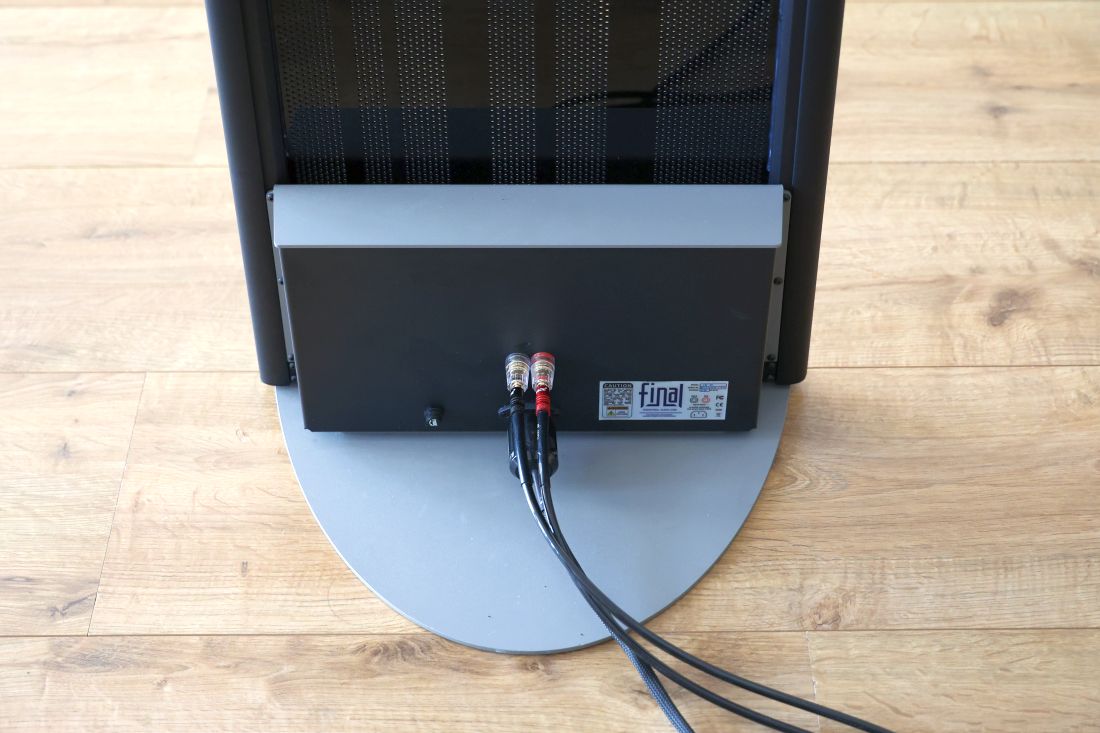
Surprisingly, the Finals’ bass reaches deeper than I thought it would. In my room, the quoted lower limit of 40Hz (+/- 3dB) seems about right when you allow for a degree of room gain from the rear and side walls. When pulled further into the room, as I like to do, they achieve a beautifully clean, linear, and uncolored sound, but the bass starts to roll off a little earlier. In this position, the bass is pure and articulate, and it still goes lower than some monitor speakers, although it may not always seem that way. This is because the Finals are naturally free of the often-excessive bass-reflex port-related bumps, and because they deliver low bass similarly to how it is perceived on headphones: clean and precise, but you don’t feel it viscerally. That said, the Finals are remarkably powerful in the upper bass range, making them versatile enough to handle most musical genres with conviction. Genres such as jazz, vocals, and especially classical pieces are relayed particularly well, but it does not end there. My musical tastes include R&B and electronic music. With the deep bass synth stabs common to these genres, the limitations of the Finals’ bass performance become more evident: certain ultra-low notes I know exist are either very quiet or absent. This makes the speakers less ideal for cases where the music relies heavily on the lowest octaves, such as Deep House. But even so, I maintain that it is better to have excellent bass that does not reach very low than very low bass that is not very good.
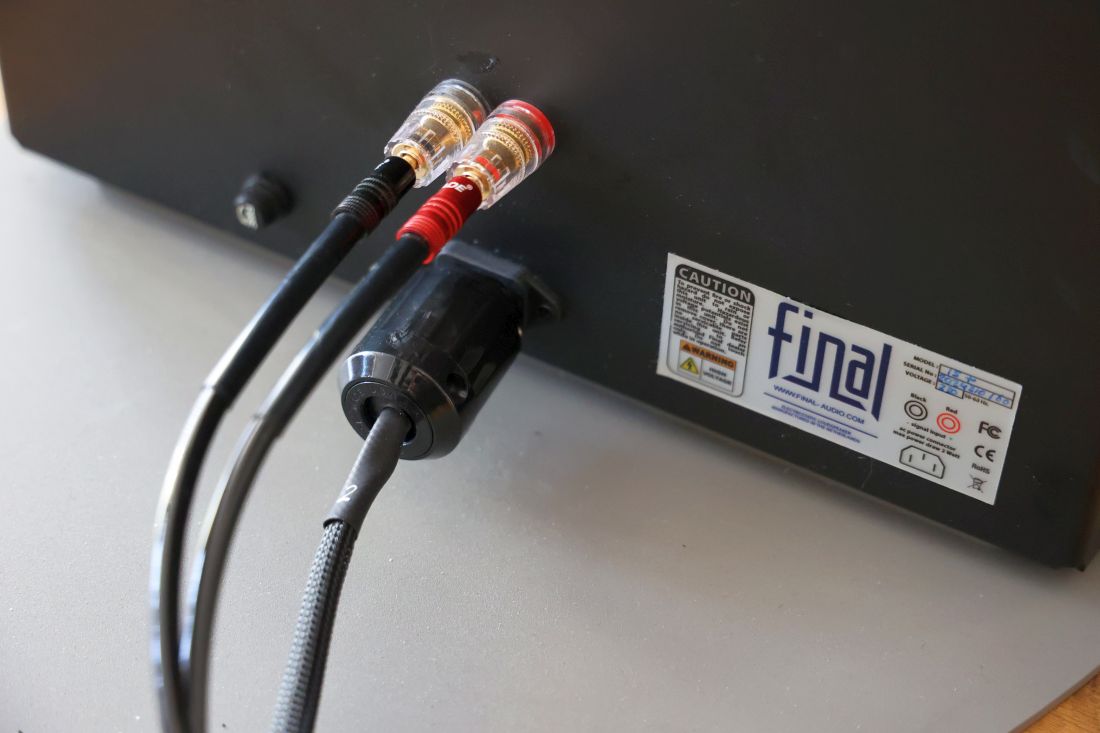
When driven by the LAiV GaNM Class D amplifiers, the Model 15+’s bass becomes even more solid and grounded than with the CH, with a pleasantly crisp and direct midrange. However, the upper treble is more rolled off than with the CH amp. This is not unusual for a Class D design when paired with a speaker impedance that dips at the higher end of the frequency spectrum. However, it is still unexpected, given that the Finals only dip to 3 Ohms, and the same amplifiers work linearly with the Logans. Alas, I do not know the Logans’ impedance plot, but there are a few factors at play, and the situation might well be different with another Class D amplifier. Maarten later confirmed there is no treble roll-off when using the Model 15+ with a Purifi amplifier. In any case, at this level, I would always recommend a test run when pairing components.
The original plan was to review these speakers along with a Bryston amplifier, but logistics dictated otherwise. Nevertheless, being very familiar with the brand, I suspect the two would work very synergistically together. The speakers are not hard to drive, but they benefit from a stable amplifier with robust bass, and Bryston is well-known for its stability and bass quality.
An important aspect of loudspeakers is perceived realism. I write ‘perceived’, because I believe that it is simply impossible to truly and entirely recreate the feeling of an actual live performance at home. The trick is for the listener to identify, for themselves, the aspects that best represent authenticity and realism, and to find those aspects in the audio playback system.
I consider the Final 15+ to sound very realistic for their lack of coloration without becoming anemic, their neutrality that retains a delicate naturalness, and their high resolution combined with lushness and fluidity. All these aspects, combined with a convincingly natural timbre free of the artifice that some electrostats exhibit, make them stand out from a forest of other speakers.
On the other hand, I consider these speakers less convincingly realistic in terms of authority, dynamic slam, and expression. Their dynamic impact is logically and understandably not as physical as that of speakers with a dynamic driver such as the Apogee Centaurs and Magicos (or most other dynamic speakers). Dynamic driver aside, their transient response is a little soft and gentle compared to all the speakers I have available at the moment, including the Diptyques and Apogees.
Speaking of which, the Finals have even better focus and soundstage layering than the recently refurbished Apogee Duettas, and they even approach the precision of the Magicos in this aspect. The Magicos have a crisper, airier treble, but the Finals have a considerably more neutral and open midrange. The treble dispersion is not as wide as that of the Magicos, but very close to that of the Apogees and Diptyques, easily covering the entire 4-person seating area. These are areas where the Finals truly shine, outperforming practically, if not literally, all other electrostatic speakers I heard. The Duettas, on the other hand, counter with deeper, more voluptuous bass and an overall more visceral feel.
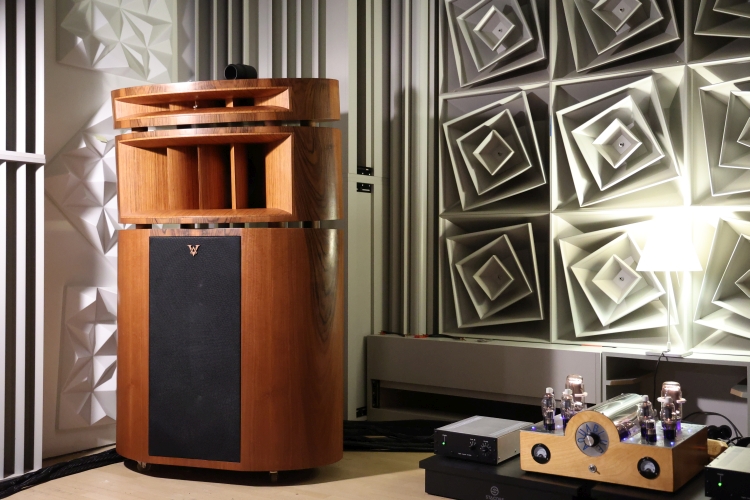
The Model 15+ make it easy to forget about the technical stuff and enjoy the music. It doesn’t really matter what your musical repertoire is, though you might want to add a subwoofer for R&B, and there are better options for getting the feeling of being at a rock concert. In this way, the Finals contrast sharply with brands like Wilson Audio, JBL, or AvantGarde.
What the Finals offer is a captivating blend of linearity, coherence, purity, and oneness of sound that is rare among loudspeakers of any kind. Furthermore, as fluid and delicate as they are, they deliver a foot-tapping, upbeat sound with much better bass than one might expect from a full-range electrostatic speaker.
Conclusion
As I found out firsthand, Final Electrostatic speakers are a special breed, even among electrostatics. Timbrally natural, open and precise, yet sweet and delicate, they are very revealing yet never offensive. The Model 15+ convey all aspects of a recording with immense transparency but without introducing hardness, sharpness, or an anemic quality. These speakers make it easy to forget about the technical stuff and enjoy the music.
External Links
Distributor for the Benelux: Mafico
Manufacturer’s website: final-audio.com

Dear Christiaan,
Thank you for this thorough review!
Looks like “love at first sight”
Definitely going to listen and upgrade my Hifi set-up to a next level.
Thanks for the great and deserved review of a brand almost unknown in the U.S. This would be my ‘final’ speaker, together with a REL line array, for much less than the top brands.