JRDG Company Special – Model 5
1986-1991
Retail Price unknown
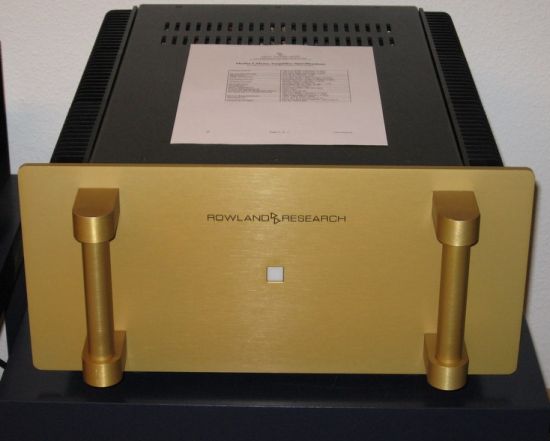
The model 5 can be seen as a more affordable but still hugely powerful stereo version of the model 7. You can tell model 7 and model 5 apart by looking at the handles’ shape: the model 7 (not pictured) has square parts while the model 5 has rounded parts.
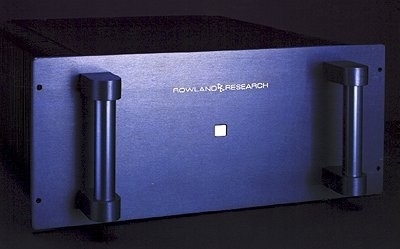
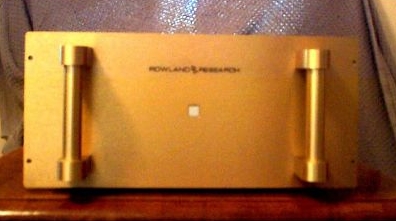
The model 5 was available in gold, black, and silver
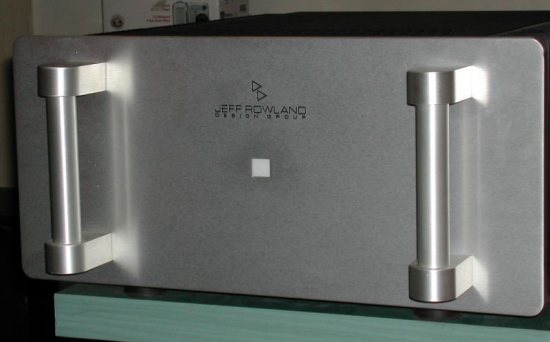
And there was also an option for rackmount holes as can be seen below
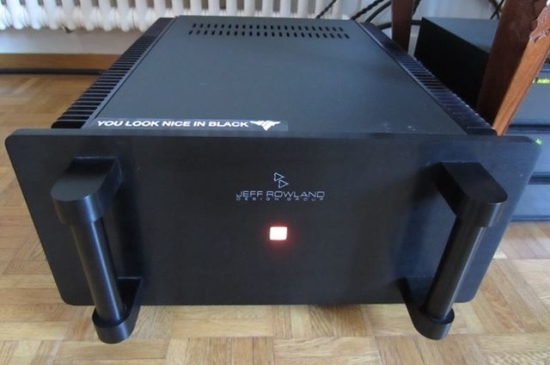
Like its bigger brother the model 7, the model 5 was available in a few versions that are functionally different. From the information that I found there are at least 3 versions with respect to back panel functionality. The below two pics for example have double speaker connector strips.
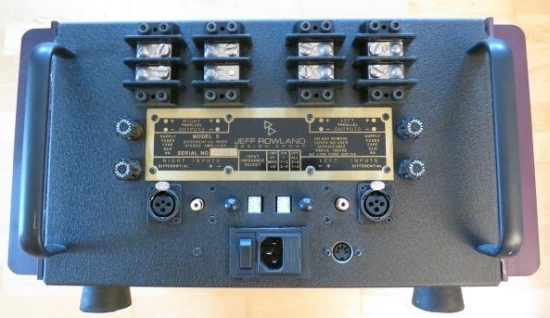
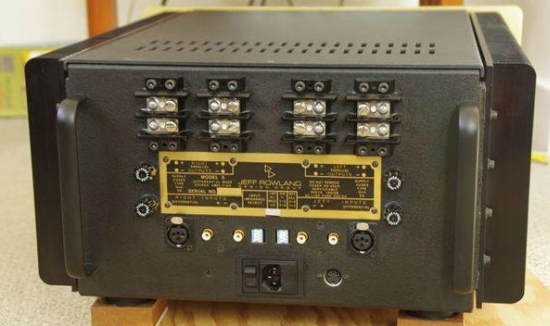
The two pics below show a version that has both metal strips and knobs for speaker connection.
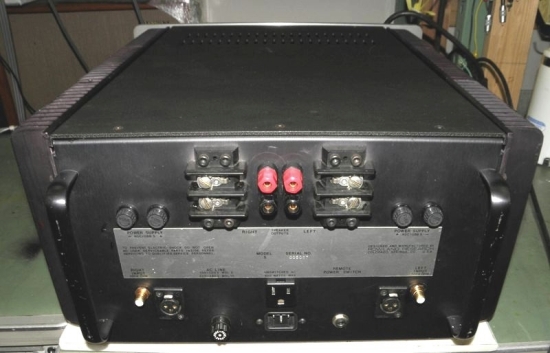
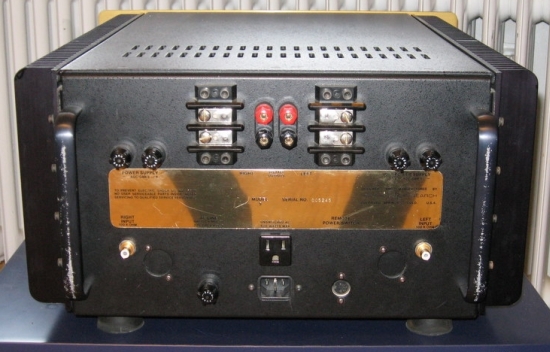
The picture above shows a version that only has cinch inputs, no XLR.
Originally Jeff Rowland amps such as the model 1, model 3, and model 7 used strips with screws for connecting loudspeaker cables. This worked fine for bare wire and spades but would not play ball with bananas. Also, the screws were prone to damage after being tightened and loosened multiple times and would eventually wear out either on the head (making the screwdriver lose grip) or even in the thread. The thing is that the screw sizes used are US standard and these are not easily available in Europe.
More information about JRDG speaker binding posts
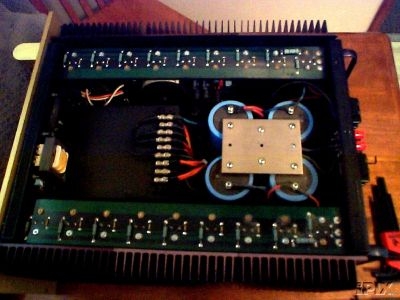
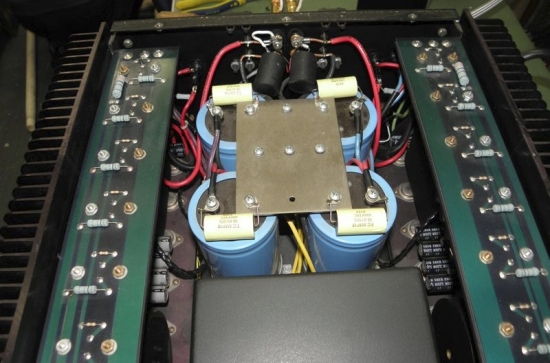
On the inside, too, there are distinctions pointing to several different versions having been available.
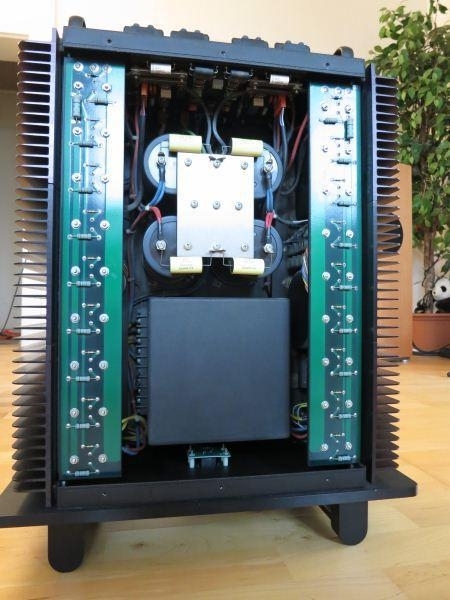
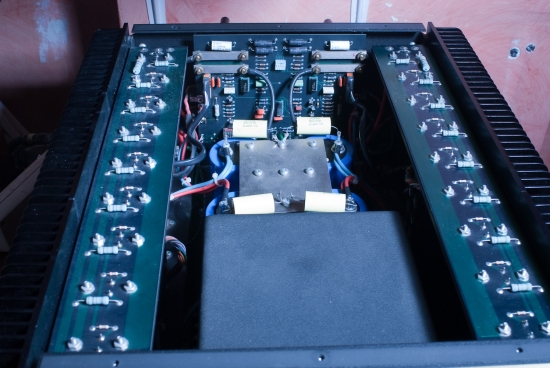
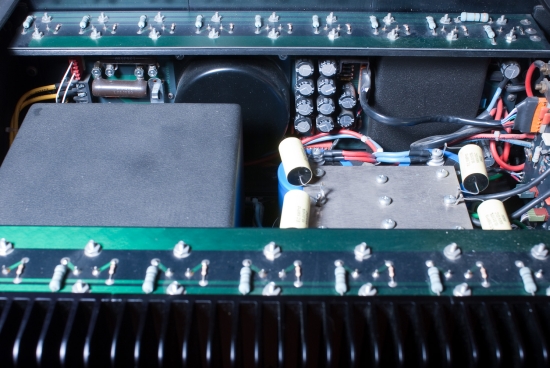
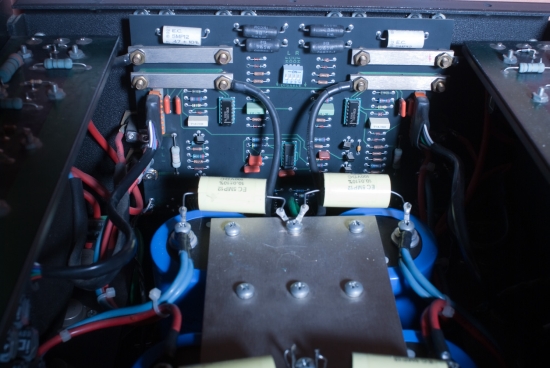
The above pics show a model 5 with 4 extra bypass capacitors on top of the big main caps but the picture below shows a model without them.
Below is a picture showing a third version with not only the 4 bypass capacitors but also some extra electronics near the (knob) speaker terminals.
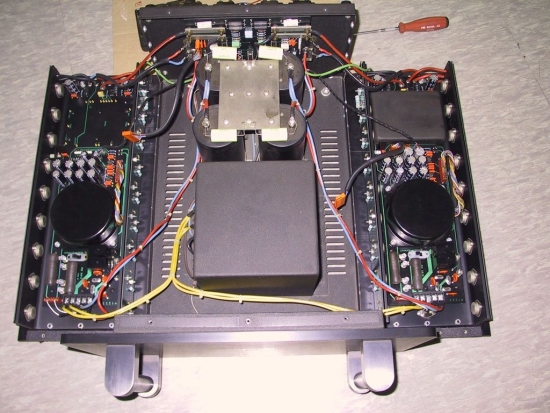
Below is a model 5 with its side panels opened as would be needed for repairs. Although Rowland amps in general rarely need service, it’s admirable how user-friendly this amp is put together.
Model 5 Features
Lack of overall or nested negative feedback eliminates time-domain distortion.
Proprietary distortion canceling techniques minimize amplitude-related distortions.
Each transistor individually tested and matched for optimum operating characteristics.
Constant output impedance is maintained over the entire audio range, allowing for universal compatibility with associated equipment.
The large number of high-speed bipolar output transistors provides uncompromising reliability and eliminates the need for electronic protection circuitry.
A single voltage amplification stage utilizes field effect transistors (operating in transconductance mode), which increases low-level signal recognition.
The absence of capacitors, inductors, fuses and protection circuitry throughout the signal path eliminates the adverse effects of these devices.
A specially designed toroidal power transformer is supported by the substantial output stage capability.
All critical circuitry is encapsulated in a thermally-conductive epoxy to ensure excellent thermal stability, mechanical integrity and to facilitate ease of service.
Model 5 Technical Specifications
Output power
150 watts RMS continuous, 8 ohms
300 watts RMS continuous, 4 ohms
475 watts RMS continuous, 2 ohms
Power Bandwidth
0.15 Hz to 250 kHz, -3 dB
Slew Rate
75 volts per microsecond
THD and Noise
Less than .03%, 1 kHz, 8 ohms, 20 watts
Less than .075%, 1 kHz, 8 ohms, 60 watts
Damping Factor
Greater than 175, 20 Hz to 20 kHz, 8 ohms
Greater than 60, 100 kHz, 8 ohms
Output Current
40 amps peak, continuous
90 amps peak, 0.1 ohm, 20 msec, 1 kHz
Overall Gain
Selectable: 20, 26, 29.5, 32 dB
Sensitivity
36 mV, 1 watt, 8 ohms
Input Impedance
Selectable: 100k, 20k, 600 ohms
Common Mode Rejection
Ratio Greater than 90 dB
Bridged Mono Output Power
550 watts RMS continuous, 8 ohms
800 watts RMS continuous, 4 ohms
1000 watts RMS continuous, 2 ohms
Power Requirements
100V-240V
More Jeff Rowland
Jeff Rowland Company Special Main Page
Jeff Rowland Company Special Power Amplifiers
I have 5 power amplifiers. My best in the 1988 Rowland Research model 5. Balance and RCA version. Sounds like tube amplifier, smooth and strong.
Hallo Christiaan and everybody; i’m a Jeff Rowland addicted and a i recently bought a Model 5 MK2, with double speaker connector (metal strips) and four Rca input… can someone explain to me why 4 rca inputs? Thanks for the help! Stef (I still have to listen to it, first I would like to avoid doing damage; the guy who sold it to me had only connected 2 rcas.
Hi Stef, I think the four RCAs are two stereo pairs. In one pair, one is for positive phase and the other is for negative phase. This is a means of connecting a balanced signal with RCAs instead of XLR connectors. You probably could indeed suffice with only connecting one or the other. Note that the absolute phase will change depending on the input you use. The ideal one depends on what pin on your source is non-inverted. In case of doubt just use one after the other and use the one you think sounds best.
Another possibility is that the second set or RCAs are loopthroughs (connected in parallel) for connecting another amplifier. In that case, you should connect only one of the two per side.
Perfekt, vielen Dank Christian! Da mir der Besitzer auch die vier Audioquest-Cinch-Kabel gegeben hat, mit denen er den Verstärker an den Vorverstärker angeschlossen hat (unter Verwendung der beiden Ausgänge des Consummate-Vorverstärkers), kann ich daher auch dann von dem symmetrischen Signal mit Cinch-Anschlüssen profitieren, wenn ich es trage habe keine XLRs; Optimal! Danke, wenn ich es nach den technischen Prüfungen verwende, werde ich ein Feedback schreiben
I came to see what the big deal was, saw an ad for $1500 locally and they had not much to say other than this was some super amp that put out huge power, originally sold new for over $10k. This was the only site with any info at all on these very limited run amps that now seem to be about the same as most high quality pro amps. My little QSC GX5 that I paid $100 and it came in a transport case, puts out 750wpc @ 4 Ω x2. My 2 older fan less QSC series 3 3500 built in 1985 put out 625wpc @ 4Ω x2 or bridged at 1250wpc x2 at 4Ω and I run both models @ 2 ohms without any problems I paid $245 for 2 of the 3500s. I also have Carver and Sunfire amps 300wpc x2 @8Ω and a pm950 with 475wpc @ 8Ω I run both of those at 2Ω powering a set of bi amped through active crossover on Martin Logan Prodigy’s all day without any issues. I really expected a $10k+ amp that’s labeled a huge power house (and has the crudest connectors I’ve ever seen on anything pro or home) and it’s rated at flea watt status in my eyes. Why am I doubting this amp can run a 2Ω bridged load for over a minute without exploding and taking out every speaker that has not been fused. No protection, crude input and speaker outputs that make car amps look sophisticated by comparison. How did they ever sell any of these when so many others were making far superior products for ⅒th the price? Just looking at it and not knowing it’s legacy, I would never consider paying over $250 for a working model. When I saw $1500 used I had to find out why. But there’s no mention of sound quality anywhere, just raw specs that I’m doubting it was capable of producing for longer than a few minutes let alone a direct rating for 2 ohms bridged. Other manufactures will hint or say their amos are capable of 2Ω loads but they don’t list it in specs because it’s probably not covered by any warranty. I do know of a few new models that list 2Ω loads but they’re not always increasing in output as the ohms go lower. The days of true A/B SS amps are coming to a close as the chip amps keep creeping closer to being able to run up to 20KHz without 1000% distortion starting at 20,001Hz. They have figured out how to stop the chip amps from changing sound character as the speakers resistance changes from mechanical movement in and out of the coils. This is a recent development but it shows how much compensation they need to use in those amps just to constantly correct the sound and filters along with memory chips to keep noise artifacts from jumping into your speakers (remember when first recording your own CDs, that “squidgeet” super loud chirping noise would happen during playback, that was before they added the buffer and memory that stopped that, much of what we hear now is artificially added by the compensation applied in the circuits) and scaring the snot out of you as you raced to grab the remote before it did it again?
There is no magic problem free amp with huge power yet, but the chip amps are in the 400wpc area now and cost less than $1k brand new with a warranty but most likely never last that long. My guess is they will replace it once and then give a 30 day warranty on the replacement so your 5 year warranty could really end up being a 2 month warranty, if they choose to, but who doesn’t trust a Chinese manufacrures quality and honoring a warranty is always fun when you’re shipping stuff back to China at $100 per 10lbs and the address is written in Chinese that cannot be converted to English without the assistance of 3 different enterpretors to make sure you get 2 that agree on the translation of the address. I know this from experience, very frustrating when they claim they never got your package!
I have to thank you for being the only source of info on these amps, it seems like Roland was changing things as he was producing them withing days after production started he would think of a better way to do it but never considered the back side to be very important, as long as he offered many color choices and had different configurations of junk inputs and outputs everything would be fine, but as it turns out maybe he should have considered better connectors especially at the price he was asking. There limitless other amps that had far better connectors and offered more power and also have protections but in to make sure everything was limited to the least possible damage in case of a problem. Maybe it’s just me expecting too much from a $10k+ amp made around 1990?