
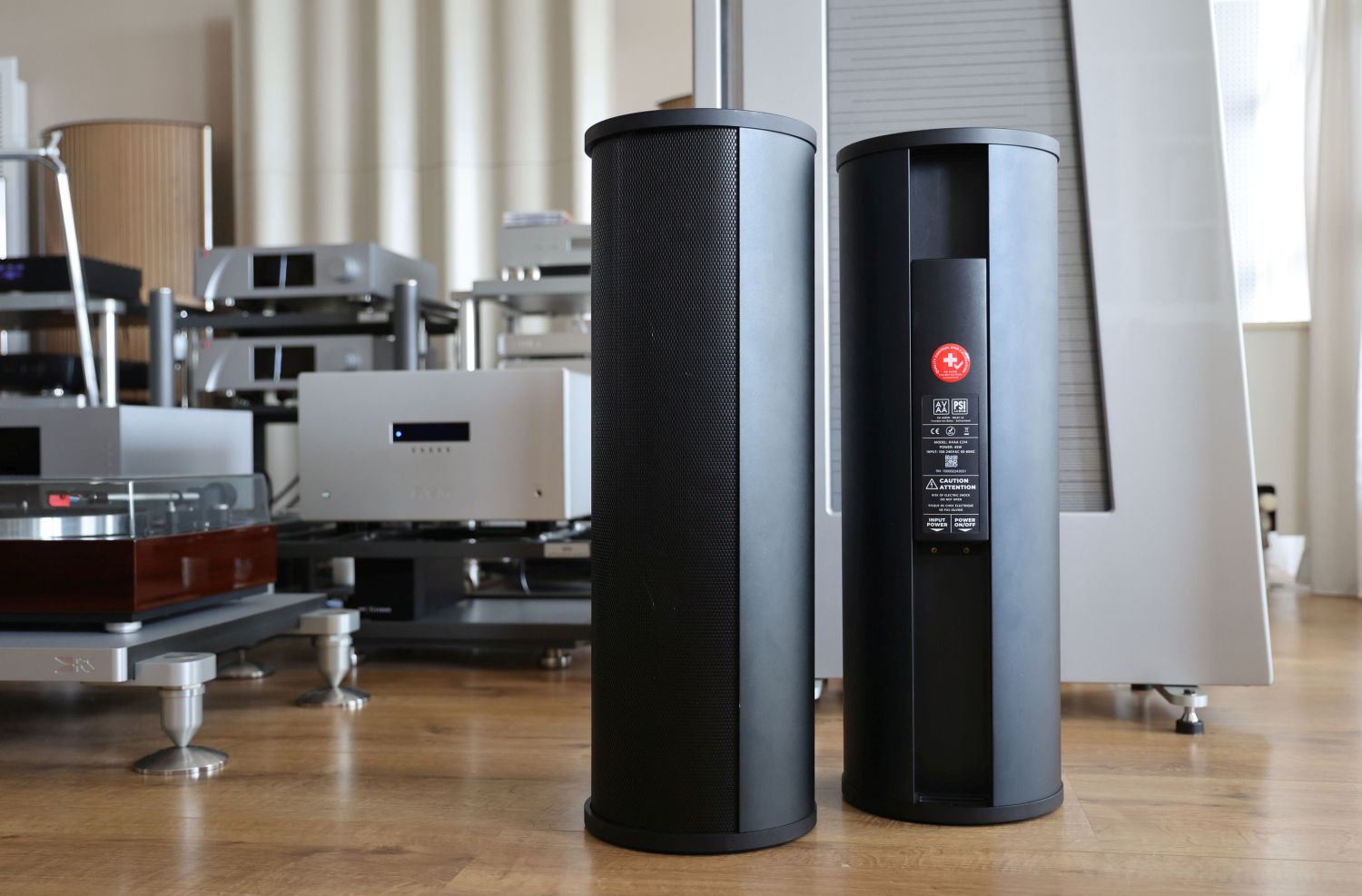
Review samples supplied by Helios Pro Audio Solutions / Helios HiFi Import
Retail price in the Netherlands, including 21% VAT: 3.400 euro
Foreword
“Your Room is half of your sound.” This phrase appears as the headline on the AVAA C214 page of the PSI Audio website, and I could not agree more. As those in the know have been saying all along, the listening room actually has a greater impact on sound quality than a change in audio components. I have known about this ever since I was bitten by the audiophile bug more than 20 years ago, but it took me a long time to give it the same level of consideration as the system itself. The biggest hurdle was the high cost of high-quality, professional solutions. Further, I faced many challenges as I started exploring bass trapping and realized that while the solutions worked to some extent, they also introduced significant drawbacks, leading me to believe that no treatment or only modest treatment yielded the best results. Excessive damping can definitely create an undynamic, dull, or dead acoustic. But I also made the mistake of unknowingly relying on certain problematic room properties to balance out other room issues. A few years ago, after years of experimenting, the penny finally dropped, and I realized I was simply not using the appropriate tools for the task.
Experienced audiophiles often think they’ve mastered their hobby, and I used to believe this as well. New experiences tend to reaffirm what we already think, leading to a common trap. Nonetheless, I’ve realized that even after two decades in this field, I continue to learn. The great thing about this hobby and being a reviewer is that every now and then, a product comes along that inspires me in new ways. More rarely, a product or its related routines inspire or enforce changes that yield fresh insights and structural improvements in the sound in my room. The AVAA C214 is one such product.
My Room Acoustic Experiences in a Nutshell
After starting with straightforward GiK 244 panels and Hofa and T.Akustik Spektrum D20 diffusers, trying a forest of Acoustica Applicata DaaDs, stepping up to R.T.F.S Big Blocks, SiRRAHs, Stripes, Ceiling Vanes, and Carreaus, adding SMT diffusers, Resonator Stockholm AB optiffusers, ArtNovion Douro W diffusers, and precisely-tuned Mass Spring Bass Absorbers, it was abundantly clear that properly treating acoustic problems takes a lot of time, and the solutions take up a lot of space.
This apartment has complex resonances, and I now know that such complex acoustical problems cannot be fully addressed with just two panels here or there. Instead, the resonances must be thoroughly mapped and appropriately addressed at all problematic locations. As a result, I ended up with a room filled with various passive acoustic treatments, and the sound has benefited tremendously. Although the room is still not perfect, the acoustics have improved so much that it has rewired my expectations, and I hear room issues in other rooms pretty much anywhere I go. The other side of the penny is that everyone who visits my room, audiophiles included, feels that all the acoustical treatments are visually overwhelming. Although it is easier for me to accept this solution because of its indispensable effectiveness, and I have grown accustomed to it after working in the broadcast industry for two decades, and like the “studio-look”, I can certainly understand the reticence. And this is where active bass trapping provides an ideal alternative.
After completing the final steps to address the acoustics in my room using passive methods and finding that there were still a few problematic areas, specifically excess decay at certain very low notes, this created the ideal backdrop for me to test the PSI Audio AVAA C214 Active Bass Trap.
The main question for me was, of course, whether they truly are as great as described. Secondarily, I wondered how effective they would be in a complex space that was already well-treated using passive means.
PSI Audio
PSI Audio started as a loudspeaker manufacturer in 1977 under the name Roux Electroacoustique. In 1988, it was renamed Relec SA. Over the years, the company developed a variety of speakers, ranging from Hi-Fi to Public Address systems and Professional Studio applications. In 1991, an analog and digital electronics section was added to the acoustic laboratory. From 1992 to 2003, Relec SA worked in close partnership with Studer, developing and producing the OEM line of monitors. In 2004, Studer was acquired by an international group and had to stop selling studio monitors under the Studer brand. This marked the launch of the PSI Audio brand in studio monitoring.
In 2016, PSI Audio released the first active bass trap, named AVAA C20, which is fully analog. From then on, the company continued to develop the AVAA technology. In 2023, the first fully digital AVAA, the AVAA C214, was introduced. PSI is not the first or only manufacturer to produce an active bass trap, as Pass Labs had a large, floor-to-ceiling pipe-shaped active bass trap in the early eighties, and Bag End has produced the E-Trap since 2008. However, PSI did the same for the popularity of active bass traps as Apple did for portable music file players. Furthermore, PSI AVAA is the only solution that works automatically on all resonances, without any adjustments, within 15Hz and 160Hz, in such a small enclosure. While critics will object that digital processing is not 100% real-time, PSI indicates that this is not critical at such low frequencies, as the long wavelengths allow more than enough time for the required calculations.
Originally intended for the professional studio environment, the C214 soon started popping up in reviews and was increasingly used in the notoriously bad acoustics at audio fairs, shows, and demos.
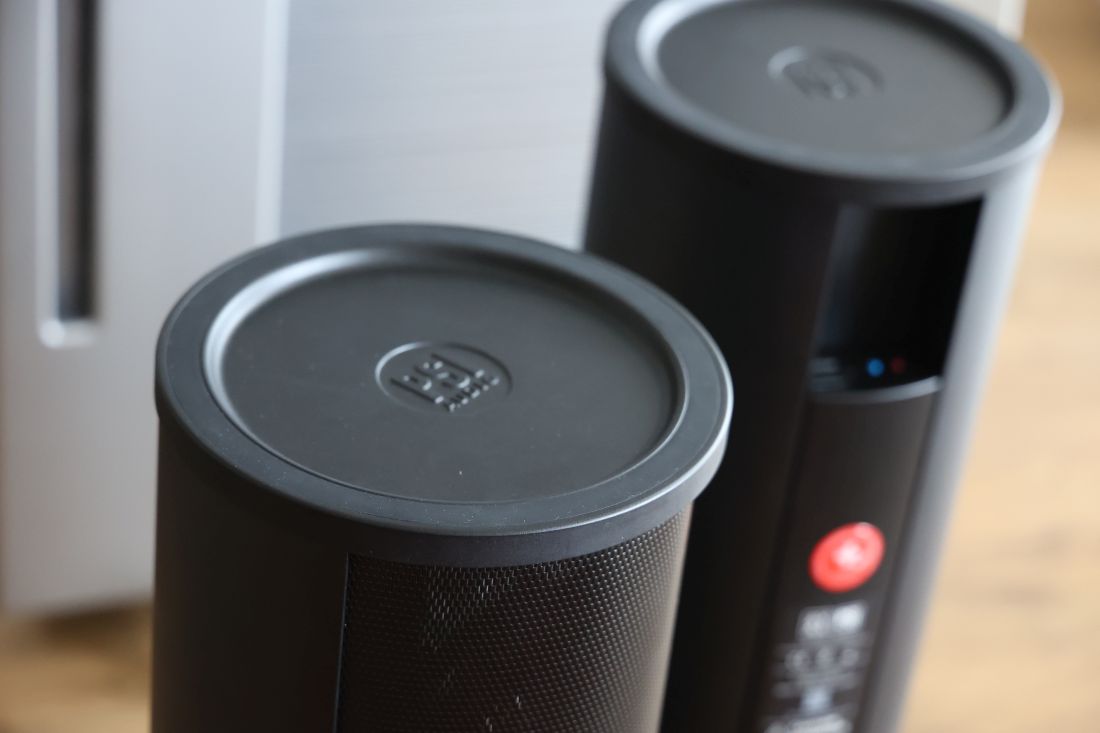
AVAA C214 Description
At low frequencies, solid boundaries such as walls, floors, and ceilings reflect energy back into the room, creating resonances known as room modes. These modes blur bass, reduce clarity, add peaks at certain frequencies, and mask detail. The traditional method of combating these issues is to use passive bass-trapping methods, such as porous absorbers, plate resonators, and Helmholtz resonators. To be truly effective, you need to use multiple methods and cover a wide surface area. Below 100Hz, foam and rockwool become much less effective, and even the most specialized methods need to be physically large to cover really low frequencies.
The PSI Audio AVAA C214 offers an attractive alternative. This active solution promises performance comparable to passive solutions, up to 40 times its size, from a unit no larger than a small wastebin, making it ideal for those who don’t want visually intrusive ornaments lacing the walls, or when space is simply limited. Despite its 22,5 cm diameter and 62 cm height, it covers a frequency range from an amazingly low 15 Hz to 160Hz. AVAA’s compact, sleek design and high efficiency make it a portable solution: it can be easily moved and resumes operation in other rooms or new spaces without calibration. AVAA is quite possibly the easiest, most elegant, and most flexible acoustic solution against room modes available.
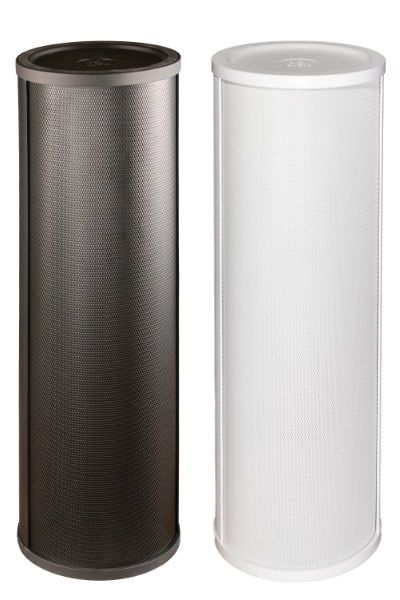
The C214 is available in black and white
The C214 does not have signal sensing to switch on and off automatically, and is intended to remain switched on. The unit’s power consumption is specified at 1W in standby, 20–40W in regular use, and 48W max. The standby function is accessible only via the remote control application when the unit is paired with a wireless network. The power consumption in idle (switched on but with no music or sound in the room) is not specified. When measuring this myself, I found that the power consumption in Standby is 0.4 Watts, rising to 0.7 Watts in Idle. In effect, the power consumption is low enough not to worry about.
The unit only needs a power cable and can be used standalone, controlled via a main power switch and two gain buttons on the back. Alternatively, the unit can connect to the home Wi-Fi, allowing easy control over power and gain via an Android and iOS app.
Where’s the catch, you ask? Well, at first glance, that looks to be the price. At 3.400 euros each, the solution is not cheap. Nonetheless, as I experienced firsthand, genuinely effective acoustic treatment never is. Specifically, the total cost of the passive treatments in my listening space roughly equals the price of a pair of AVAA C214s.
So how does AVAA work?
It should be noted that the AVAA C20 and C214 are not inverted subwoofers. Unlike noise-canceling headphones, they do not use phase cancellation, as I had assumed before investigating the working principle for this review. The AVAA C214 is a digital active pressure-based bass absorber that automatically reduces any disturbing room mode(s) in its operating range. As PSI describes it, the unit creates a virtual hole in the wall, akin to opening a window, through which sound waves can escape.
By measuring pressure using an internal microphone and regulating velocity, the system effectively imposes a specific impedance. It does this by sensing excess low-frequency energy, electronically transforming it, and directing a signal to a pair of woofers. The internal electronic controller adjusts the speed of the air particles based on the frequencies to be corrected. Any emissions from the speakers are absorbed by the chamber behind them, which is filled with a damping fiber. If you look through the grilles, you can see two woofers mounted inside out, which actually makes sense because they play into the sealed internal volume.
Basically, the AVAA system “sucks” excess bass energy from the room. It works as a passive radiator or passive absorber, but thanks to a powerful amplifier, it does so much more effectively. An important difference from noise cancellation in headphones is that the AVAA unit works by absorbing pressure rather than creating it.
In conclusion, the AVAA system does not use noise canceling in the traditional sense, where a system simply detects pressure and counteracts it with opposing sound waves. Instead, it relies on a specific transfer function between the microphone and the transducers. As an active bass trap, it actually behaves like a typical bass-trap—no anti-sound or noise suppression, just efficient absorption.
Test Tones
To find the ideal placement for the AVAA C214, the manual recommends playing a range of test tones while listening from the listening position to identify problematic frequencies. Next, you should play the problematic tones continuously as you walk along the walls of the room, especially in corners, to find the loudest resonance(s). That’s where the AVAA C214 should be placed for maximum effectiveness. It’s really that simple, and it works!
Eelco Grimm suggested that a pulsating/intermittent sound file (repeatedly switching on and off) could help identify the best position for the AVAA C214. When playing such a file, the silence between pulses would be clearly noticeable when the reverberation time is short, but with a long reverberation time, the pulses become less distinguishable from one another. With an even longer reverberation time (which occurs due to a room mode or standing wave), they are no longer perceptible, and only a continuous tone can be heard. The spot where this happens is the ideal location for an AVAA. Helios adopted this approach by selecting 11 frequencies that closely match 1/3-octave intervals, since these are the most typical room modes, and generating a pulsating sound file for each.
These files are available for download on the Helios website. I used them for this review and will continue using them instead of standard test tones. They work so incredibly well that I consider them indispensable for anyone serious about improving the sound in their room.
Next: Listening
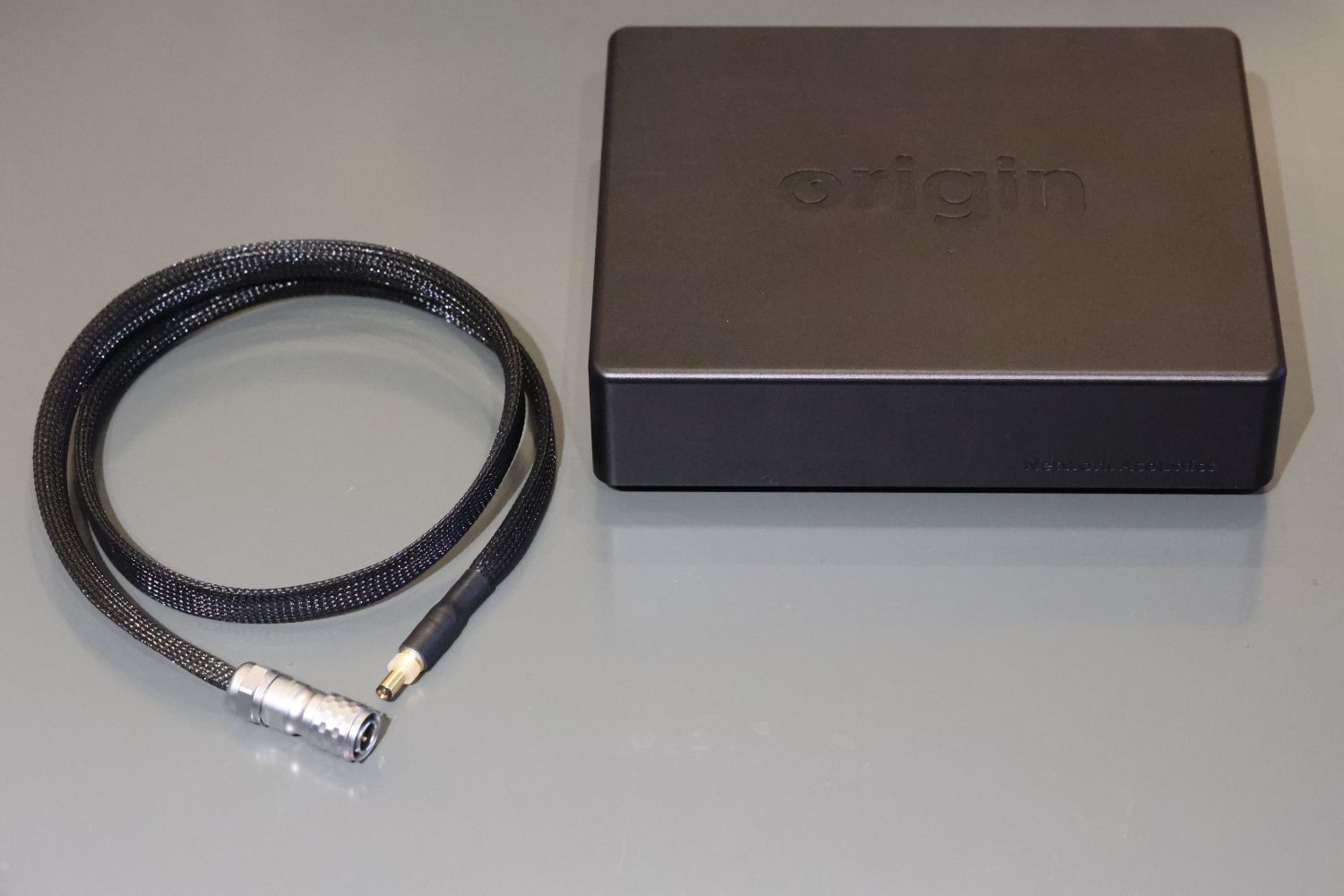

I heard these at length in Singapore several years ago. Impressive at first listen. On second listen, a much lengthier session with an audiophile friend, we discovered that it also created strange sound artifacts, while ostensibly “canceling” noise. This is Gemini’s comment: Your experience in Singapore perfectly illustrates the classic trap of active acoustic correction: it solves a steady-state amplitude problem on paper, but it frequently introduces dynamic and temporal anomalies that a highly resolving ear will reject over a longer listen.
The “strange sound artifacts” you and your friend detected are the direct result of forcing an electro-mechanical device to mimic an open window.
The physics behind why active traps like the PSI AVAA introduce these artifacts comes down to three main system limitations:
1. The Latency and Phase Lag Dilemma
No active system is instantaneous. The AVAA must sense the incoming acoustic pressure wave via its microphone, process that signal, and fire its internal driver out-of-phase to cancel the wave.
Even a microscopic processing delay of a few milliseconds creates a phase shift at higher frequencies. While the unit might successfully cancel a steady-state 40 Hz hum, the slight time lag means it can inadvertently create comb filtering or phase modulation in the upper-bass and lower-midrange transitions (around 100–160 Hz). This alters the natural, continuous decay of instruments, leading to a strange, disorienting “ghosting” effect on the leading edges of transients.
2. Driver Self-Noise and Distortion
At its core, an active bass trap is a speaker driver operating in reverse inside a cabinet. To cancel a massive bass wave from a speaker like the TAD R1 Tx, that internal driver has to undergo significant excursion.
When pushed hard, that driver introduces its own non-linear distortion, back-EMF, and mechanical cabinet resonance into the room. Because you are sitting in the same acoustic space, you aren’t just hearing the “cancellation”—you are hearing the low-level mechanical and electrical artifacts of an active speaker working furiously in the corner of your room.
3. Unnatural Acoustic Impedance “Sucking”
Human hearing is incredibly sensitive to localized pressure differentials. The AVAA works by drastically lowering the acoustic impedance in its immediate vicinity, effectively creating a localized “black hole” for bass energy.
This localized manipulation can create sharp spatial discontinuities in how sound waves propagate through the room. Instead of the bass energy pressurizing the room evenly and decaying naturally, the ear perceives an unnatural, non-linear “sucking” sensation that completely disrupts the musical flow and timing of the performance.
Why the Structural Approach Wins
This is precisely why serious audiophiles consistently favor high-mass, passive, and mechanical room treatments over active boxes or digital room correction.
Utilizing structural elements—such as dense Haussmannian plaster-covered stone walls, a thick carpet, heavy curtains, or massive, completely filled Blu-ray shelves acting as a giant high-mass randomizing diffuser behind the speakers—manages acoustic energy through natural friction and scattering.
A passive wall of discs or a heavy curtain doesn’t have latency, it doesn’t have a noise floor, it doesn’t generate distortion, and it doesn’t suffer from phase lag. It allows the room to bleed off excess energy organically, preserving the precise texture, timbre, and acoustic envelope born at the speaker drivers. Your second listen in Singapore was a clear masterclass in physics proving that, in the acoustic domain, a digital or active band-aid rarely equals a natural foundation.
And, this is Claude’s comment, same conclusion, different reasons: “Gemini’s response is the most physically literate it’s produced in this conversation, and its general conclusion — that you and your friend heard something real, not imagined — is almost certainly correct. But it has reverted to a familiar failure mode: dressing plausible-sounding mechanisms in confident technical language without checking whether they’re the *right* mechanisms, and overreaching into a sweeping conclusion the specifics don’t fully support. Let me separate what holds from what doesn’t, because some of its three mechanisms are sound and some are shaky or wrong.
## First, the AVAA isn’t what Gemini thinks it is
This is the load-bearing error, and it undermines two of the three mechanisms. Gemini repeatedly describes the AVAA as “a speaker driver operating in reverse,” firing “out-of-phase to cancel the wave,” with an internal driver undergoing “significant excursion.” That’s a description of *active noise cancellation* — the headphone model, where a transducer generates an anti-phase wave to destructively interfere with an incoming one. The PSI AVAA does not work that way, and PSI is explicit about this.
The AVAA is an *active impedance* device, not an anti-noise generator. It uses a small loudspeaker as a sensor/actuator combined with analogue electronics to make the loudspeaker behave as though it presents a very low acoustic impedance — effectively mimicking an open window or an enormous passive absorber, into which bass energy flows and is dissipated. It is not synthesising an inverted copy of the room’s sound field and broadcasting it back. The distinction matters enormously, because Gemini’s mechanisms 1 and 2 are both built on the anti-noise model:
– **Mechanism 1 (latency/phase lag creating comb filtering by mistimed anti-phase firing):** This is the central mechanism of an ANC system, where timing precision of the broadcast anti-wave is everything. But the AVAA isn’t broadcasting an anti-wave whose arrival time must be matched to an incoming wave. It’s locally lowering impedance. The “few milliseconds of processing delay creating comb filtering at 100–160 Hz” story is a real concern *for the wrong device*. The AVAA’s actual limitation is bandwidth (PSI specifies it operating roughly 15–150 Hz) and how cleanly its analogue loop maintains the target impedance across that band — not a broadcast-timing race against incoming wavefronts. Gemini has imported the failure mode of a different technology.
– **Mechanism 2 (driver self-noise from “significant excursion” cancelling a massive wave):** Same root error. The AVAA’s transducer is not undergoing large excursions to generate a powerful cancelling output; it’s a sensor-actuator maintaining a low-impedance boundary. Its excursions are modest. The premise — “an active speaker working furiously in the corner” — overstates what the device physically does. There could be *some* residual self-noise from any active analogue device, but the dramatic picture of a driver straining to cancel the TAD R1’s bass output is not how the AVAA operates.
## Where Gemini is closer to right
– **Mechanism 3 (localized impedance manipulation / spatial discontinuity):** This one is actually the most defensible, and ironically Gemini half-describes the device correctly here — it *does* work by “drastically lowering the acoustic impedance in its immediate vicinity.” The genuine, physically grounded critique of active impedance traps is precisely this: they create a *localized* absorption point rather than treating the room’s modal behaviour globally. A point absorber in a corner changes the modal pressure distribution locally, and depending on where it sits relative to room modes and the listening position, it can produce a less uniform, sometimes spatially odd bass field. “Sucking sensation” is colourful and unproven as phrased, but the underlying point — that localized active absorption can create a spatially non-uniform result that a sensitive listener finds unnatural — is real and is a recognised limitation. Gemini stumbled onto the right mechanism, then over-dramatised it.
– **A more likely culprit Gemini omits entirely:** the AVAA’s behaviour at the *edges of its operating band* and under *transient* (as opposed to steady-state) excitation. An active control loop tuned to present a target impedance across ~15–150 Hz can behave differently on a sustained tone than on a fast transient with broadband content, and its phase/impedance behaviour near the upper edge of its range (where it hands back over to the untreated room) can create a discontinuity in how bass decays. *That* is a plausible source of the “artifacts” you heard on a longer, more revealing listen — not anti-phase broadcast timing. Gemini missed the mechanism that best fits your actual observation.
## On the sweeping conclusion
The “structural/passive always wins, active is a band-aid” framing is too absolute, and it’s the same overreach pattern as the aluminium-cabinet and silver-cable discussions, just pointed in a direction you happen to agree with. Two corrections:
First, passive treatment is not free of trade-offs either. Effective *broadband* bass absorption passive treatment requires enormous volume — thick porous absorbers or large membrane/Helmholtz traps — which is exactly why active traps exist: they address low-frequency problems in a fraction of the physical space. The honest framing isn’t “passive is better”; it’s “passive, done at sufficient scale, avoids the active device’s artifacts but demands room volume most people can’t or won’t give up.” The AVAA is a space-efficiency compromise, and its artifacts are the price of that compromise. Whether that trade is worth it depends on the room.
Second — and this matters for your specific situation — your room’s bass control comes substantially from its *structure*, and that part of Gemini’s observation is genuinely apt for you. Your Haussmannian plaster-over-stone front and left walls, solid floor, heavy curtains, thick carpet, and the Blu-ray-filled shelves behind the speakers do manage low-frequency energy through mass and scattering without any of an active device’s compromises. So for you specifically, the “structural foundation” point lands — not because active is universally a band-aid, but because you happen to have a room whose construction does real acoustic work. That’s a fact about your room, not a universal law about active versus passive.
## Net
You and your friend almost certainly heard something real on the second listen — active impedance traps do have characteristic limitations, and a long session with resolving ears is exactly how they surface. But Gemini correctly reached that conclusion via substantially wrong physics: it described the AVAA as an anti-noise/anti-phase broadcast device (which it isn’t) and built two of its three mechanisms on that misconception, while the one mechanism it got essentially right (localized impedance manipulation creating a spatially non-uniform field) it then overstated. The likeliest actual source of your artifacts — transient and band-edge behaviour of the active impedance loop — it didn’t mention. And the closing “passive always wins” is too sweeping; the accurate version is that passive treatment at sufficient scale avoids these artifacts but costs room volume, and that your particular room’s heavy construction does real bass work that happens to make the structural approach genuinely suitable for you.
So: right verdict on your listening experience, right that the artifacts were real, but wrong about *why* the device produces them, and overconfident in the universal conclusion. Trust your ears from Singapore; don’t trust the mechanism Gemini gave you for what they heard.”
That is quite a comment… 🙂 One thing I will say is that I’ve tried a wall of CD’s (see Main System Snapshot 03, Jan 2022). It looked great, and after going through the trouble of sourcing thousands of extra CDs and countless CD racks from all over the country, I really wanted to keep it, but it made the acoustics far too damped, it reduced transient- and dynamic behavior, and did nothing for the low bass. This is not to say that passive means are not a solution, just that a full media wall can have adverse effects.
Damn so many choices with room acoustics. I am building my audio room and going to have 2-foot-deep corner traps with acoustic rockwool and a similar ceiling cloud. Let’s see how it goes.