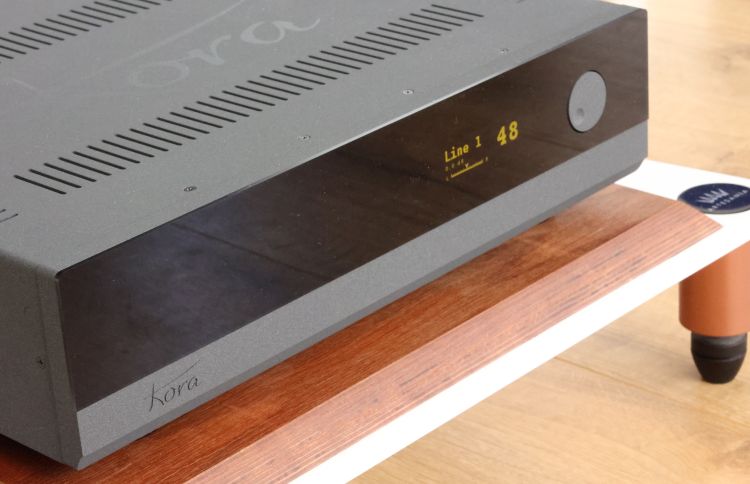
Kora CSA 2120 Square Tube pure Class A Power Amplifier

Automatic Current versus High Current
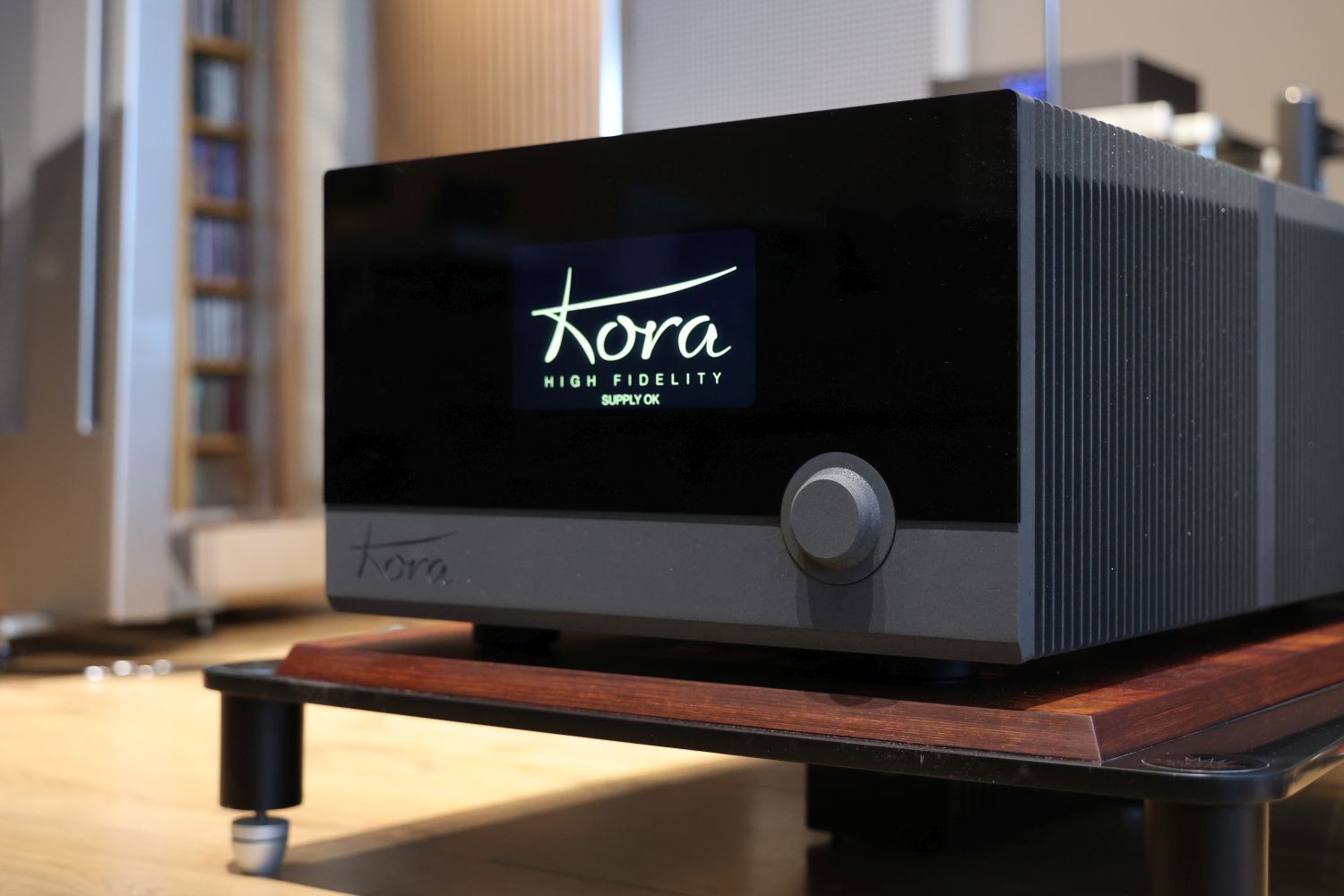
So far, I have been listening to the Kora using the recommended Automatic Current control setting. Now was the time to investigate the audibility manual Current setting.
While using the Kora in Automatic Current mode with the Apogees, not a complex load but relatively low-sensitivity, I noticed that the Current Indicator flashed from Low to High on high peaks in the music when playing a little louder. This was a tell-tale sign that the speakers required a little more than the amp would deliver in its Low Current mode. But that’s what the Auto mode is for, right? Kora also writes in the manual that the transitions are inaudible, and I can confirm this is the case. However, they do not claim that Low, Auto, and High modes all sound the same. And indeed, they do not!
When switching from Automatic to High Current, the Kora responds as it always does: in utter silence! There is no click, hum, or pop, just the apparent change of mode. In the sonic presentation, however, the change is far from subtle. In this mode, the sound becomes noticeably more organic, fluid, and free-flowing, while retaining all of its virtues in High Current mode.
The claim “elevating the entire performance” is so often made in the industry that we’ve all grown weary of it, but the big Kora truly delivers. The High Current Mode is not a case of trading one set of virtues for another. Rather, it’s keeping what’s there and making it better. In a way, the Kora now sounds more like what you expect from a big Class-A amplifier, but the sound remains crisp and tight, with a more natural flow, and increased charm. To be very clear: the uplift in naturalness is achieved without adding coloration or thickness, without reducing dynamic behavior, and without slowing the pacing. If anything, I felt that the amplifier was now more dynamically differentiated!
High Current for efficient speakers?
It seems logical to expect that High Current mode is only required for low-sensitivity speakers. But of course, I had to prove or disprove this suspicion. So, to be certain, I briefly repositioned the easy-to-drive Driades and repeated the test. To my surprise, the increase in fluidity and flow I noted with the Apogees was also evident with these small monitors. Sure, it was less required, but very welcome nevertheless.
The only downside of using this mode is, of course, the increased power consumption. Pretty soon, the amplifier becomes quite warm, to the point that it can raise the temperature of a small room. Conversely, the Kora becomes only “normally” warm when using Auto Current mode. Sonically, however, it is clear that the Current Modes serve a valid function, and I highly recommend experimenting with this.
After this little detour, let’s get back to the Apogee Duettas.
At 28.000 euros, the CSA 2120 is priced firmly in the high-end. When considering that their entry-level amp is “only” 5.700 euros, 28k is a very substantial jump. But as soon as you see this beast in real life, you realize that it buys a huge amount of real estate! Naturally, a bigger amplifier is not necessarily always better than a smaller amplifier; rather, the inverse is usually true. However, this is another area where the CSA 2120 shines, and with any speaker: coherence! Unlike many big power amplifiers with many output transistors, the Kora Class A does not sacrifice coherence for power. When it comes to Kora amplifiers, bigger is definitely better.
It’s interesting how expectations are sometimes proven entirely wrong. For instance, the Kora hybrid tube amplifier sounds less like a stereotypical tube product than the Halcro Eclipse, which is a pure transistor design. Sure, the Halcro is twice as costly as the Kora, but it’s still a good reminder to always keep an open ear! When I purchased the CH A1.5, it was 31.000 euros, close to what the Kora currently costs. But time flies, and I just realized that I wrote that review already back in 2019. Right now, the A1.5 costs 42.000 euros. Nevertheless, given that the CH is my resident reference amplifier, it still makes sense to compare the two.
The CH A1.5 is a very heavy amplifier, and large by normal standards, but the Kora CSA 2120 makes it look rather small! The CH A1.5 is a full-transistor design, and although it does not sound quite as liquid and free-flowing as the Halcro, it is lusher and more fluid than the Kora. The CH is also more highly resolving, airier, and more refined. On the other hand, to my utter astonishment, the Kora has an even tighter grip on the Apogees, making them sound crisper, more direct, and more robust. It’s crazy, but when it comes to the bass, the Kora has basically Class-D-like control. The Kora’s user guide describes the power stage as insensitive to current feedback phenomena and the amplifier as offering exceptional stability with complex loads, even when highly capacitive, and my tests have triple-confirmed this!
Although the Kora performs well with the Dueattas, especially in its natural timbre, immediacy, and impressive control of the speaker, I ultimately found this pairing less appealing than the CH A1.5 pairing. This isn’t just a matter of inherent quality or personal taste; it mainly comes down to the voicing of these products. The Kora sounds earthier, fuller, and darker than the CH, which is comparatively airier and more light-footed, while the Duettas themselves are quite voluminous and full-bodied. As always, choosing the right match is just as important as the overall quality of any component.
Platforms
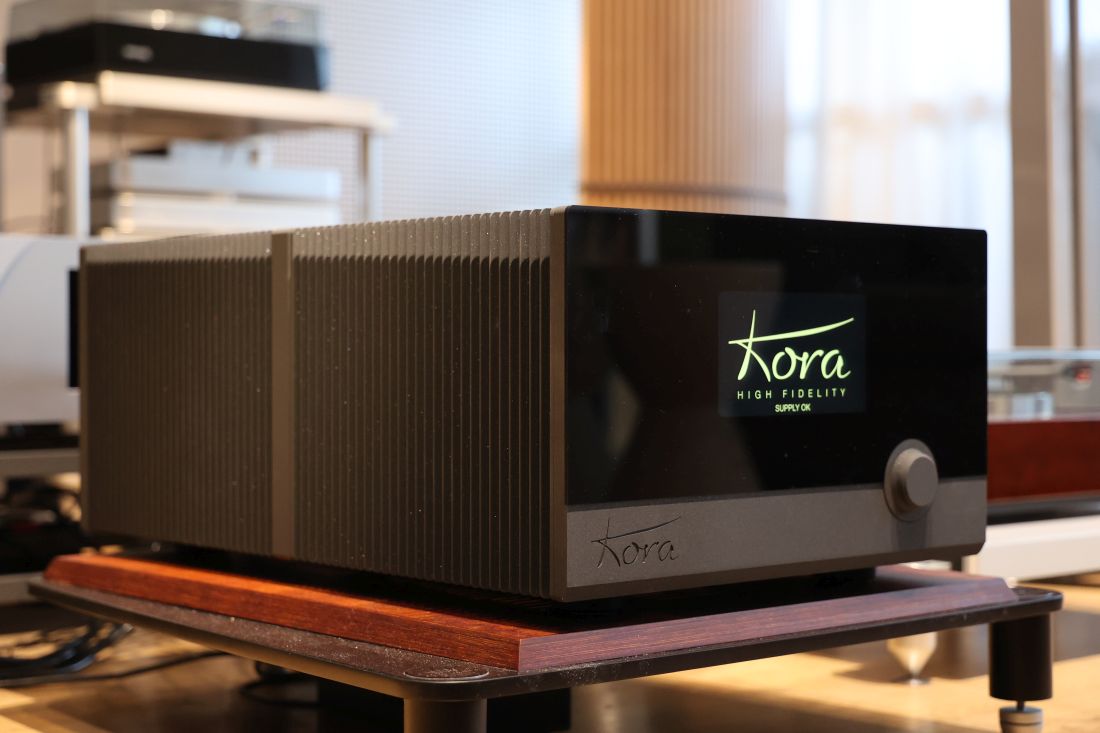
Of course, it is neither fair nor wise to compare two amplifiers on different platforms. However, whether on the very solid and relatively straightforward Krion-Panzerholz Modular Floor Platform or on the complex steel/Carbon Fiber rack-in-a-rack Aire Platform (basically a low Exoteryc Rack), the Kora amp sounds solid, robust, and always in control. Nevertheless, the two racks still have a marked influence on the sound.
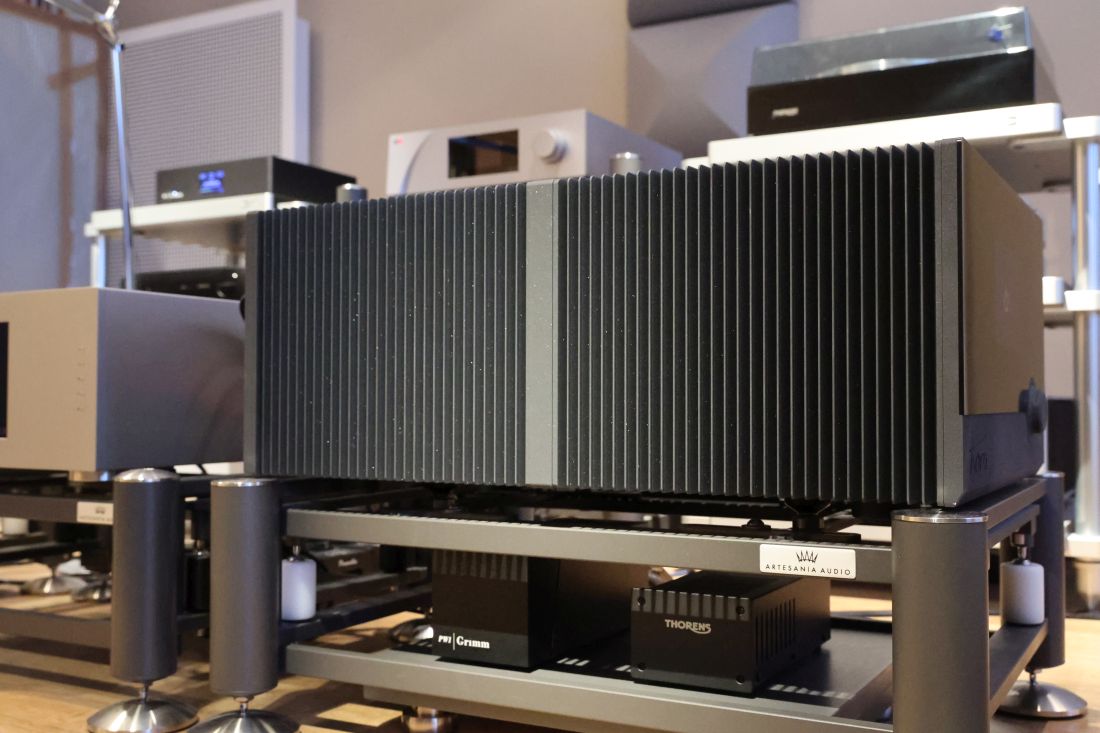
In a nutshell, the Modular Floor Platform further enhances the amplifier’s inherently robust bass and natural, acoustically convincing midrange. The Exoteryc platform, on the other hand, strikes a more light-footed balance, adding fluidity, flow, and treble air. In this case, for my ears and with the Duettas, the Aire platform was definitely a better match.
Diptyque
When the Kora was delivered, Distributor Dennis from Dimex told me how amazingly well this amplifier performed with the Diptyque magnetostatic speakers. Of course, a distributor of both brands would say that, wouldn’t they? However, after hearing the DP 140 MkII extensively in my system on two separate occasions, I think I am in a good position to predict how they would perform in unison.
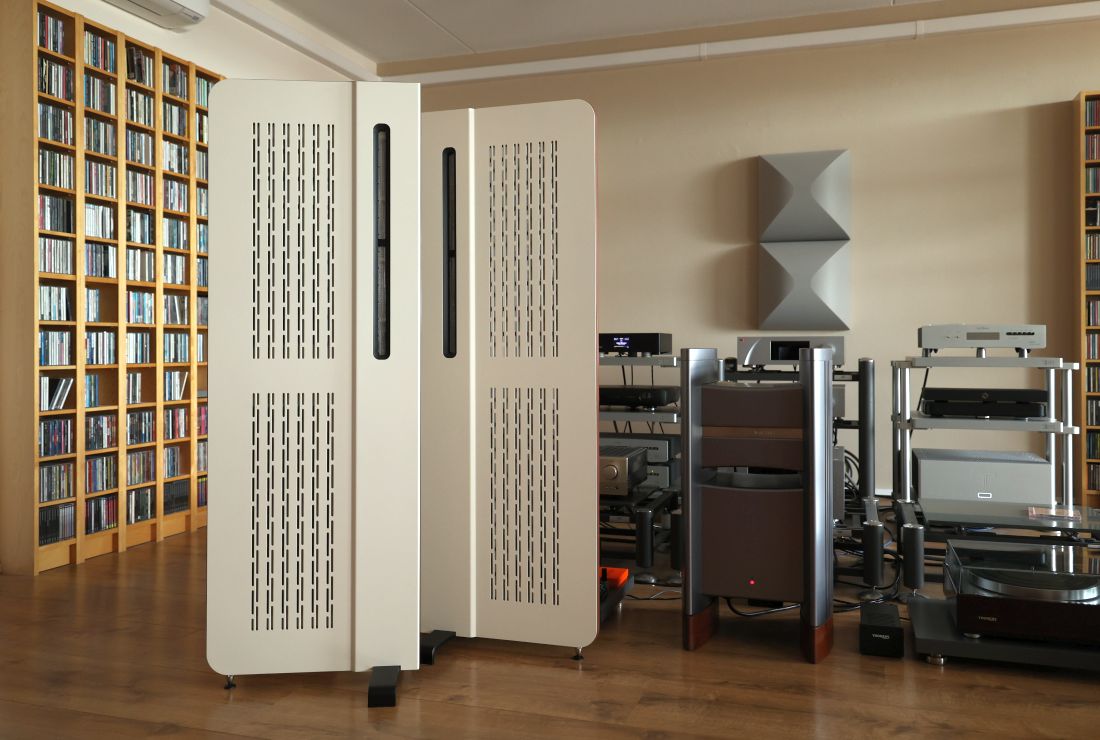
The Kora CS2120, with its robust and voluminous bass, and its full, natural, and slightly dark tonality, should indeed work highly synergistically with the lean, open, bright, and superbly airy Diptyques. It’s too bad I don’t have these speakers here now to put this to the test, but I’m confident they would pair superbly with the CSA 2120.
Conclusion
The Kora CSA 2120 SquareTube pure Class A power amplifier has a remarkably unique set of abilities. It maintains a vice-like grip on any speaker I tested, delivering tighter, more robust, and more solid bass than any other amplifier I know, whether tube or transistor.
Uniquely, this amplifier’s immense control does not come at the expense of a lean, harmonically deprived sound. On the contrary, while the CSA 2120 is certainly not warm or lush, it possesses a full-bodied tonality, with a highly realistic rendering of timbres and textures.
Although this is a special hybrid of tube and transistor, it remains very neutral and uncolored, and it simply does not exhibit the typical euphonic colorations or bass thickness associated with typical tube designs. Not even a little bit. Instead, this amplifier relays what’s in the recordings without any sugarcoating. If you are looking for a lush, golden, euphonic sound, this is not the amplifier for you.
However, if you are looking for a muscular yet natural and realistic-sounding amplifier that will drive anything with gusto, whether small monitors, electrostatics, or magnetostatics, the Kora excels with authoritative control, solidity, and impact.
External Links
Manufacturer: Kora.fr
Distributor for the Benelux: Dimex.nl