Detailed Info about the Apogee Duetta and Duetta II
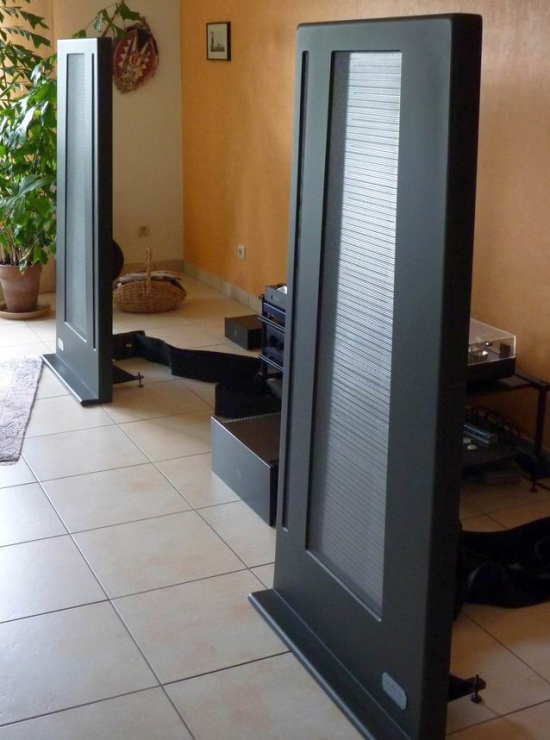
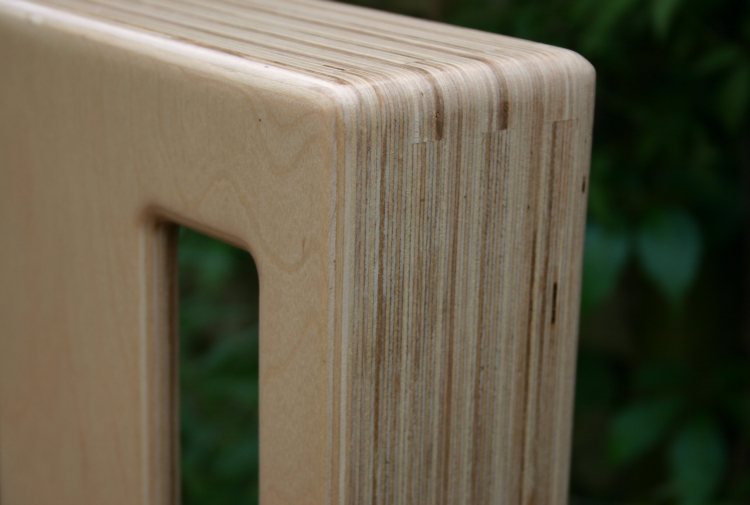
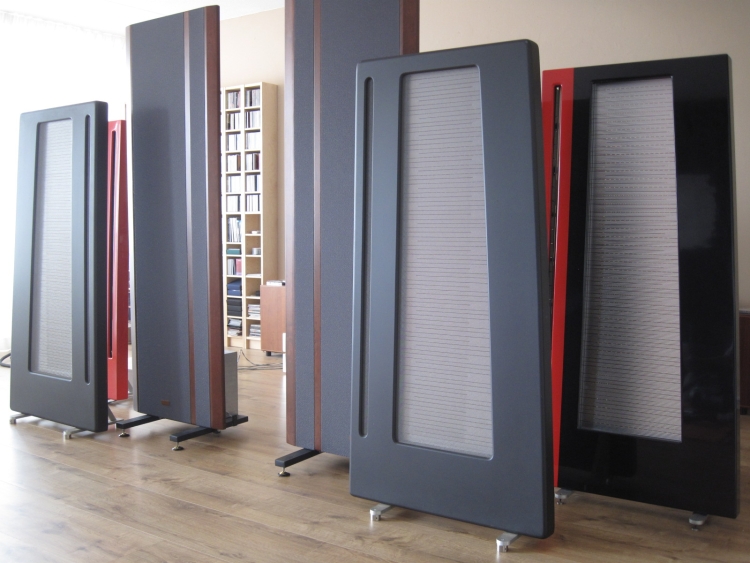
Above: the original Duetta and the Duetta II have a wood “lip” at the bottom. The later Signature model has aluminum feet.
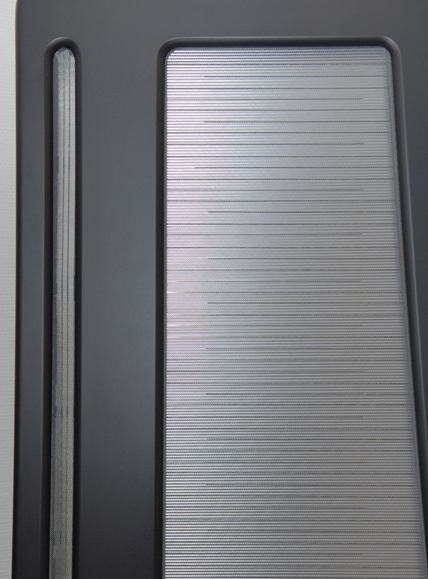
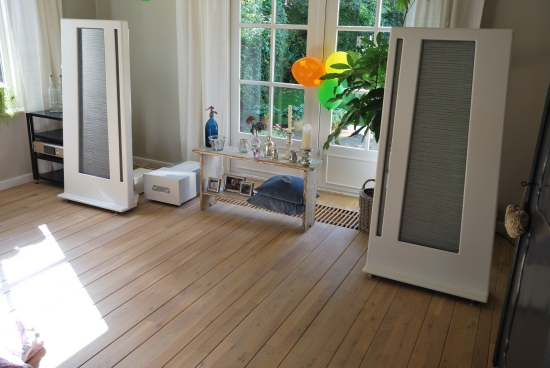
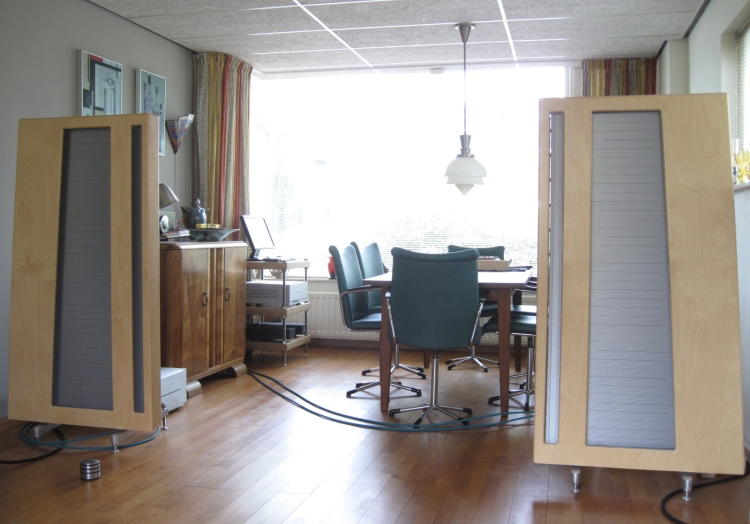
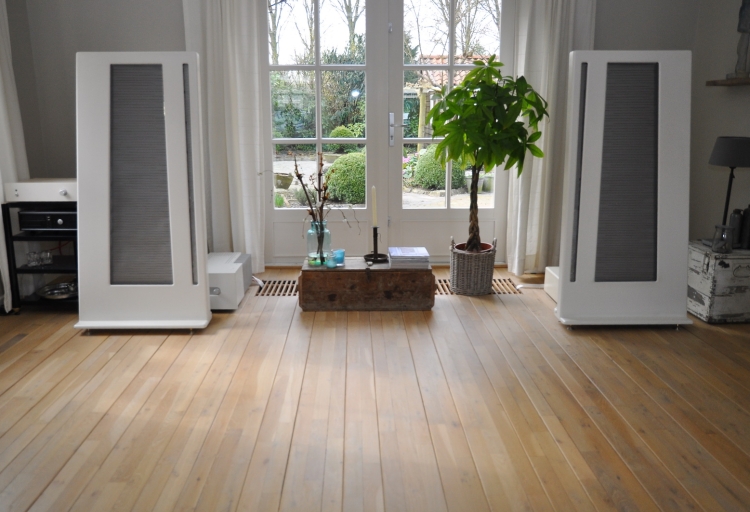
Above: a very nice and clean looking original Duettas (low serial number) painted in colour “Historical White” of “Painting The Past” paint. The owner told me that the choice for this colour was WAF-induced, but I must say I quite like this serene look. The crossovers have been rebuilt and are in same colour boxes behind the speakers. The owner even his own amplifier and also painted it in the same colour. The heating vent in the floor hides a subwoofer using the 15.000 liters basement.
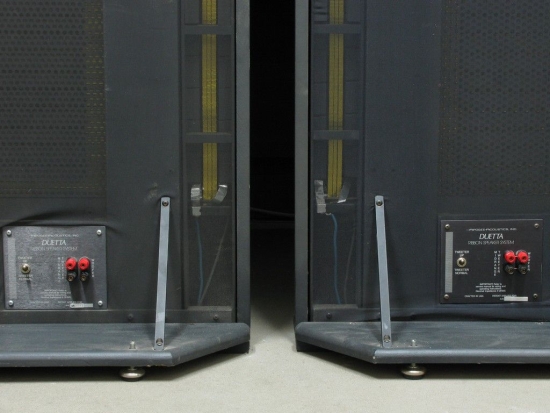
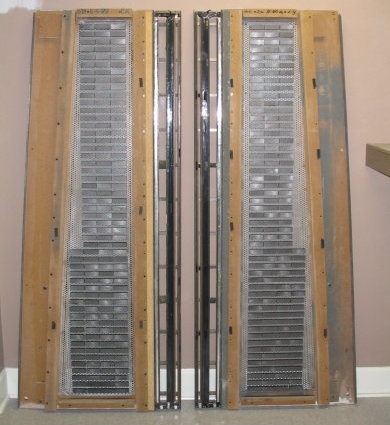
The original Duetta was built with steel angle iron bracing top and bottom of the rear section like the Scintillas, and a simple 6dB/octave crossover and too attenuated at the top end apparently making them sound dull.
Generic Info – Original Duetta
The “Duetta” is a mid-size two-way full-range ribbon speaker. It utilizes ribbon transducers for both the midrange/tweeter and the woofer. The use of ribbons in both elements provides exceptional benefits over the entire music spectrum.
The two-element woofer and midrange/tweeter ribbons coupled with internal seamless crossovers provide:
- Unparalleled clarity
- Precise imaging over a wide listening area
- Rise time consistent with the fastest amplifiers
- Excellent dynamic impact
Features
A trapezoidal woofer ribbon designed to provide a broad nonresonant frequency response.
A unique narrow combination midrange/tweeter ribbon.
Extremely low mass permits almost instantaneous acceleration for unexcelled transient response.
These techniques afford a combination of unprecedented power and clarity along with excellent imaging and soundstage.
Specifications
1986-1987
Original Retail $2300
Height 147.3 cm
Width 66 cm
Impedance 4 ohms
Bass driver
Aluminium/Kapton panel (hand cut)
Midrange
Aluminium/Kapton
Max Sound Level
Over 100db @ 4 Meters using a 100 watt Stereo Amplifier (18’x 24′ room, geometry dependent)
Frequency response
20Hz (-6dB) to 25kHz
Suggested amp power
100W (8 ohm load)
Weight
115lbs each (52KG)
Finishes available
Light grey, Anthracite, or Taupe
Generic Info – Duetta II
Virtually identical to the original Duetta and structurally the same as Duetta Signatures apart from the cover and stands. The original Duetta was based upon the technology of the Full Range and Scintilla. It was Apogee’s first attempt to provide a smaller, less expensive speaker. Like the Scintilla, it provided a very detailed sound, not universally admired.
According to Alvin Gold, Leo Spiegel said that one of the purposes of the II’s revisions was to make the Duettas more sonically compatible with compact disc. The II is, therefore, softer and less detailed, which was also not necessarily to everyone’s preference.
Specific changes from the original model:
- The top part of the MRTW ribbon was canted back about 5 degrees at the top to improve vertical dispersion.
- Crossover became a compound circuit, starting at 6 dB/octave, increasing to 12 dB/octave once well clear of the crossover region. This approach was used on several models to come, including the Diva.
There were at least two different versions of the Duetta II. The early ones had an efficiency 4 dB lower than the later ones (106 dB vs. 110 with a 100-watt amp). The later ones also had considerably extended high-end response. The early ones were too limited on the top end, according to some.
Main Differences between the Duetta versions
Original Duetta
- Simple, earlier crossover design with gentle crossover slopes (Apogee often used ~6 dB/octave philosophy)
- Voiced slightly warm / bass-heavy / dark / somewhat “thick”. Big, rich, slightly “romantic”, not the most refined, open, or extended in treble.
- No user adjustability
Duetta II
Can be considered the transitional version. Same speaker platform as the original Duetta, improved, basically a Signature without the final crossover.
- Crossover revised vs original Duetta with some component value changes (coil and capacitor tuning), but still relatively simple topology.
- Voiced to sound slightly cleaner than the original, but still a bit rolled off on the top and somewhat bass-heavy.
Duetta Signature
Same basic topology as the Duetta II, but with a major crossover redesign. This final version has much better tuning to achieve better matching between the bass ribbon and MRTW, and more refined crossover-region behavior.
- Redesigned crossover network with different component values (inductors, caps, resistors), allowing improved HF integration and balance.
- Added 3-position MRTW level switch
- More open and extended treble, better balance (less bass-heavy), cleaner, more precise midrange, and more neutral overall.
Duetta Exclusive
The Duetta Reference was a bespoke edition for the German market. This was actually a Duetta Signature with only one small modification in the crossover. The only difference is the addition of a single capacitor, which can easily be removed without further changes to restore the standard Duetta Signature sound.
More Duetta
Extensive Duetta Signature Review
More Apogee