• About
    • About HFA
    • HFA Awards
    • Associated Equipment
    • Banners on HFA
    • HFA Analytics Data
    • HFA Audio Setup History
    • HFA Audio Setup Snapshots
    • Sitemap
    • Contact
  • HFA Awards
  • Reviews
    • All Reviews
    • Amplifier
      • All Amplifier Reviews
      • Integrated Amplifier
      • Preamplifier
      • Power Amplifier
      • Phono Preamp
    • Loudspeaker
      • All Loudspeaker Reviews
      • Passive Speaker
      • Active Analog Speaker
      • Active Digital Speaker
    • Digital
      • All Digital Reviews
      • CD Player
      • SPDIF DAC
      • USB DAC
      • Music Server
      • Network Player
      • Digital Recorder
      • Digital Interface
      • Audio Software
    • Turntable and Accessories
      • All Turntable and Accessories Reviews
      • Turntable
      • Tonearm
      • Phono Cartridge
      • Turntable Accessories
    • Cable
      • All Cable Reviews
      • Analog Interlink
      • Phono Interlink
      • Speaker Cable
      • Power Cable
      • Digital Cable
    • Accessories
      • All Accessories Reviews
      • Racks / Stands / Feet
      • Tuning / Tweaks
      • Power Connector
    • Industry Update
  • Insights
    • All Insights
    • Analog Insights
    • Cable Insights
    • Connector Insights
    • Digital Insights
    • Extensionblocks / Filters Insights
    • Generic Insights
    • System Synergy Q&A
  • Specials
  • Show Reports
    • All Show Reports
    • Alkmaar Audio Show
    • Chattelin Audio Systems
    • Dutch Audio Event
    • Enosound
    • HifiDeluxe
    • HifiLive
    • Munich High End
    • XFi
  • Classics
    • All Classics
    • Analog Classics
    • Digital Classics
  • Links
  • About
    • About HFA
    • HFA Awards
    • Associated Equipment
    • Banners on HFA
    • HFA Analytics Data
    • HFA Audio Setup History
    • HFA Audio Setup Snapshots
    • Sitemap
    • Contact
  • HFA Awards
  • Reviews
    • All Reviews
    • Amplifier
      • All Amplifier Reviews
      • Integrated Amplifier
      • Preamplifier
      • Power Amplifier
      • Phono Preamp
    • Loudspeaker
      • All Loudspeaker Reviews
      • Passive Speaker
      • Active Analog Speaker
      • Active Digital Speaker
    • Digital
      • All Digital Reviews
      • CD Player
      • SPDIF DAC
      • USB DAC
      • Music Server
      • Network Player
      • Digital Recorder
      • Digital Interface
      • Audio Software
    • Turntable and Accessories
      • All Turntable and Accessories Reviews
      • Turntable
      • Tonearm
      • Phono Cartridge
      • Turntable Accessories
    • Cable
      • All Cable Reviews
      • Analog Interlink
      • Phono Interlink
      • Speaker Cable
      • Power Cable
      • Digital Cable
    • Accessories
      • All Accessories Reviews
      • Racks / Stands / Feet
      • Tuning / Tweaks
      • Power Connector
    • Industry Update
  • Insights
    • All Insights
    • Analog Insights
    • Cable Insights
    • Connector Insights
    • Digital Insights
    • Extensionblocks / Filters Insights
    • Generic Insights
    • System Synergy Q&A
  • Specials
  • Show Reports
    • All Show Reports
    • Alkmaar Audio Show
    • Chattelin Audio Systems
    • Dutch Audio Event
    • Enosound
    • HifiDeluxe
    • HifiLive
    • Munich High End
    • XFi
  • Classics
    • All Classics
    • Analog Classics
    • Digital Classics
  • Links
scroll down for more
Phono Preamp Reviews

Apertura Armonia Evo, Edena Evo, and Adamante

Christiaan Punter 23 July 2026 No Comments
  • Facebook
  • Twitter
  • LinkedIn
  • Pinterest
  • Email

Review sample supplied by hexagonaudio
Manufacturer: Stentor SAS – Apertura
Retail prices in the NL (incl 21% VAT):
Armonia Evolution – €6.500
Edena Evolution – €9.500
Adamante – €18.000

Three Models Compared

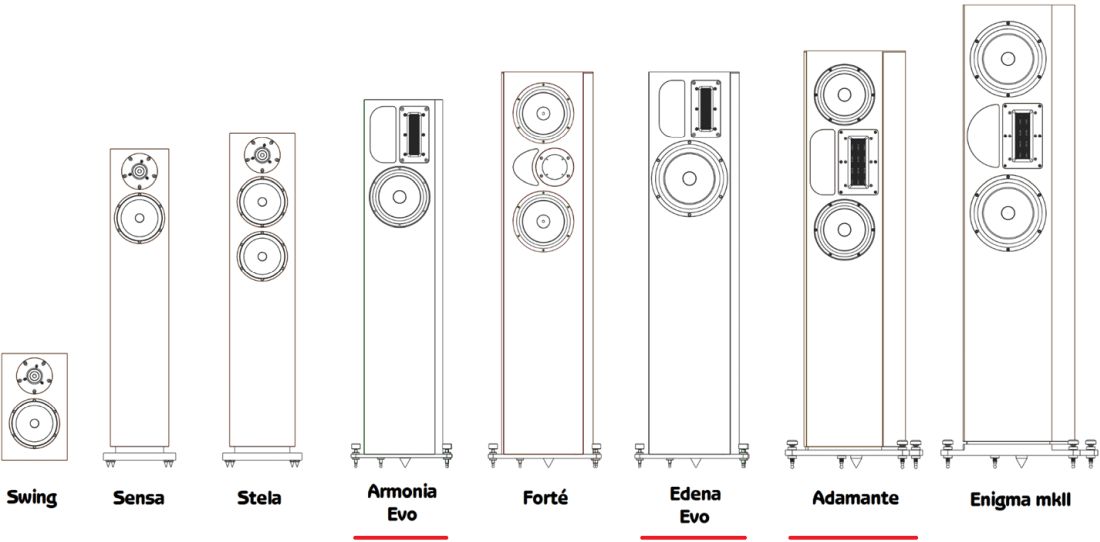
In this review, I will compare three models from the current Apertura lineup to provide a representative cross-section of their performance and illustrate what to expect when moving up the ladder. The Armonia Evolution is the smallest model with a ribbon tweeter. The Edena Evolution is similar, but larger in construction. It uses the same ribbon tweeter with a larger woofer. The Adamante is the biggest and most upscale model under the Flagship Engima MkII. It has two woofers and a larger ribbon tweeter, in a D’Appolito configuration.
Apertura in a nutshell

The story starts with Christian Yvon and his passion for sound reproduction.

In 1978, Christian Yvon created his own laboratory to lead sound and acoustic research; he has developed several new technologies while striving to reproduce the recorded musical information as faithfully as possible, not more, not less; the proprietary DRIM crossover structure is one of them.

In 1979, he worked for Goldmund speakers and developed many of their products, such as the “Dialogue,” “Apologue,” “Analogue,” and “Epilogue” loudspeakers. Christian Yvon also worked for Focal, Sonus Faber, and many others.

In 1982, he decided to develop his own loudspeakers, choosing the name Apertura as the brand and going on to develop a full range of loudspeakers over the decades.

In 2010, Christian Yvon met Eric Poyer. Eric Poyer had extensive experience at a renowned high-end manufacturer before founding his own OEM audio company over 20 years ago. Christian and Eric partnered and created the company “Stentor” to develop and produce a complete line of Apertura products.  For the last 16 years, this collaboration has resulted in the development of a comprehensive product range.

Stentor SAS – Apertura is a family business company where the whole team is 100% committed to building the perfect loudspeaker. As a part of this team, Christian is in charge of acoustic design, and Eric is responsible for mechanical design and production. Apertura loudspeakers are handcrafted in France at the head office near Nantes on the West Coast, in close collaboration with a small number of tightly selected subcontractors. Cabinets and drive units are rigorously selected from the best, and every manufacturing step is performed internally to build a high-end product, including acoustic and mechanical design, drive unit testing and matching, crossover design and manufacture, assembly, and individual strict tests before packing.

Technologies common to all three models

> Low Storage Cabinet with curved walls: not flat, machined panels

The curved walls and asymmetrical shape of the Apertura cabinets go beyond aesthetics. Instead of typical MDF, their construction uses multiple thin HDF layers bonded and molded under pressure, making them stiffer and better at dissipating energy than solid slabs. This raises the resonant frequency and prevents resonance at a single frequency. The cabinet’s low-storage signature helps minimize intermodulation distortion, which can blur and obscure the mid-range or create uneven, one-note bass sounds. Combined with an asymmetrical footprint, internal bracing, double-thickness panels in key locations, and lap joints instead of butt joints, this results in a cabinet with diffuse resonance, excellent energy dissipation, and minimal coloration.

> Asymmetry And The Internal Air Volume: Attenuation of internal energy through clever choice of materials and cabinet design

Many believe that asymmetrical cabinet walls prevent standing waves, but Apertura believes that’s a misnomer. Curved walls mainly add stiffness and resist flexure; they do not control internal standing waves. Controlling internal energy is essential for sound clarity, as drive units project energy backward that can cause resonances and leakage. Effective solutions involve more than just adding absorptive wadding; they require a multi-faceted approach. Apertura uses calculated damping materials, including proprietary pocketed sheeting, to influence airflow and reduce unwanted vibrations. The rear panel area is also minimized, while the top and bottom panels are double-thickness to prevent driver rear energy from disrupting the sound.

> Mechanical Grounding: One spike, not three and definitely not four

The unwanted pressure from the driver’s rear wave can cause many issues, such as vibrating the cabinet and feeding energy back into the drivers, thereby distorting the sound. However, simply absorbing this energy creates problems. The cabinet’s main role is to load drivers and contain rear output, but once energy enters, it moves problems elsewhere. The ideal is a clean exit path into the supporting surface, like proper grounding. Often, speakers rest on spikes, but these are often misused, creating multiple, confusing paths that disrupt stability. Apertura uses a single ground path at the speaker’s center, with adjustable round-tipped outriggers for precise alignment.

> The DRIM Crossover: Simplicity and phase coherence, as well as steep slopes

According to Apertura, the crossover is the weakest point in any loudspeaker design, often harming signal phase and timing. Christian Yvon’s DRIM crossover topology, unique to his designs, achieves phase coherence crucial for musical reproduction with steep slopes to eliminate out-of-band driver artifacts. Simple, low-order crossovers have good phase coherence but roll off slowly, allowing breakup modes and peaks to form. The DRIM crossover combines phase coherence with steep, adjustable slopes for precise driver matching. Apertura speakers use this approach with two-way designs for simplicity and musicality, and adaptable slopes to accommodate wideband ribbon drivers. Drivers are measured, matched, and the crossover tuned for each pair, resulting in excellent driver integration, consistency, and system performance at this price.
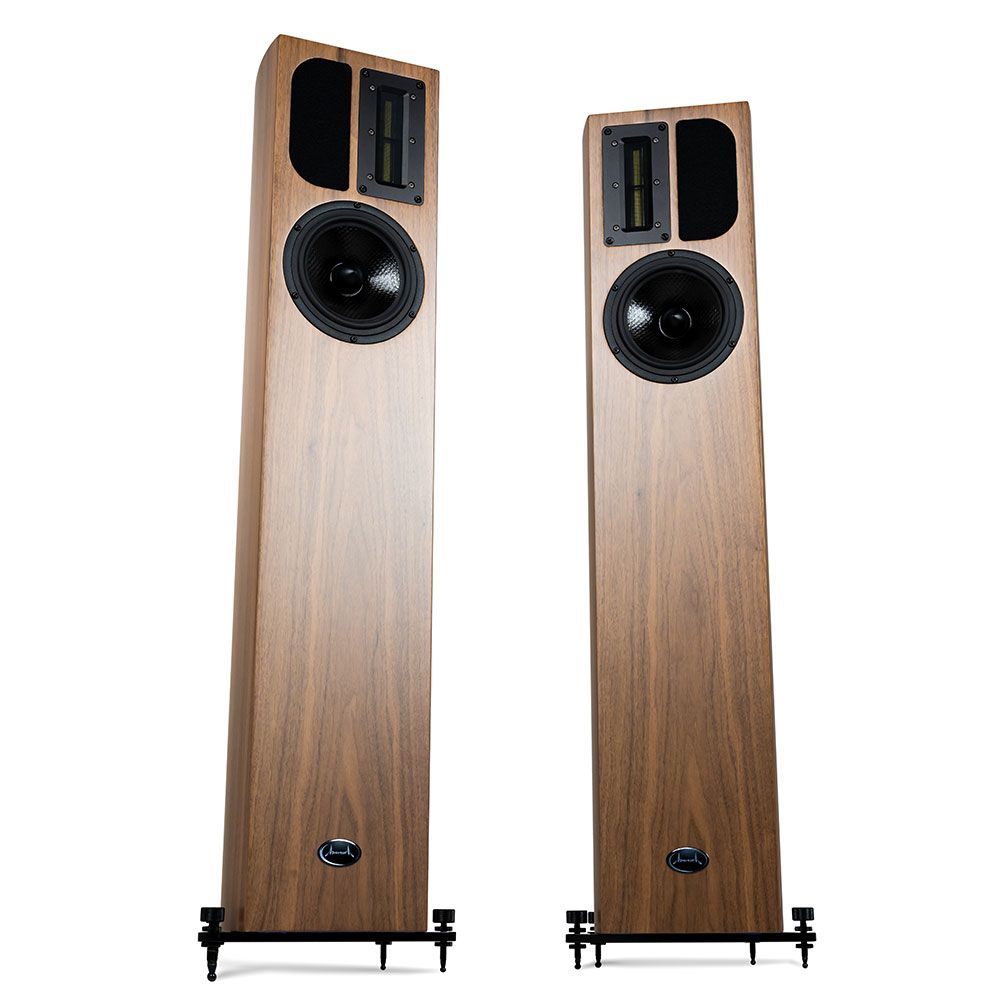
Armonia Evolution

The Armonia Evolution is the smallest Apertura loudspeaker model to feature a ribbon tweeter. This newest tweeter model features a flat, metalized polymer diaphragm that is twice as large as the one on the non-Evo Armonia tweeter. The double surface area reduces the ribbon’s movement, thereby lowering distortion. The tweeter is paired with an 18 cm “isotactic matrix” mid/woofer with a woven polypropylene composite cone and a long voice coil for a high linear excursion. The isotactic matrix material combines stiffness, lightness, and good damping properties. The speaker has an amplifier-friendly nominal 8-Ohm impedance with a moderate 87dB efficiency.
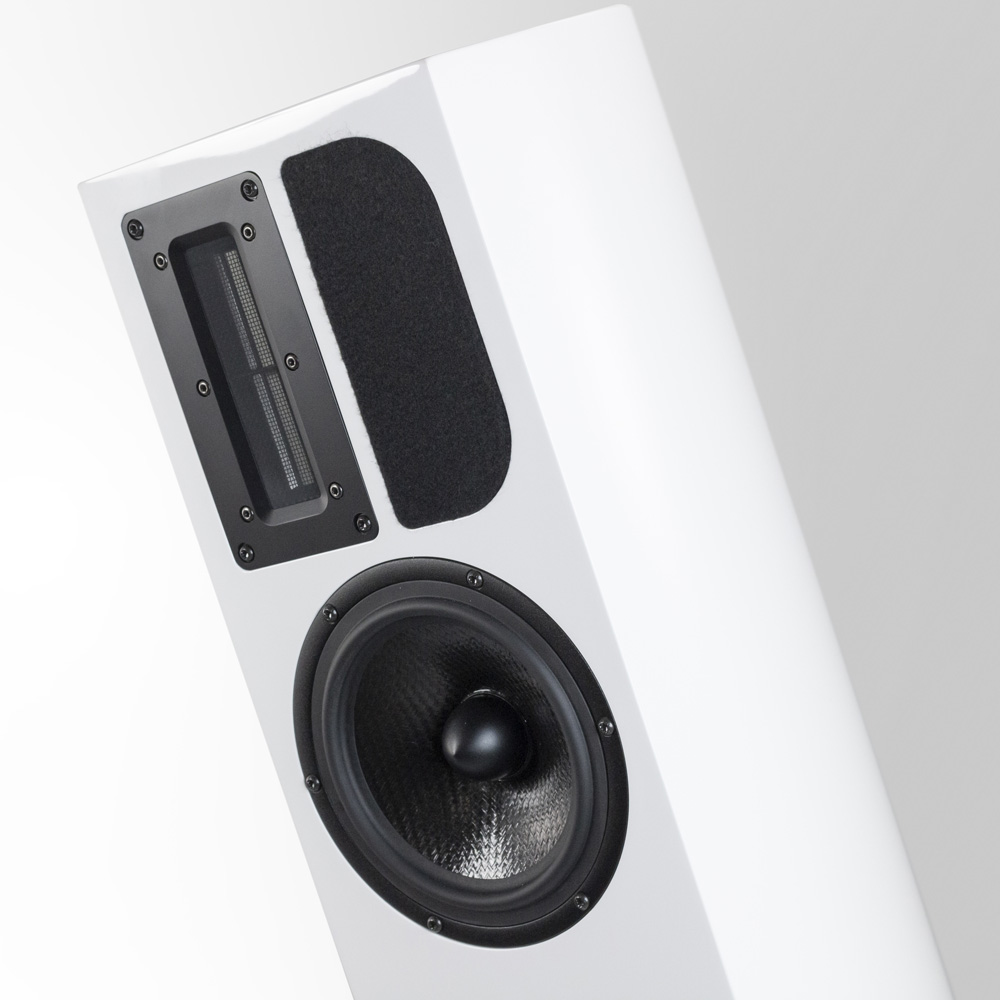
The Armonia Evo’s proprietary DRIM crossover design features triple attenuation slopes and phase control throughout the entire bandwidth. The Armonia Evolution crossover uses two separate circuit boards for the low-pass and high-pass sections and incorporates very high-end capacitors. Each set of drive units is individually measured, with crossover parameters adjusted accordingly. Hand wiring is performed on a 140 µm copper printed circuit board. The crossover structure is optimized to prevent magnetic interference between components, and the pure copper terminal block is silver-plated.

The cabinet features a unique shape with two curved sides of varying lengths and no parallel front and back panels. It consists of a laminar, pressure-molded structure made from thin layers designed to absorb vibrations and prevent the transmission of vibrational modes. Inside, a multi-cavity framework adds stiffness and provides designated spots for damping materials to eliminate standing waves, utilizing three different types of damping materials.
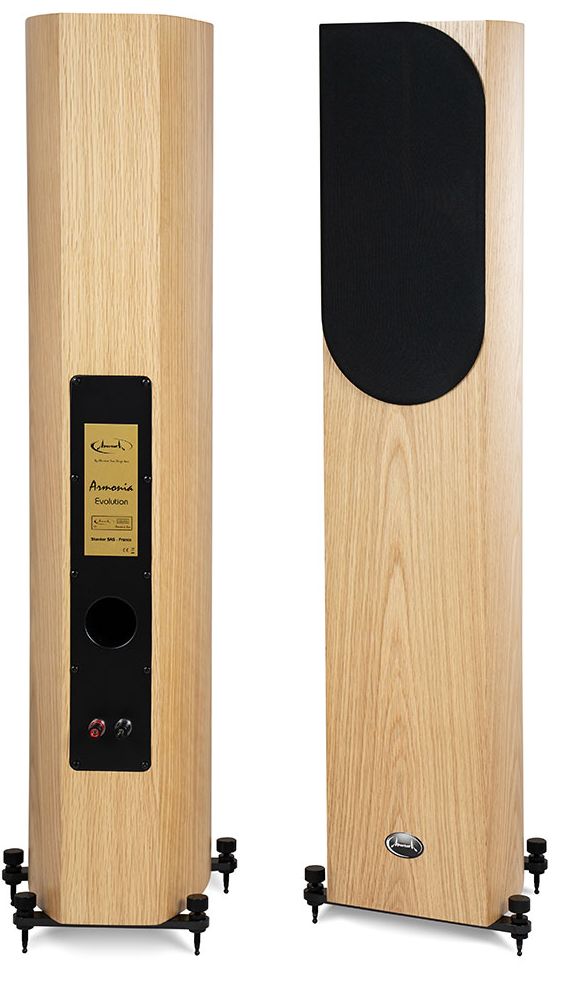
Instead of the usual 3 or 4 spikes, the Armonia Evolution is mechanically grounded using a 5-footer system. To optimize the dispersal of structure-borne noise into the floor, the speaker enclosure rests primarily on a central cone positioned at the center of gravity, along with four adjustable outriggers for precise alignment. Aluminum stands and spikes are included: silver anodized for the High Gloss White finish and black anodized for all other finishes.

Armonia Evolution specifications:

Six different standard finishes are available:
Satin: Light Oak, American Walnut
High Gloss: Figured Maple, Rosewood, Piano Black, White

Frequency range: 37Hz – 30kHz +-3dB
Sensitivity: 87dB/2.83v/1m
Impedance: 8Ω
Load: bass-reflex
Drive units: 18 cm mid-woofer, 8×120 mm ribbon tweeter
Crossover frequency: 2,8 kHz
Dimensions with stands: 292 x 291 x 1069 mm (W x D x H)
Weight: 22,2kg

Related Posts
Grimm PW1 MM/MC Phono Preamp
Manunta EVO Phono 3 and M2Tech Nash – Round 2
Manunta EVO Phono 3 and M2Tech Nash
Lejonklou Entity 1.2 MC Phono Stage
atm-audio Migjorn Phono Stage
COS D10 DAC, preamp, and network player
AVID Pellar, Pulsus, Pellere, and Pulsare II Phono Stages
Lejonklou Entity MC Phono Stage
Page 1 of 6
Apertura
  • Share This:
  • Facebook
  • Twitter
  • LinkedIn
  • Pinterest
  • Email
Christiaan Punter Owner of Hifi-Advice.com

Your comment Cancel reply

All comments are welcome, but please stay on-topic. First-time comments need manual approval which causes the post to appear a little later. Avoid using links to prevent marking as spam.


Categories

  • Accessories Reviews
  • Active Analog Speakers Reviews
  • Active Digital Speakers Reviews
  • Alkmaar Audio Show
  • Amplifier Reviews
  • Analog Classics
  • Analog Insights
  • Analog Interlink Reviews
  • Analogy Records
  • Apogee Acoustics Company Special
  • Audio Software Reviews
  • Audiophile Insights
  • Cables Insights
  • CD Player Reviews
  • Chattelin Audio Systems
  • Connectors Insights
  • Digital Cable Reviews
  • Digital Classics
  • Digital Insights
  • Digital Interface Reviews
  • Digital Recorder Reviews
  • Digital Reviews
  • Dutch Audio Event
  • Enosound
  • Extensionblocks / Filters Insights
  • Generic Insights
  • HFA Audio Setup History
  • HFA Audio Setup Snapshots
  • HifiDeluxe
  • HifiLive
  • Industry Update
  • Integrated Amplifier Reviews
  • Marantz & Philips Classics
  • Munich High End
  • Music Server Reviews
  • Network Player Reviews
  • Passive Speakers Reviews
  • Phono Cartridge Reviews
  • Phono Interlink Reviews
  • Phono Preamp Reviews
  • Power Amplifier Reviews
  • Power Cable Reviews
  • Power Conditioning
  • Power Connector Reviews
  • Preamplifier Reviews
  • Racks / Stands / Feet Reviews
  • Rhapsody
  • Show Reports
  • SPDIF DAC Reviews
  • Speaker Cable Reviews
  • Specials
  • System Synergy Q&A
  • Tonearm Reviews
  • Tuning / Tweaks Reviews
  • Turntable Accessories Reviews
  • Turntable and Accessories Reviews
  • Turntable Reviews
  • Uncategorized
  • USB DAC Reviews
  • Vienna High End
  • XFi

BRANDS

  • A&B Systems
  • A10 Audio
  • Aavik
  • Acapella
  • Accuphase
  • AcousticMatters
  • Acustica Applicata
  • Admire Audio
  • Aequo Audio
  • AG Lifter
  • Aidas
  • Akiko Audio
  • Analog Domain
  • Analogy Records
  • Analysis Audio
  • Analysis Plus
  • Ansuz
  • Anthem
  • Anti-Cables
  • Antipodes Audio
  • Apertura
  • APL
  • Apogee
  • Apogee Acoustics
  • Aqua
  • Arcam
  • Aries Cerat
  • Artesania
  • ASI
  • Astin Trew
  • atm audio
  • A Tube High Fidelity
  • Audeze
  • AudioAanZee
  • Audio Aero
  • Audio Club Premier
  • Audio GD
  • Audiolab
  • Audiolympic
  • Audiomeca
  • Audio Note
  • Audionote
  • Audio Note (UK)
  • Audio Origami
  • Audio Physic
  • AudioQuest
  • Audio Research
  • Audio Synthesis
  • Audio Technica
  • Auer Acoustics
  • Auralic
  • Aurender
  • Aurum Cantus
  • Avalon
  • AvantGarde
  • AVID
  • AVIDHIFI
  • AVM
  • Ayon
  • Ayre Acoustics
  • B&W
  • Bals
  • Bang & Olufsen
  • Behringer
  • Belden
  • Benz
  • Bergmann
  • Black Rhodium
  • Boenicke Audio
  • Bowers & Wilkins
  • Bricasti
  • Brodmann
  • Bryston
  • Burmester
  • Børresen
  • CAD
  • Cardas
  • Care Orchestra
  • CAT
  • CEC
  • Chord Electronics
  • CH Precision
  • Clarisys Audio
  • Classé
  • Clearaudio
  • Concert Fidelity
  • Conrad Johnson
  • Consonance
  • COS
  • Curious Cables
  • D'Agostino
  • DAD
  • Dali
  • Daniël Hertz
  • Daudio
  • dCS
  • Degritter
  • Denafrips
  • Denon
  • Devialet
  • Devore
  • Diptyque
  • Doepke
  • Driade
  • DS Audio
  • Dynavector
  • Dynavox
  • E&T
  • EC-Designs
  • Echole
  • Elac
  • Electrocompaniet
  • Elijah Audio
  • EMAG
  • EMMLabs
  • Emotiva
  • EMU
  • Enosound
  • Ensemble
  • Esoteric
  • Estelon
  • Euphony
  • Exogal
  • Fadel Art
  • Fezz Audio
  • FIM Gold
  • Final
  • Final Touch Audio
  • Finite Elemente
  • FoilFlex
  • Franco Serblin
  • Furutech
  • Fusion Audio
  • Gauder Akustik
  • Genelec
  • Gigawatt
  • GiK
  • Goldmund
  • Graham Audio
  • Grandinote
  • Grimm Audio
  • Gryphon
  • Gustavson Audio
  • Halcro
  • Hanze Hifi
  • Harman/Kardon
  • Harmonic Resolution Systems
  • Harmonic Technology
  • Harmonix
  • Heaven's Gate
  • Hifi-Tuning
  • HiFi.nl
  • HifiMan
  • High Fidelity Cables
  • Hofa
  • Holo Audio
  • Home Audio Fidelity
  • HRS
  • IeGO
  • Ikigai
  • IMF
  • Isotek
  • Jadis
  • Jay's Audio
  • JCAT
  • Jeff Rowland
  • Jena Labs
  • JMF Audio
  • Jorma Audio
  • Jorma Design
  • Joseph Audio
  • JPLAY
  • JVC
  • Kemp
  • Kharma
  • Kimber
  • KingRex
  • Kinki Studio
  • KlinktBeter
  • Kora
  • Krell
  • Kroma Atelier
  • Kupp
  • LAiV Audio
  • Lampizator
  • Lapp
  • LAST
  • Lector
  • Leema
  • Lejonklou
  • LessLoss
  • Line Magnetic
  • Linn
  • Logitech
  • LOK
  • Loudness War
  • Lumin
  • Luxman
  • M2Tech
  • Mad Scientist
  • Magico
  • Magnan
  • Magnepan
  • Mamba Audio
  • Manley Labs
  • Manunta
  • Marantz
  • Mark Levinson
  • Marten
  • Martin Logan
  • Master
  • Matrix
  • MBL
  • McIntosh
  • Melco
  • Melody
  • Meridian
  • Metrum Acoustics
  • Michell
  • MIT
  • MJ Acoustics
  • Modus Audio
  • Mogami
  • Mola-Mola
  • Monitor Audio
  • Monrio
  • Moon
  • Morel Hifi
  • MP&S-Klangwelten
  • Munich High End
  • Musetec
  • Musical Fidelity
  • Mytek
  • Nagaoka
  • Naim
  • Naiu Laboratory
  • Nakamichi
  • NBS
  • Network Acoustics
  • Niels Setup
  • Nordost
  • NuPrime
  • Ohm Audio
  • Oladra
  • Olive
  • Onkyo
  • Onzow
  • Origin Live
  • Ortofon
  • Oyaide
  • Panasonic
  • Paradigm
  • Parasound
  • Pass Labs
  • Peak Consult
  • Philips
  • Pink Faun
  • Pioneer
  • Playback Designs
  • Precision Audio
  • PrimaLuna
  • Proceed
  • Prodigio Audio
  • PS Audio
  • PSI Audio
  • PUUR AVD
  • PUUR hifidelity
  • Pylon Audio
  • Qln
  • Qobuz
  • Quad
  • R.T.F.S.
  • RAAL Requisite
  • Raidho
  • Reference Sounds
  • Reference Tweaks
  • Rega
  • Rein Audio
  • REL
  • Resonator Stockholm
  • Revel
  • Ricable
  • Roon
  • RTFS
  • SAEQ
  • SAT
  • Schiit
  • Seawave Acoustic
  • Sennheiser
  • Shakti
  • Shuguang
  • Shunyata
  • Shure
  • Signal Projects
  • Silent Angel
  • Siltech
  • SME
  • SolidSteel
  • Solid Tech
  • Sonic Frontiers
  • Sonos
  • Sonus Faber
  • Sony
  • Sooloos
  • SOtM
  • Soulution
  • Sound Anchor
  • Sound Lab
  • Spectral
  • Spotify
  • Stack Audio
  • Stealth
  • Stenheim
  • Stillpoints
  • Straight Wire
  • SW1X Audio Design
  • Symo
  • Synergistic Research
  • Synology
  • Synthese
  • T+A
  • Taiko Audio
  • Tascam
  • Teac
  • TechDAS
  • Technics
  • The Chord Company
  • Thorens
  • Transparent Audio
  • Trends
  • Tung Sol
  • Unison Research
  • UpTone Audio
  • VAIC
  • van Damme
  • van den Hul
  • van Medevoort
  • Vermeer Audio
  • Vermouth Audio
  • Vibex
  • Vifa
  • Vincent
  • ViRa High End
  • Viva
  • Vivid Audio
  • VTL
  • Wadax
  • Wadia
  • Wattgate
  • Wattson
  • Way Cables
  • Weiss
  • Western Electric
  • WestminsterLab
  • Widealab
  • Wilson Audio
  • Wilson Benesch
  • Winyl
  • Wires 4 Music
  • Wireworld
  • Wolf von Langa
  • Wooden Bull
  • XACT
  • Xavian
  • xFyro
  • Xindak
  • XLO
  • Yamaha
  • Zanden
  • Zellaton
  • Zesto
  • ZYX

Follow HFA on Social Media

Facebook

LEGAL

Privacy Policy

This site is protected by reCAPTCHA. Google Privacy Policy and Terms of Service apply. All rights reserved © 2026 - hifi-advice.com.
  • Contact
  • Home